How was the $3.8 billion cost of the Blueprint calculated? You’ll be shocked
Feb 01, 2026 | 9:57 pm ET
Description
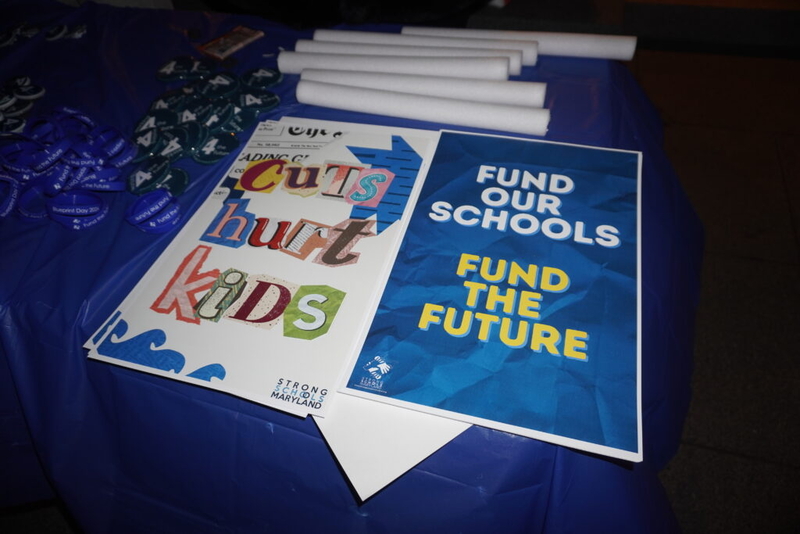
Signs from a 2025 rally in support of the Blueprint for Maryland’s Future education reform plan, which could be under attack again this year. (Photo by William J. Ford/Maryland Matters)
The $3.8 billion cost of the Blueprint for Maryland’s Future was pulled out of political thin air.
That may be hard to believe. But beneath all the fierce controversy over whether Blueprint funding is too much or too little, the origin and validity of the $3.8 billion have been hidden.
The truth about them should be a game-changer in the debate over the adequacy of Blueprint funding. As a member of the Kirwan Commission, which drafted the Blueprint and first set a $3.8 billion price tag, I was in the room when it happened.
The commission was established to fulfill the state constitutional requirement that each Maryland student receive an adequate education. And two years before the commission got underway, APA Consulting was hired to do an adequacy study for Maryland. APA had the most experience of any school finance consultants in the U.S.
APA essentially used the state-of-the-art “evidence-based/professional judgment” methodology that costs out, based on research and input from educators in the field, the school programs needed to enable all students to meet grade-level standards.
The study was ready in 2016 when the commission first convened. Some members thought it was too high, some (like me) too low. But little, if any, analysis or deliberations followed.
Your opinion matters
Maryland Matters welcomes guest commentary submissions at [email protected].
We suggest a 750-word limit and reserve the right to edit or reject submissions. We do not accept columns that are endorsements of candidates, and no longer accept submissions from public officials or political candidates.
Opinion pieces must be signed by at least one individual using their real name. We do not accept columns signed by an organization. Commentary writers must include a short bio and a photo for their bylines.
Views of writers are their own.
Instead, the legislative leadership on the commission recommended annual increases in state education spending to rise to $3.8 billion over 10 years. But the $3.8 billion was not supported by any calculation of actual costs. Rather, the leadership thought that amount was the upper limit of what the political traffic would bear.
Many Democrats, like virtually all Republicans, fear voting for tax increases. On top of this, then-Gov. Larry Hogan. a Republican, made clear that he would veto any increases in funding, so why should legislators go further out on a political limb?
At about the same time, the leaders of the commission came under the spell of Marc Tucker, an expert on high-performing schools in other countries. He quickly became the commission’s lead consultant and driving force. He discarded the APA evidence-based methodology altogether, and pushed his belief that if we followed practices in other countries, we would soar to their level with very little additional spending.
His belief had never been tested, much less proven. And he cited no evidence to support his theory that it would cost little to no more state money to pay for the Blueprint.
Unheeded was the fact the highest performing school systems in the world evolved over generations in countries steeped in political and social welfare cultures far different than ours. Tucker conceded that “many of [the Blueprint’s building blocks] take 20 to 30 years to implement in the other countries.”
Further, because of later actions by the commission and General Assembly, the funding was cut to $3.4 billion and extended the timeframe from 10 to 13 years. Bear in mind that Blueprint funding was from the outset a low percentage increase in state tax revenues compared to the state’s fiscal wealth, and inflation has eroded its purchasing power.
It may be hard to accept such a negative portrayal of Blueprint funding but the chickens have come home to roost. There is a rising crescendo of criticism by local school systems and advocates (and even a few legislators). Blueprint funding is limited to the point that there are almost no added expenditures for basic in-school operations like appropriate class sizes, interventions for struggling learners, arts instruction, librarians, guidance counselors, social workers and security officers.
In their 2024 implementation plans, local school systems generally viewed the Blueprint as unrealistic and unfunded. In December, the Maryland Association of Counties reported that, “As implementation proceeds, county and school leaders say [the Blueprint] is revealing growing gaps between statewide policy design and local fiscal and operational realities.” The Public School Superintendents’ Association of Maryland (a prominent voice for local school districts) has detailed many serious challenges across the pillars of the Blueprint.
It is legally and morally imperative for the governor and General Assembly to act. Foremost, to update the APA study of adequate funding. And they must do no further harm like the significant cuts in Blueprint funding that were enacted at the last session.
Maryland must at long last fix its broken promises of adequacy and equity for all schoolchildren, most notably students who are poor and of color.
Annapolis, MD