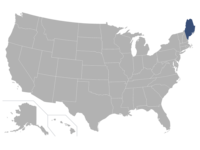
In 2024, voters in Maine approved a ballot initiative that placed a $5,000 cap on contributions to super PACs, independent political committees that may raise and spend unlimited sums of money to support or oppose candidates and issues.
Two conservative political action committees, Dinner Table Action and For Our Future, and Alex Titcomb, the Maine-based leader of both organizations, sued in December 2024, arguing the law is unconstitutional. A federal judge in 2025 sided with them and blocked the law.
In October of last year, two appeals were filed in the 1st U.S. Circuit Court of Appeals in an attempt to reverse the judge’s ruling. One came from Attorney General Aaron Frey. The other came from the initiative’s sponsor, Citizens to End Super PACs, along with the nonprofit organization Equal Citizens.
(Disclosure: OpenSecrets, while not a party to the lawsuit, provided data and other information via a report and deposition for the case analysis.)
Joshua Dunlap, one of the attorneys representing the plaintiffs, resigned earlier this year to become a judge on the appellate court being asked to hear the appeal. He received a recommendation from Sen. Susan Collins (R‑Maine), who, during her 2020 re-election race, benefited from millions in super PAC spending.
Federal judges must disqualify themselves from cases they handled in private practice. A spokesperson for the appellate court did not immediately respond to a request for comment. Collins spokesperson Blake Kernen noted that Dunlap is one of six judges on the court and may not be selected for the three-judge panel that would hear the case.
Funding pipeline includes group tied to Leo
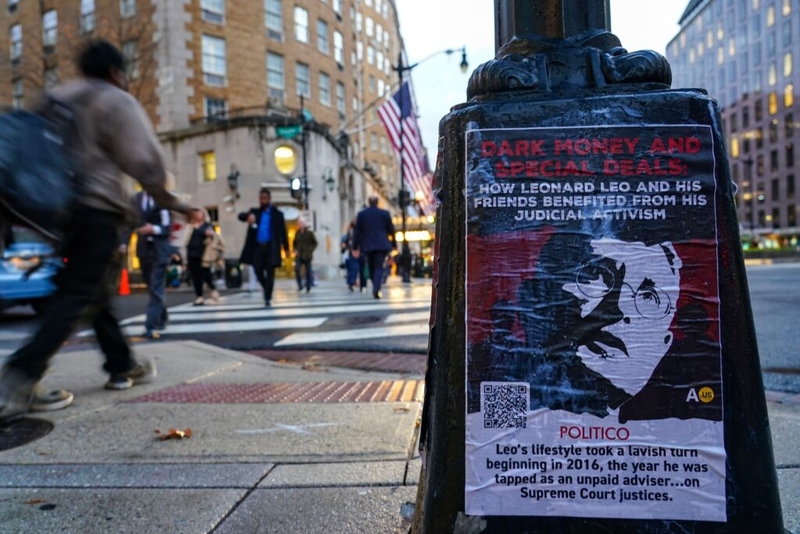
An OpenSecrets review of state and federal filings revealed a financial pipeline connecting the plaintiffs to an arm of the political network built by Leo – a lawyer, businessman, conservative activist and co-chairman of the board of directors of the Federalist Society. Leo, a key architect of the conservative shifts of the Supreme Court and the broader federal judiciary, has lived on Mount Desert Island since 2020.
He hosted a 2019 fundraiser for Collins that drew protesters upset with her vote to confirm Supreme Court Justice Brett Kavanaugh. That confirmation fight was backed in part by a Leo-linked dark-money group that later and under its new name contributed to one of the organizations behind the lawsuit.
Dinner Table Action has reported just over $1 million in contributions since registering with the Maine Ethics Commission in 2021. The group describes itself as the state’s largest conservative grassroots organization. Of the more than 6,000 contributions it received between February 2021 and December 2025, more than 80% were under $200, with a median donation of $50. Maine residents accounted for more than $830,000 of its funding.
The in-state total includes the two largest lump-sum contributions it received. Both came from For Our Future; its address is a post office box in Richmond, Maine. In 2024, For Our Future contributed $100,000 to Dinner Table Action across separate installments of $50,000 in August and October. Additionally, between July 2023 and March 2025, For Our Future provided $58,300 in in-kind support, almost entirely reported as personnel time.
Those two groups share more than financial ties. Dinner Table Action and For Our Future list the same phone number. Both identify Titcomb as principal officer and Mary Alioto as treasurer. And the email address For Our Future used when registering with the state Ethics Commission is hosted on Dinner Table Action’s domain.
The difference between them, Titcomb explained, is that Dinner Table Action is a membership-based PAC and For The Future is a “personal PAC” that allows him “a little bit more flexibility since it’s not bound by the membership aspect of the [Dinner Table Action] organization.”
“Logistically, it just helps to have multiple PACs where different sources might be aligned toward that vision of that particular entity more so than another,” he told OpenSecrets.
Titcomb co-founded Dinner Table Action with state Rep. Laurel Libby (R). He is a fellow at the Club for Growth Foundation, a 501(c)(3) nonprofit affiliated with the conservative Club for Growth, which advocates for lower taxes and limited government.
In 2023, he formed For Our Future, a group that has raised more than $410,000. Its largest funder by far is the Concord Fund, which contributed $375,000 across three payments: $50,000 in May 2023, $100,000 that August and $225,000 in February 2024. That money “helped us as we expended it on supporting candidates that align with the mission,” Titcomb said.
The Concord Fund was formerly known as the Judicial Crisis Network, an organization closely tied to Leo and his political and judicial advocacy network. It also has long been associated with the Judicial Education Project, now known as The 85 Fund, and the two organizations share personnel. Leo associate Carrie Severino is listed as president of the Judicial Crisis Network and as director and secretary of The 85 Fund. Gary Marx, president of the Concord Fund, is The 85 Fund’s director and treasurer. The 85 Fund also shares a Fort Worth, Texas, mailing address with the Lexington Fund, an organization that in June 2025 donated $1 million to a pro-Collins super PAC. A Maine campaign finance report filed in April 2024 listed the Concord Fund at the same address – but in a different suite.
The Concord Fund did not identify any of its donors on its most recent publicly available IRS filing in April 2025, as permitted by law. As a 501(c)(4) “social welfare” group, it may spend on elections without disclosing its donors, allowing large sums to move through campaigns with little transparency.
In January, the Concord Fund officials filed articles of dissolution and termination with the Virginia Corporation Commission, a development first reported by NOTUS, in a move that could further obscure how money flows through the network. OpenSecrets reached out to Leo through the Federalist Society and to Marx but did not immediately receive responses.
“Dinner Table, they see us as a radical, far-right group and, ‘Oh, we’re funded by big money’ – just use that generic ‘big money,’ special-interest-type of donors,” Titcomb said. “But it’s not unique compared to the organizations on the left side of the aisle in regards to political fundraising and money in politics.”
Local media outlets, he continued, “always make a story when it’s a right-of-center [organization] that gets a $100,000 contribution or a six-figure contribution from out of state. … The Democrats or the left-of-center organizations here in Maine have long gotten hundreds of thousands of dollars from out-of-state and special interests, but for some reason, those are never highlighted in the local press.”
The other side of the money trail
The group that supported the ballot measure, Citizens to End SuperPACs, was a ballot question committee founded in 2023 by organizer Cara McCormick and based on a legal theory promoted by Harvard University law professor Lawrence Lessig.
Super PACs can raise and spend unlimited amounts to influence elections as long as they do not coordinate their spending with candidates. That freedom to accept unlimited contributions has made them a preferred vehicle for wealthy donors and politically active nonprofits. However, Lessig argues that candidates may coordinate the contributions that come into their super PACs, and that loophole undermines the premise that such spending is truly independent.
“It’s totally legal for [a candidate] to coordinate contributions to his super PAC, even though he is regulated not to coordinate expenditures. So the fact that contributions can be coordinated means the whole premise behind equating contributions with expenditures is just false,” Lessig told the Bowdoin Orient in November 2025.
Before it was terminated, Citizens to End SuperPACs reported $481,709 in cash contributions and $1.04 million in in-kind support. Just over $1 million of the in-kind support came from Equal Citizens, Lessig’s 501(c)(4) nonprofit, which paid vendors directly for signature‑gathering and legal services.
In Maine, non-individual contributors who give more than $100,000 in aggregate to a ballot question committee must file a Major Contributor report disclosing the names of the contributor’s five largest sources of funds.
The major contributor report filed by Equal Citizens identifies Steve Jurvetson, a Silicon Valley venture capitalist and supporter of Democratic causes who donated $150,000 in fall 2023 and issued it a since-repaid loan of $500,000, and Arjun Rao, a Texas-based executive with real estate industry software vendor Yardi Systems who donated $250,000. Private investment firm founder Vin Ryan also loaned the group $500,000.
Maia Cook, executive director of Equal Citizens, said her group led the effort to place the measure on the ballot, then stepped back while local organizers ran the campaign. After the measure passed and the lawsuit was filed, she said, Equal Citizens returned to help defend it. (Disclosure: Cook is a former intern at OpenSecrets.)
“Once it was on the ballot, we stepped back and had no ongoing role in the campaign to enact it,” she said.
How broadly the measure applies remains unclear. While Kernen said the law would not apply to super PAC spending tied to Collins’ federal Senate race, Mark Brewer, who chairs the University of Maine’s political science department, noted that neither the ballot measure nor the implementing statute draws any distinction between state and federal races.
“Who’s covered? We don’t know,” Brewer said. “I looked at … statute, ballot initiative. It’s unclear, right? Who’s exactly covered? It doesn’t explicitly say who’s covered. And so, regardless of what you do, you ultimately have to get the courts to weigh in on this.”
Super PAC spending in Collins’ last Senate race
When Collins last ran for the Senate in 2020, outside spending in Maine was dominated by super PACs fueled by six‑ and seven‑figure contributions.
The biggest Republican-aligned super PAC in that race was the Senate Leadership Fund, which supports GOP candidates. In Maine alone, it spent more than $12.6 million – just under $100,000 to support Collins, and more than $12.5 million opposing Democrat Sara Gideon. That spending was fueled by donors giving far more than the limit specified in the blocked Maine law: 99 contributions to the super PAC were $1 million or more, including at least three of at least $19 million apiece from the Karl Rove-linked 501(c)(4) nonprofit One Nation.
Another major player, the 1820 PAC – named for the year of Maine’s statehood – spent $10.3 million on that 2020 race, with more than $2.7 million supporting Collins and nearly $7.7 million opposing Gideon. Of the super PAC’s 159 itemized contributions of $200 or more, 120 exceeded the $5,000 threshold that Maine voters later approved. Its donor list included Oracle co-founder Larry Ellison, who donated $1 million; Ken Griffin, the founder of the Citadel hedge fund who gave $1.5 million; and Blackstone CEO Stephen Schwartzman, who made four separate $500,000 contributions.Outside spending could again play a prominent role as Collins seeks re-election. In January, the Senate Leadership Fund pledged $42 million – its largest investment in Maine – to support her this year. And the Pine Tree Results PAC, a super PAC backing Collins, raised $12.7 million between Jan. 1, 2025, and March 31, 2026, and has $11.6 million in cash on hand, according to Federal Election Commission data.