Housing expert: Affordability crisis, declining immigration are slowing demand for housing
Oct 23, 2026 | 3:56 pm ET
Description
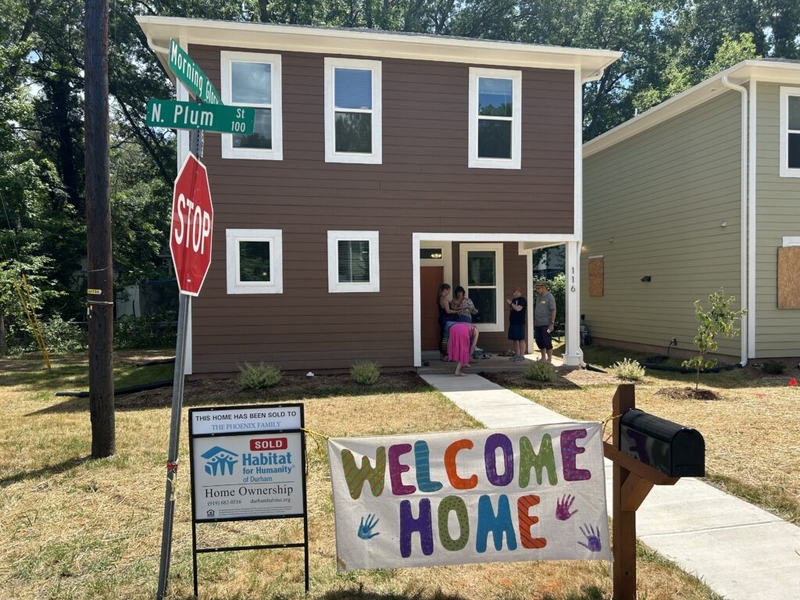
A Habitat for Humanity Home in Durham. (Photo: Greg Childress/NC Newsline)
Housing demand across the country is slowing due to an affordability crisis that makes it difficult for people with moderate-to-low incomes to buy a home or pay high rents, said Alexander Hermann, a senior research associate at the Harvard Joint Center for Housing Studies.
High housing costs, high home prices, high rents and rising interest rates are all part of the problem, Hermann said. Other key factors include a decline in the immigrant population and a “tepid and difficult job market for a lot of potential housing consumers,” he said.

At the same time, student loan debt repayments have restarted for a lot of young people.
“These factors all prevent new households from forming, and cause more young adults to double up and live with parents,” Hermann said.
Hermann’s remarks came Thursday at the N.C. Affordable Housing Conference in Raleigh. Nearly 1,400 people signed up for the two-day event, which ended today. The annual conference is presented by North Carolina Housing Finance Agency, the North Carolina Housing Coalition and Centrant Community Capital.
Hermann said the nation is struggling through one of the most expensive housing markets in years. In 2020, when the market was booming, monthly payments on median-priced homes were under $2,300, he said.
“As interest rates rose, you saw payments on median-priced homes rise up to $3,000 pretty quickly in 2022, and it peaked at just under $3,400 as recently as last year,” Hermann said.

Citing data from “The State of the Nation’s Housing,” the center’s flagship annual report, Hermann said home prices in Charlotte and Raleigh have risen even more rapidly in recent years than in the U.S. overall.
The problem is hitting young adults and people of color hardest, Hermann said. The strongest growth in homeownership was among those groups in 2021-2023, but he said that progress has been reversed.
According the National Association of REALTORS®, the median age of first-time homebuyers is now about 40 years old. A growing number of young adults report needing money from their parents to buy a home, Hermann said.
Rentals
The rental market is impacted by many of the same problems as the for-sale market, Hermann said. Slower immigration, a weaker labor market, rising interest rates and inflation all have impacted the rental market.
Growth in rents has remained flat since 2023, but they’re still 33% higher than they were in 2019, the year before the pandemic, Hermann said.
In North Carolina, rents in five of the six markets tracked by Realpage remained flat or declined, Hermann said. Only Wilmington saw rents increase, and that was by 4.5%, he said.
Stagnant rent and an increase in rental construction should have improved affordability, even amid rising operating costs, but that hasn’t happened, Hermann said.
Housing took bigger bite out of household budgets in 2025, new report shows
“In fact, renter unaffordability in some ways is at record levels, and certainly hasn’t come down at all from peak unaffordability just a couple of years ago,” Hermann said.
A record high number of 22.7 million renter households – about half, Hermann said – were cost-burdened by their rents in 2024, he said. That means they spent more than 30% of their incomes on rent and utilities. The 22.7 million households is a 2.3 million increase since 2019.
“About 26% are severely burdened, meaning they spend more than half their income on housing,” Hermann said.
In North Carolina, 730,000 renter households are cost-burdened, which is an increase of 100,000 since before the pandemic and almost double the number since 2001, Hermann said. Of those, 380,000 households are severely cost-burdened.
Looking ahead, Hermann said projections for the next 10 to 20 years suggest growth in the number of American households will be “significantly lower than what the nation has experienced recently and historically.”
“That’s due largely to the aging of the population, but also declining fertility rates,” Hermann said. “Further, future household growth will be even lower if immigration levels remain modest, and there’s a lot of potential bad that comes with that.”

The good news about the slowing demand for housing is that it will take time for efforts to boost the nation’s housing supply to work. The slowdown should give the market time to right itself.
“That’s still going to require more housing, but ideally the equilibrium in the future is one that’s more affordable for households at every income level, but also has a diversity of housing types, and it exists in a wide range of communities where people want to live,” Hermann said.
Scott Farmer, executive director of NCHFA, said despite the challenges in the housing market, he’s optimistic that affordable housing is now a major topic of discussion among national, state and local leaders.
Samuel Gunter, executive director of the N.C. Housing Coalition, agreed that the attention is encouraging.
“That is a promising sign that more people are willing to get creative, because the affordability challenges have crept so far up the income ladder that no one is untouched by it, no matter how wealthy you are,” Gunter said. “You’ve got kids, you’ve got in-laws, you’ve got grandkids who are struggling to get into a home.”
Raleigh, NC