House panel agrees with Senate, drops ‘food libel’ provision from Farm Bill
Feb 24, 2026 | 2:38 pm ET
Description
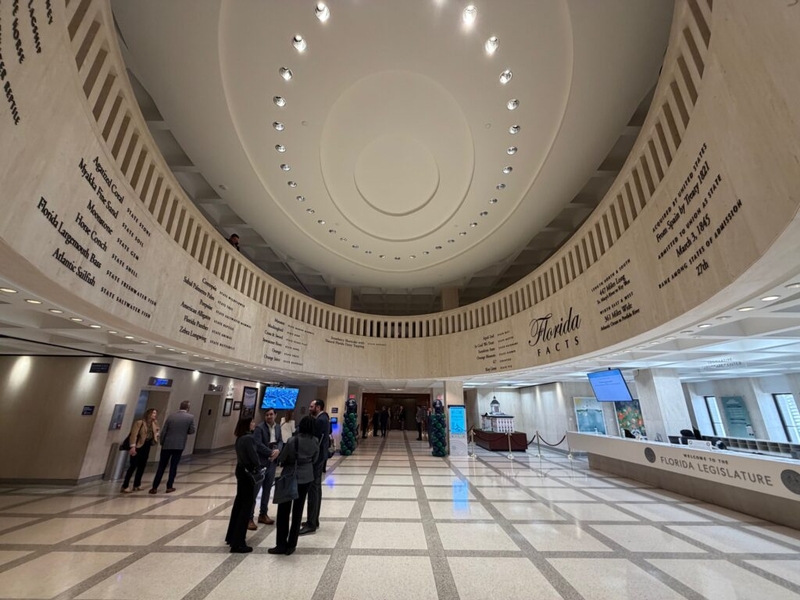
The Fourth Floor Rotunda in the Florida Capitol. (Photo by Michael Moline/Florida Phoenix)
The Florida House State Affairs Committee, bowing to growing opposition to a proposal to allow food producers to sue critics for libel, caved Tuesday, adopting an amendment spiking the language.
The move essentially coordinates the House with pending legislation already accepted in the Senate and moves the package closer to final passage.
The offending language in HB 433, the Farm Bill, would have authorized producers to sue people or organizations criticizing any food products or processes. That would have expanded a state law now allowing “food libel” actions involving perishable products.
Leafblowers, door-to-door salesmen, and surplus land addressed in Senate-passed ag bill
The provision enlivened environmentalists, agriculture producers, and advocates of the Trump administration’s Make America Healthy Again (MAHA) movement. One opponent of the food libel provision said during a Senate meeting the libel provision would be “muzzling MAHA.”
“This provision posed serious concerns about the right of everyday citizens to speak honestly about issues impacting their communities. Protecting our waters depends on the ability to raise concerns openly and without fear of financial retaliation,” Daniel Andrews, CEO of Captains For Clean Water, said in a news release following the House committee vote.
Jason Garcia, an independent journalist, reported the link between this provision and the sugar industry, perennially under attack for its practice of burning off sugarcane fields in preparation for harvest, spreading smoke and soot through nearby communities.
Captains For Clean Water advocated fiercely against the libel measure, saying it would’ve chilled speech for “scientists, journalists, parents, and anyone willing to raise concerns about environmental or public-health impacts.”
The 800-plus line bill also discourages door-to-door solicitation, threatening “a noncriminal violation” punishable with a $500 fine for first offenders who solicit a property that has posted a sign warning against soliciting. Second offenses would be punishable as second-degree misdemeanors.
Calling the addition of the solicitation provision an “overwhelming request,” bill sponsor Rep. Danny Alvarez, a Republican from Hillsborough County, gave examples of people selling roofing, solar panels, and generators as those who might be unwanted.
Rep. Anna Eskamani, a Democrat from Orlando, asked about Girl Scouts selling cookies.
Alvarez said he would be open to amending the bill for the Girl Scouts.
Rep. Angie Nixon, a Democrat from Jacksonville, asked about children running lawn-mowing businesses. She added that the measure could have a chilling effect on “electoral canvassing.”
Additionally, the bill would allow state land designated for conservation to be reviewed by the state Acquisition and Restoration Council, a 10-member group that evaluates state lands for conservation, to determine its suitability for commercial agriculture. If it’s found suitable, the land could be sold by the government. It applies to conservation lands purchased since Jan. 1, 2024.
The land would have to remain under an easement, however, stipulating that it will not be developed.
That provision caught the eye of Rep. Lindsay Cross, a Democrat from St. Petersburg, an environmental scientist.
“Thinking that something is going to be a park with public access that in just a few years becomes a cattle ranch I think is a little disingenuous,” Cross said.
Alvarez said the surplus process is trying to “keep Florida rural.”
“Over 30% of Florida is owned by the government. We’re going to put it back on the tax rolls,” Alvarez said, adding that, since the land will be free of development, “we’re going to protect Florida’s national security and state security by keeping people farming.”
The bill passed on a 22-3 vote with Eskamani, Nixon, and Rep. Ashley Gantt, a Democrat from Miami, voting against. It still has to be heard by its final committee, Judiciary, before heading to the floor.
The Senate bill, SB 290, unanimously passed that chamber last week.
Tallahassee, FL