Florida judge won’t toss DeSantis’ new congressional map
May 27, 2026 | 11:05 am ET
Description
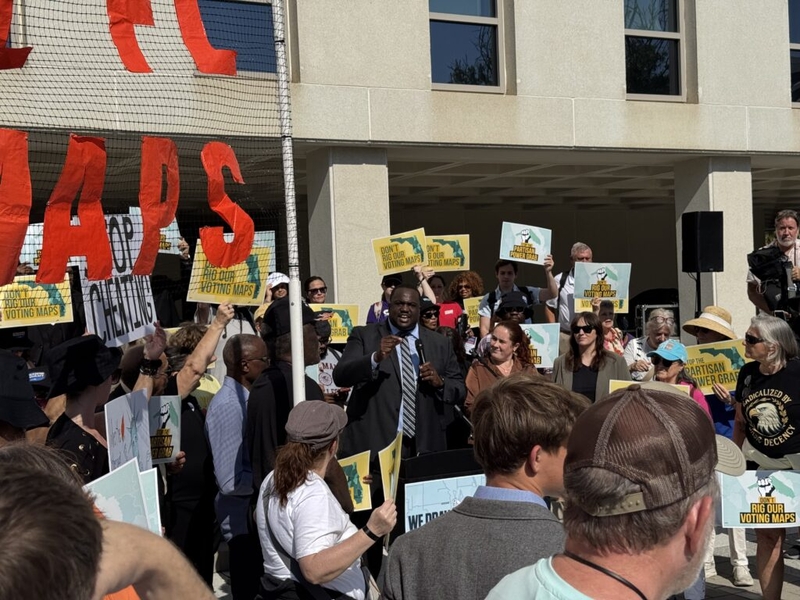
Genesis Robinson of Equal Ground speaks as a crowd protesting mid-decade redistricting gathers outside the Florida Capitol as lawmakers convened inside in a special session on the matter on April 28, 2026. (Photo by Jay Waagmeester/Florida Phoenix)
A Florida judge has refused throw out Gov. Ron DeSantis’ newly adopted congressional map, meaning the redraw — which eliminated as many as four Democratic seats — could be in place for the 2026 midterms.
In his eight-page decision, Circuit Judge Joshua Hawkes cited a bevy of reasons for siding against the three advocacy groups trying to trash the new map, including potential “confusion” ahead of the looming elections, a lack of evidence the maps were improperly drawn, and implying that Florida’s existing map, designed by DeSantis in 2022, would be illegal under a landmark new Supreme Court ruling.
He did not address whether the map means Florida’s constitutional ban on partisan gerrymandering must be struck down. Hawkes said it’s “premature” to evaluate that argument.
“The primary is less than three months away, and the general less than six months. The public interest weighs more in favor of certainty than a haphazard judicial mandate of discarded maps,” he wrote.
DeSantis in 2022 muscled through a congressional map that gave Republicans — already the dominant party in Florida — 20 seats compared to Democrats’ eight. But the 2026 map, drawn by one analyst in the governor’s office, would bolster that lead to 24-4.
The central argument for the partisan switch is a primarily Black South Florida district, CD-20. The governor’s office says that district’s makeup is unconstitutional under a new Supreme Court ruling, which found that the federal Voting Rights Act alone isn’t enough to justify race-based redistricting.
Hawkes agreed, questioning whether that district would be legal following the Louisiana v. Callais decision.
But DeSantis’ mid-decade redistricting call came before the SCOTUS decision, on the heels of President Trump’s call for Republican states to redraw their maps to boost the GOP’s thin congressional majority. That directive set off a political cascade, as heavy-hitting blue and red states — like California and Texas — rushed to pad their congressional majorities.
Despite this, and mapmaker Jason Poreda’s acknowledgement that he took partisan data into account, Hawkes said there wasn’t enough evidence of “impermissible intent.” This referred to the “Fair Districts” amendments, a pair of 2010 citizen-led ballot amendments in the Florida Constitution that ban congressional and legislative districts from ignoring minority groups or being drawn to favor a political party or incumbent.
Both DeSantis and the groups involved in the suit have agreed the Fair Districts amendments run up against the map, but they differ on what it means. DeSantis believes the entire item need to be tossed, including the partisan favoritism language, while the plaintiffs say that’s illegal. Hawkes declined to weigh in.
The groups involved in the lawsuit include Equal Ground, Common Cause, and the League of Women Voters. Minutes after Hawkes’ ruling came down, they appealed the ruling.
“We will continue our fight to protect the will of Floridians who overwhelmingly voted to ban partisan gerrymandering in this state,” said Common Cause Florida Executive Director Amy Keith.
“Because Floridians of all political backgrounds are so clearly against partisan gerrymandering, we will exhaust all legal options to make sure a map this partisan does not last the rest of this decade.”
Tallahassee, FL