History: When Ohioans came to watch the synagogues rise
Oct 15, 2026 | 3:30 am ET
Description
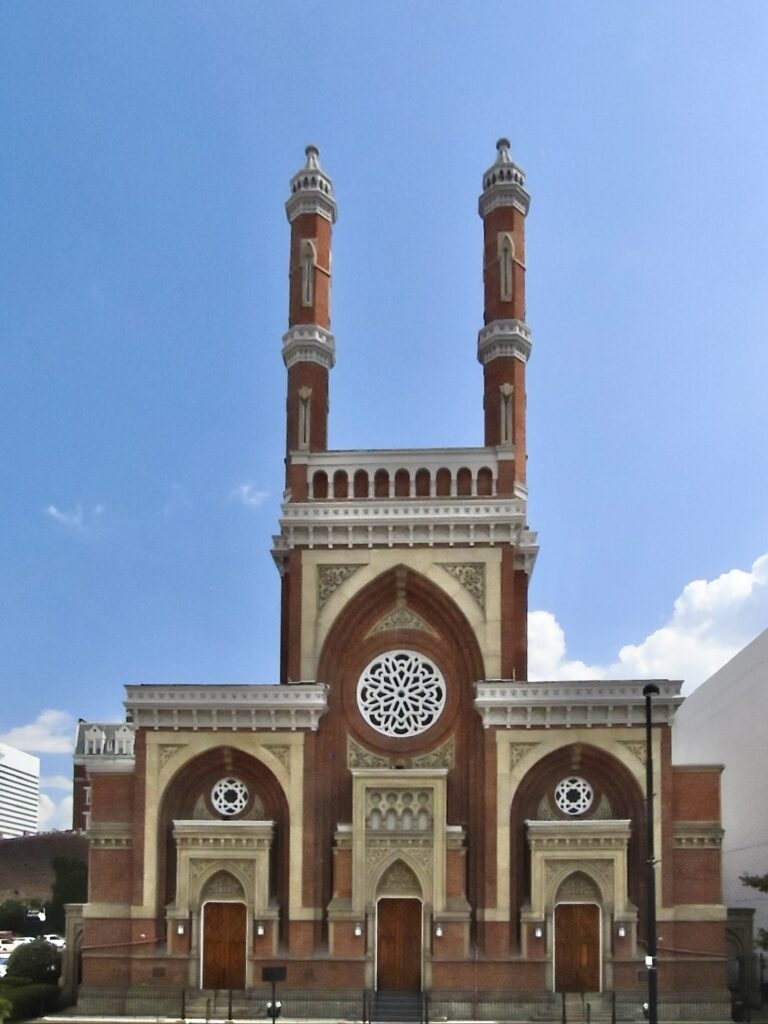
This historic Isaac M. Wise Temple in Cincinnati (Getty Images file photo)
In 1836, Cincinnati’s small Jewish community dedicated a synagogue.
It was reported to be the first building erected as a synagogue in the western United States. The congregation behind it, B’nai Israel, had been organized twelve years earlier. When it received a charter from Ohio in 1830, it counted 32 adult men and 20 adult women.
The synagogue did not rise through the congregation’s efforts alone.
According to an account published several years later in “The Occident and American Jewish Advocate,” 52 Christians had each given $25 toward its construction. When the building was dedicated, so many Christian neighbors came that not everyone could be admitted. The congregation gave preference to local clergy and to the families of those who had contributed to the building.
Ohio’s Jewish population would grow considerably in the decades that followed. Congregations formed and new synagogues rose in Cincinnati, Cleveland, Columbus and elsewhere. Again and again, their construction became a public occasion.
In Cleveland, the Jewish community was still new enough in 1845 that a synagogue cornerstone laying attracted significant attention.
A “large number of citizens” gathered as members of Anshe Chesed laid the cornerstone for a new building on Eagle Street. “The Cleveland Herald” predicted that the synagogue, when completed, would be “an ornament to our flourishing city.”
When the congregation opened the following year, it had about 70 members, and a newspaper noted that its members had “received some aid from other citizens.” Hanging on a wall inside was a framed inscription:
“A testimonial of gratitude to J. M. Woolsey, Esq., and Lady for their liberal assistance in erecting this edifice.”
Jewish worship also required some explanation.
A reporter at the dedication described the women’s gallery, hats being worn during worship, the ark and the Torah scrolls kept inside it. A tallit became a “light shawl.” The bimah was described as an “Altar.”
“As the consecration of a synagogue is somewhat new in this quarter,” the newspaper explained, “we will briefly describe the ceremonies.”
Members of the congregation formed a procession at their former place of worship and carried five Torah scrolls to the new synagogue. Reaching its doors, they chanted in Hebrew:
“Open unto us the gates of righteousness.
“O, let us enter and praise the Lord.”
Not every observer regarded Judaism generously. “The Cleveland Plain Dealer,” writing about the dedication, called the worshippers “deluded people” who had resisted Christianity for 1,800 years.
Public welcome and religious prejudice occupied the same city at the same time.
Twenty-two years later, another synagogue cornerstone was laid in Cincinnati.
Protestant ministers attended. Beneath the cornerstone went copies of the Declaration of Independence, the United States Constitution, the Articles of Confederation and George Washington’s Farewell Address.
Rabbi Max Lilienthal, a speaker at the occasion, declared, “America is our Palestine; here is our Zion and Jerusalem!”
Lilienthal rejected the expectation of a restored Jewish kingdom governed by an earthly Messiah. Instead, he spoke of Washington and the signers of the Declaration of Independence and looked toward a time when people would live together in “brotherly love, peace, justice and mutual benevolence.”
One newspaper ended its account with another detail about the rabbi.
“This is the same Rabbi who preached some time ago in a Christian church.”
Two years later, thousands gathered in Columbus.
It was May 1870, and the city’s Jewish community was laying the cornerstone for what would become its first purpose-built synagogue, at Friend and Third streets. Bands played as fraternal organizations and public officials joined the procession, while people crowded around the foundation to watch.
Rabbi Isaac Mayer Wise of Cincinnati spoke for more than an hour on what he called human dignity.
“God hath made man upright,” Wise told the crowd, drawing from Ecclesiastes.
The new synagogue, he said, would proclaim not only the unity of God but the dignity of human beings. Wise rejected the idea of inherited depravity and original sin. Human beings were free moral agents, he argued, responsible for what they did.
“God is just, and you are free,” he said.
“God is love supreme, and man is His image.”
The synagogue would stand, Wise said, as “the fortress of defense to the holiest and highest treasure of the human family, the divine acknowledgment of human dignity.”
When the building was dedicated later that year, “The Israelite” reported that Christians took pride in its construction. Members of the congregation remembered assistance from “the liberal and pious of all sects.” Jews and Christians gathered together for the first Friday evening service.
The relationship continued outside the sanctuary.
In 1872, municipal officials allowed the congregation to use City Hall for a fair that helped pay the remaining debt on its synagogue. Among the attractions were contests to elect the fair’s “mayor” and “marshal.” The winning mayor received a gold-tipped cane.
The winning marshal received a revolver.
When the congregation promoted a concert at the Opera House later that year, it publicly thanked Columbus residents for their “liberality in assisting them in the erection of their house of worship.”
Similar scenes continued as Ohio’s Jewish communities grew.
In Cleveland in 1886, Anshe Chesed began another synagogue, this time at Scovill Avenue and Henry Street. The cornerstone ceremony became what one newspaper called “the most extensive festival in the history of local Judaism.” About 4,000 people gathered.
Members of the Masons took part in the ceremony, which included remarks from former Cleveland mayor George W. Gardner and closed with a prayer from a Unitarian minister. Sunday school children and members of several Jewish congregations joined a procession through the streets to the new temple.
“Every square foot of standing room on the temple floor was occupied,” a reporter observed, while late arrivals stood outside in the street.
The synagogue was dedicated the following year. Again, Jewish and non-Jewish Clevelanders came. City officials and Christian ministers were among those present. An American flag hung outside. Two more stood on either side of the ark.
In the yard was a sign bearing a single word:
“Welcome.”
By the beginning of the twentieth century, Columbus’ first synagogue was no longer large enough for its congregation. A new building rose on Bryden Road.
More than 1,000 people witnessed its cornerstone ceremony in 1903. The Ohio Grand Lodge of Masons participated. The mayor spoke.
Rabbi David Klein thanked the congregation’s “neighbors and friends.”
“Judaism is a faith pure and simple and sublime,” he said.
If Judaism required a creed, Klein continued, it might be this: “One God over us all, and in Him all his children must form one brotherhood sustained and animated by the spirit of the Father.”
Above the entrance would appear words from Isaiah:
“For my house is a house of prayer unto all nations.”
When the synagogue was dedicated in 1904, one of its three dedicatory services was devoted to “good fellowship.” Ministers from Congregational, Universalist and Methodist churches participated. The president of Ohio State University spoke of Jews as “the teachers of the nations.”
Klein told those gathered that the new temple was open to people of all creeds.
More than six decades had passed since Cincinnati’s first synagogue opened its doors to a crowd of Christian neighbors. None of these stories erases the reality of religious prejudice or disagreement. But the crowds are difficult to miss.
For decades, Ohioans gathered as synagogues rose in their cities. Some helped build them. Others simply came to watch.
Inside, Ohio’s Jewish communities spoke for themselves.

Columbus, OH