One Kansan gets her driver’s license back as cases challenging anti-trans law head to trial
Aug 25, 2026 | 5:36 pm ET
Description
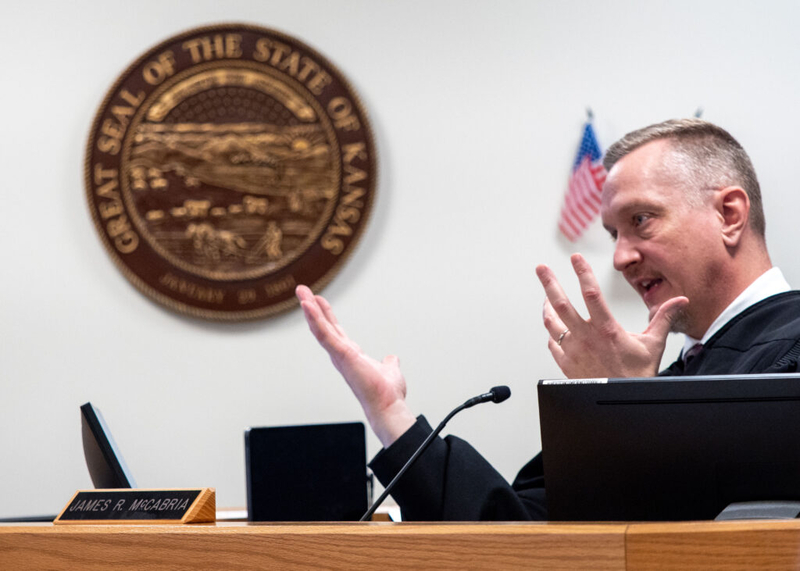
Douglas County District Court Judge James McCabria talks with attorneys during a March 6, 2026, hearing on the Kansas law that restricts transgender individuals to using their biological sex at birth on documents and which bathrooms they use in government buildings. (Photo by Sherman Smith/Kansas Reflector)
TOPEKA — One transgender Kansan had her driving privileges reinstated after challenging a state law that regulates gender markers on driver’s licenses.
But only Jamie Miller’s license was returned while hundreds of other trans Kansans await a final decision in her case, which could determine the standing of the state law that has faced scrutiny from the jump for the restrictions it imposes on trans people.
Douglas County District Judge James McCabria issued on Aug. 17 a nine-page decision that set aside the Kansas Department of Revenue’s invalidation of Miller’s license earlier this year. The department oversees the state’s division of motor vehicles, which issues all driver’s licenses and was responsible for invalidating trans Kansans’ licenses after Republican lawmakers passed Senate Bill 244.
The law instituted a pair of anti-trans measures, restricting bathroom use in publicly owned facilities and mandating driver’s licenses gender markers align with a person’s sex assigned at birth. Miller sued the state and Attorney General Kris Kobach in an attempt to block the driver’s license portion of the law from going into effect. McCabria denied that request in March.
The law codified in February the Kansas legislative majority’s anti-trans rhetoric, sparking protests and incurring multiple lawsuits.
McCabria’s recent decision didn’t answer whether Miller’s gender marker should reflect male or female.
“That is not the subject of this decision,” he wrote. “This decision is about the process, not the subject matter of the underlying dispute.”
Miller has had a driver’s license that reflects her gender since 2017. On Feb. 24, she received notice that her driver’s license would be invalidated in two days. The Revenue Department’s letter didn’t mention an option to appeal, but state statute allows for a monthlong appeal window.
The attorney general agreed to a grace period, delaying enforcement of the law until March 26. Miller received another letter on March 24 with information on the grace period and notification her license would be invalidated two days later. The deadline for an appeal moved to April 21.
The Revenue Department sent yet another letter on April 7, notifying Miller her license was invalidated because she didn’t make any changes to her license. Miller called and emailed the department to request an appeal, which was met with a generic response. She sued on April 27.
McCabria concluded that the Revenue Department violated Miller’s due process when it provided unclear guidance about an appeal process and offered conflicting information about the validity of her driver’s license.
McCabria characterized the department’s notices as follows: “ ‘your license will be invalid in two days, you can appeal, no, wait, your license isn’t invalid yet, you can appeal, no, wait, your license has been invalidated because you didn’t do anything to appeal but if you want to appeal, call us.’ ”
The department didn’t provide “meaningful notice,” McCabria said, and Miller was never given a “meaningful opportunity” to be heard before or after her license was invalidated.
McCabria, in the same decision, consolidated Miller’s case with another challenging the same law, so they will be heard at the same trial, which is scheduled for four days beginning Sept. 29. The other case disputes both provisions of the law.
In addition to the driver’s license restrictions, it challenges the constitutionality of the law’s bathroom ban, which bars people from using public restrooms that don’t align with their sex assigned at birth. Public institutions could face penalties for failing to ensure proper bathroom use, with fines beginning at $25,000 and escalating to $125,000 for subsequent offenses. The law’s supporters said it would make restrooms safer for cisgender women while critics say it accomplishes the exact opposite of what lawmakers seek. That’s because the law requires transgender men, who look and sound like men, to use the women’s bathroom, and vice versa.
Under the law, individuals may be fined $1,000 and charged with a misdemeanor for repeatedly using a bathroom in violation of the law. And an individual who feels “aggrieved” by a trans person’s bathroom use can pursue a private right of action for $1,000.
The case, which is also in Douglas County Court, involves two trans men who are arguing the law violates their rights to due process, privacy, equality and expression. McCabria denied a request for a temporary injunction in that case, allowing the law to remain in effect.

Topeka, KS