Here’s what we know about Maine Democrats’ plan to replace Graham Platner
Jul 10, 2026 | 12:53 pm ET
Description
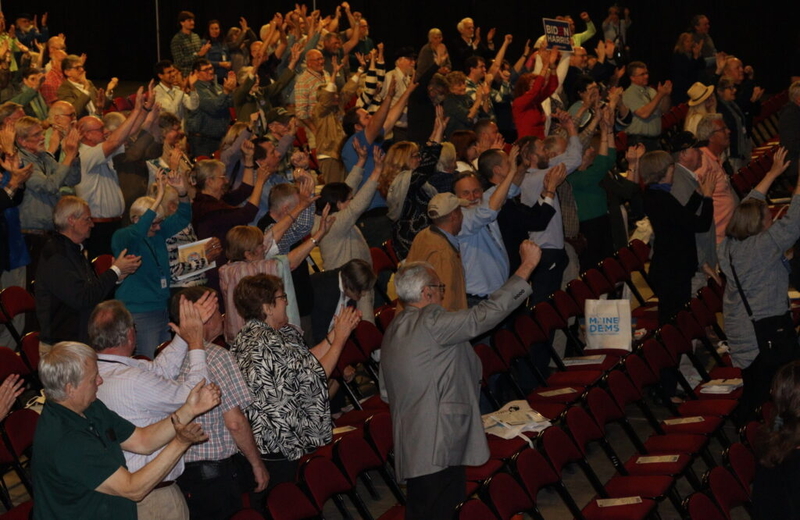
Attendees of the Maine Democratic Party's state convention in Bangor on May 31, 2024. (Emma Davis/ Maine Morning Star)
Editor’s Note: This story was updated Friday night after the Maine Democratic Party shared details of the convention and voting process.
County-level Democrats are mobilizing to determine how to choose delegates to send to the 601-person convention the Maine Democratic Party will hold on July 25 in Bangor to select Graham Platner’s replacement as the party’s U.S. Senate nominee.
On Friday evening, after Platner officially withdrew, the party released the details of that convention and the voting process that will be used, after sharing its candidate qualifications on Thursday. The selection of delegates appears to be left up to individual county committees, which will call meetings in the near future open to all Democrats registered in a given county.
“We are up against a timeline that we did not choose, and we face legal limitations, because our laws never anticipated this unusual challenge,” Maine Democratic Party Chair Charlie Dingman said in a statement Friday night. “We have worked hard to create a process that is inclusive of varying viewpoints and diverse backgrounds of Democrats across the state of Maine, legally sound, and fair to all candidates who seek the nomination.”
One of the candidate qualifications is a stipulation that candidates must submit a written statement “about the candidate’s vision of how their campaign will continue to support and build on the currently existing grassroots energy and movement in Maine ensuring that no Mainer is left behind by their next United States Senator.”
This appears to be a nod to calls from Platner’s campaign and several voters to ensure the new nominee builds off of the momentum that had been behind the progressive policies pushed by Platner — who announced he was exiting the race Wednesday night after an accusation of sexual assault but has yet to formally withdraw.
Platner’s campaign and the state party have been sparring over the process of selecting his replacement, and executive Director Devon Murphy-Anderson has said Platner’s team “would have no role” in the decision.
Candidates have to submit their declaration of intent to the chair of the party no later than 5 p.m. July 15. As of Friday, at least seven candidates have announced their intentions to compete to replace Platner.
Voting process
At the convention, voting on candidates will be done in rounds until one candidate secures a majority.
The five candidates who receive the most votes in the first round will advance to a second round, and each subsequent round will eliminate the candidate with the least votes until one candidate is chosen.
Each qualifying candidate will have an opportunity to address the delegates at the convention before they vote.
Signature requirements
In order to qualify to run, candidates must submit 500 nominating signatures from registered Democratic voters in Maine by 11:59 p.m. on July 21, according to the party’s candidate qualification rules. Within those 500, at least 50 have to be from at least eight counties.
But the candidate can provide up to 1,000 signatures if they choose. The party will be verifying the signatures, and once it validates 500, it will cease verification. In addition to submitting physical signature sheets, a digital spreadsheet is required from each candidate, which the party says is to help with timely verification and “to demonstrate basic campaign organizational capacity.”
Third party challenges to the signatures of any candidate won’t be accepted by the party.
This means that independent voters — who were able to vote in the primary — will not count toward the total, nor will those voters be able to participate in the convention.
Maine began offering semi-open primaries in 2024, meaning voters not enrolled with a political party can choose one party’s primary to vote in. More independent voters selected Democratic tickets than Republican ones in the June 9 election in which Platner was selected as Democratic nominee for Senate.
Selecting delegates
The convention will include 500 delegates elected proportionally by county committees, along with 101 members of the state committee.
Each county will get one-third of the delegates it received at the 2026 state convention, which were assigned based on the 2024 primary turnout.
For example, Hancock County is expected to get around 20 delegates, about a third of the 69 delegates the county sent to the state convention in May, said Marcia Myers, chair of the Hancock County Democrats and a DSC member.
County chairs will each be tasked to call special nominating meetings to make delegate selections, but the party has not specified publicly a process that must be used, aside from the fact that the delegates are required to be registered Democrats.
If delegates are chosen like they are for the convention the party holds every two years, any registered Democrat in a given county would be eligible to put their name forward as a delegate during a county-level meeting and then everyone present would vote on which delegates to send to the nominating convention.
“A lot of people feel that they want candidates who are aligned with Platner’s progressive message,” Myers told Maine Morning Star. “We’re hearing that loud and clear.”
The party also agreed on working together with the “people dedicated to Graham Platner’s campaign,” she said.
At least two candidates have discussed recruiting supporters to be delegates. Former Maine Senate President and gubernatorial candidate Troy Jackson published an online form to ask supporters if they would try to be chosen as a delegate by their Democratic county committee and nominate him at the convention, or attend a local caucus and support his delegates.
Shah is reviving his approach from the gubernatorial primary race by bringing back town halls so he can meet delegates in their own communities. He said he’ll be relying on his volunteer base (which was about 850 when he ran for governor) and is supportive if they want to be delegates, as long as the county rules allow it.
“If we end up with a higher number of delegates who are Shah supporters, that should only be because there are more Shah supporters in Maine, not because we’ve gamed the system,” Shah said during a press conference in Freeport on Thursday announcing his Senate bid.
What voters want
Some voters are in favor of the type of convention the party settled on, including Portland resident Alex Kasser who said Wednesday that’s what she’d hoped would be the case. But others have concerns.
“I think the idea of having a convention intentionally obfuscates the sort of people power aspect of Graham’s campaign,” said Sophie Creamer of Brunswick.
Creamer, who voted for Platner in the primary but stopped supporting him after the sexual assault allegation, worries average Mainers will now be left out of the process. A lot of people in Creamer’s circle likely wouldn’t have the time to take on such a role at the last minute, Creamer said.
“Only like the really, really diehard politics people that I know would probably become delegates,” Creamer said.
Given concerns about delegates being truly representative of Maine voters, Creamer said, “While it is messier, I think it would be much more worthwhile for the long-term health of the Democratic Party in Maine to have a flash caucus.”
State committee members who attended the emergency meeting Wednesday said the party had also considered a larger convention to include more people, but the national event planners and logistics specialists they consulted advised it would not be possible to pull off given timing constraints.
Other voters who said a convention wouldn’t have been their first choice, said Mainers have to “roll with it,” as Alfred Beattie of Dresden put it.
“It’s the best we got right now,” Beattie said.
- 10:05 pmThis story was updated Friday night after the Maine Democratic Party shared details of the convention and voting process.
Augusta, ME