Gov. Polis vetoes bill to allow civil suits against immigration authorities
Jun 04, 2026 | 3:09 pm ET
Description
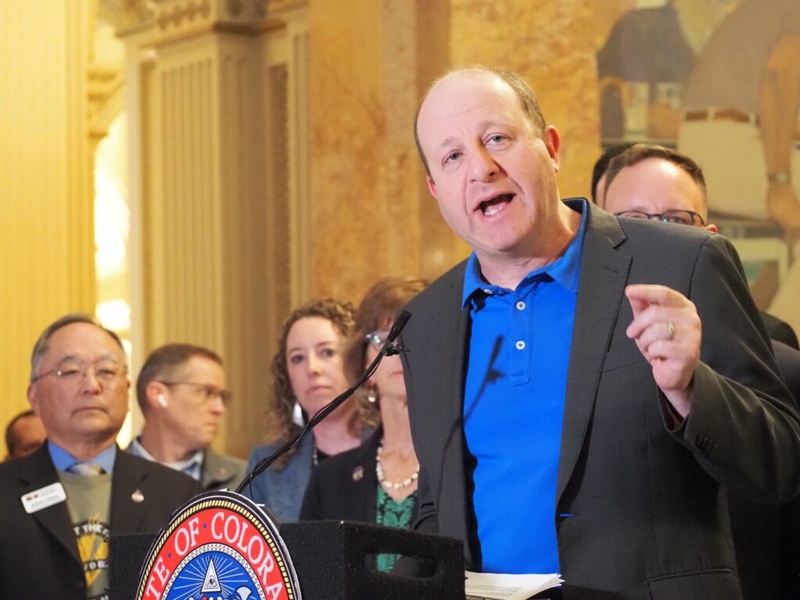
Gov. Jared Polis speaks during an Agriculture Day event at the Colorado Capitol on March 24, 2026. (Photo by Sara Wilson/Colorado Newsline)
Gov. Jared Polis vetoed a measure Wednesday that would have allowed Coloradans to sue federal immigration officials who violate their constitutional rights, one of the first bills Democrats introduced in the 2026 legislative session.
Senate Bill 26-5 would have created a state-level cause of action against federal officials for alleged constitutional violations during immigration raids, arrests, traffic stops and warrantless entries. It came in response to increased operations by the Department of Homeland Security and Immigration and Customs Enforcement to carry out President Donald Trump’s mass deportation scheme against immigrants who lack permanent legal status.
The narrow focus on civil immigration enforcement presents legal risks, Polis said in his veto letter, because if a court struck down the bill, it “could weaken current protections for vulnerable community members.”
“This bill doesn’t apply to any other context besides civil immigration enforcement — including rights violations in protests, elections, prisons, or the workplace,” Polis said. “For example, even in the narrow context of immigration, the bill doesn’t cover violations of constitutional rights during criminal investigations in immigration.”
Polis said he would support a broader measure that would protect Coloradans “against all manner of constitutional violation by federal agents.” He mentioned Senate Bill 26-176, a bill that died under opposition from district attorneys, that would have let Coloradans sue any federal official, as well as state and local officials, who violated their civil rights, not just during immigration enforcement.
“Constitutional rights are a shield against government overreach and misconduct; they are vital to any democracy, and especially to our own at this time,” Polis said. “It defies the very purpose of natural rights if they are only available when the circumstances, set by one legislature, are just right.”
Alex Sánchez, president and CEO of Voces Unidas, said in a statement that Polis’ veto of SB-5 “caps one of the most disappointing legislative sessions for Latinos and immigrants in recent Colorado history.” Democrats, who control the state government, are to blame, he said.
“From making farmworker exploitation legal again, to blocking protections against federal agents beating people in the street, to allowing masked ICE agents to continue hiding their identities, to continuing the transfer of immigrants from county jails after minor traffic infractions, Colorado’s Latino communities deserved strong leadership,” Sánchez said. “We got excuses instead.”
12 total vetoes
Wednesday’s action brings to 12 the number of vetoes issued by Polis in 2026, surpassing his record of 11 vetoes set last year.
Polis also vetoed Senate Bill 26-134, which would have lowered the fees businesses need to pay credit card companies every time a customer swipes their card. It was one of the most heavily lobbied bills this legislative session.
“Ultimately, the bill presents too much legal risk to Colorado’s business environment and consumers, with limited upside for our small businesses, for me to be comfortable signing,” Polis said in his veto letter.
Similar legislation passed in Illinois has yet to be successfully implemented because it is tied up in litigation, Polis said. He also questioned if the bill is operationally feasible and if it would actually save Colorado businesses a meaningful amount of money.
Banks and credit card companies and the Electronic Payment Coalition strongly opposed SB-134. Richard Hunt, chair of the coalition, said Polis made the “prudent and responsible decision.”
“This bill would have created chaos for merchants and consumers alike, threatened popular credit card rewards programs millions of Coloradans rely on, and placed community banks and credit unions in an impossible position,” Hunt said in a statement.
A bill that would have changed the workers’ compensation program for firefighters not employed by the state, Senate Bill 26-184, also received a veto from Polis.
Other bills Polis vetoed included a second attempt at eliminating Colorado’s second election requirement for unions, a bill that would have banned surveillance pricing and a bill that would have required social media companies to respond to law enforcement search warrants within 24 hours of receiving one.
Polis has until June 12 to sign or veto bills passed by the Legislature this year. He is term-limited and cannot run for reelection in November.
Denver, CO