In rush to meet federal deadline, Minnesota cuts funding to 60% of providers in 13 Medicaid programs
Jun 04, 2026 | 3:46 pm ET
Description
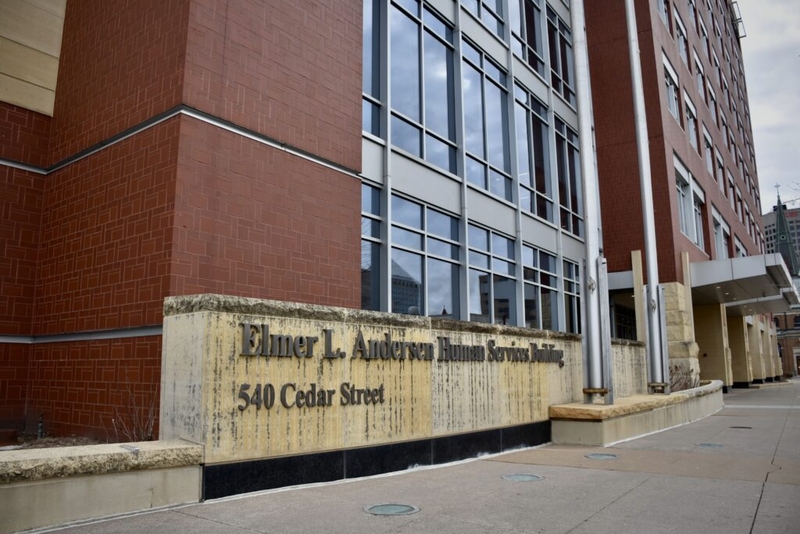
The Elmer L. Andersen Human Services Building in St. Paul, MN Thursday Jan. 15, 2026. (Photo by Alyssa Chen/Minnesota Reformer)
The Minnesota Department of Human Services cut off funding to more than 3,000 care providers across 13 Medicaid services in its sweeping “revalidation” effort — a four-month screening of roughly 5,500 providers made in response to heightened federal scrutiny over fraud in Minnesota’s social services.
Providers that had payments terminated range from smaller businesses serving a few dozen people to well-established companies such as Dungarvin, a national, decades-old human service organization with over 2,000 impacted Minnesota clients.
The state faced a May 31 deadline from the Trump administration to screen providers by reviewing their documents and conducting unannounced site visits, after which it cut off providers that still had in-process revalidations. Providers and their advocates say the process was rushed and has left legitimate providers unable to get paid for delivering services to vulnerable Minnesotans. While they are able to appeal the funding cuts, some say they’ll struggle to stay in business that long.
Out of thousands of organizations cut off from funding, just 59 were referred to DHS’ Office of Inspector General for further investigation.
The 13 Medicaid programs include personal care assistance, better known as PCA, services to help children with autism and services to transport people on Medicaid to their appointments, among other kinds of services. The programs, along with a housing service that was shut down, were deemed “high-risk” to fraud, waste and abuse by the state in October.
It’s not the first time providers of the “high-risk” services have been caught, en masse, in the Walz administration’s anti-fraud dragnet: The state’s Department of Human Services abruptly delayed all payments to providers of those services in December, which providers said put their businesses and clients at risk. Payments came back after a few weeks, but advocates say that some smaller providers, who operate on thin margins, are still struggling from the financial impacts of the now-permanent two-week delay in payment.
The Trump administration has ratcheted up pressure on the state’s Medicaid program since then, repeatedly threatening to cut billions in federal Medicaid funding, purportedly to put pressure on the state to clean up fraud in the high-risk programs. In February, Minnesota agreed to a May 31 deadline to “revalidate” roughly 5,500 providers in the high-risk Medicaid services — a massive undertaking usually done gradually over 3 to 5 years.
Providers are now going through another ordeal not unlike the December payment pause, where many legitimate providers are getting cut off from payments that may eventually resume after an appeals process, though it’s unclear when.
Tight timeline for an ‘unprecedented’ effort
Then-DHS Deputy Commissioner John Connolly called the effort to revalidate providers all at once “unprecedented” when it was announced in February.
The agency had to recruit state employees, some from other agencies such as the state’s pollution control agency, to conduct site visits.
Such a large undertaking, which DHS committed to doing in roughly four months, may have been too much for the agency to handle.
Out of the 5,583 providers of the 13 Medicaid services required to revalidate, DHS confirmed in a Thursday press release that only 2,061 — less than 2 in 5 — are able to continue providing services without interruption. Out of the remaining providers, which were all disenrolled, 2,491 were cut “due to submissions of incomplete paperwork and documentation.”
In a Thursday video call with providers, a DHS employee said that the agency sent termination letters for revalidations that were not completed by the May 31 deadline. That appears to include cases in which DHS did not review applications in time.
In the call, the message with the most likes came from Carrie Guida, the executive director of a group home provider in Cass and Crow Wing counties: “I think it is very disingenuous for DHS to post a new release that they ‘finished a comprehensive top-to-bottom review … on time on May 31’ when clearly they have not. Many providers were terminated simply because DHS ran out of time to complete this process in its entirety.”
Guida gave the Reformer screenshots showing that her business, Pine River Group Home, has had a revalidation “pending review” since March 2. On May 31, Pine River Group Home received a termination notice from DHS saying that it had failed to revalidate.
“We didn’t fail to revalidate. They failed to process our revalidation request,” Guida said.

Other providers say they were terminated because of bureaucratic minutiae and misunderstandings — not evidence of potential fraud.
For instance, Sam Major’s mental health services business, Apollo Counseling, was terminated for failing to disclose the company’s COO as a managing official. Major asked the state employee who conducted a site visit if the COO, who is a contractor not an employee, should be listed as a “managing employee” — a phrase from one of the questions during the site visit. The state employee didn’t know, Major said, so he guessed he should leave the COO off.
He found out he guessed wrong nearly two months later when he received a termination letter from DHS.
“There aren’t clear standards that anyone can point to and say, ‘This is why I terminated you,’” Major said. “This is all vibes.”

In another case, a provider was cut off because of an apparent glitch in the state’s web portal. Josh Berg, an outspoken provider advocate and the director of services at assisted independent living provider Accessible Space, said that several of his organization’s board members, who had been listed in the screening portal for years, were somehow deactivated when he added a new one.

Minnesota didn’t ask for an extension, fearing political backlash
The state has told providers they can appeal their terminations within 60 days, but Guida and other providers say two months without payments puts their businesses in jeopardy.
“I’m moving some emergency cash around to cover payroll next week — I don’t have 60 days worth,” Guida said. More than 800 providers have appealed their terminations, the DHS spokesperson said.
Matthew Bergeron, the lawyer and lobbyist for the Residential Providers Association of Minnesota, said that he suspects that the 60-day appeal process is a way for DHS “to get more time without drawing the ire of the feds.”
“I think they just hit a hard deadline, and with the federal oversight of that process, anything where not every ‘i’ was dotted and ‘t’ was crossed resulted in termination,” Bergeron said, adding that he expects “probably the overwhelming majority” of providers to be reinstated after appealing.
The federal government offered DHS the option to request more time in its March letter. A DHS spokesperson said in an email the agency didn’t because it’s “working to safeguard the $2 billion in threatened cuts by the federal government.”
Centers for Medicare and Medicaid Services Administrator Mehmet Oz “communicated from the start that he felt the department was not moving fast enough,” the DHS spokesperson said.
Sue Schettle, the CEO of the Association of Residential Resources Minnesota, said DHS leadership also told her that they didn’t ask for an extension earlier because they thought they wouldn’t need it.
State officials have said that the federal funding freezes could deliver a serious blow to the state’s budget, health facilities and Medicaid enrollees. Medical Assistance, which is what Minnesota calls its Medicaid program, cost $18 billion in 2024, with 60% paid by the federal government.
Berg said that he is “extremely frustrated” that the state didn’t ask for an extension in spite of the possible political ramifications.
“What I feel is missing from our agency, from the administration, is nobody’s fighting for Minnesota right now,” Berg said.

Saint Paul, MN