Gov. Polis again vetoes Colorado bill to ease union collective bargaining
May 29, 2026 | 7:44 pm ET
Description
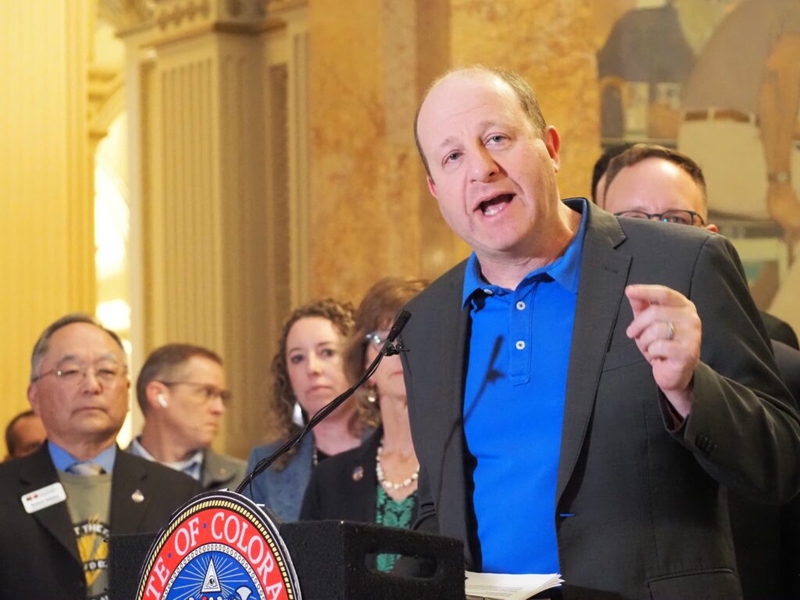
Gov. Jared Polis speaks during an Agriculture Day event at the Colorado Capitol in March. (Photo by Sara Wilson/Colorado Newsline)
For the second time, Colorado Gov. Jared Polis vetoed a bill that would eliminated a unique second election requirement in the state’s union formation law, after business and labor groups failed to reach a compromise on how to tweak the measure.
“In the wake of (last year’s) veto and the substantial negotiations that preceded it, I would have hoped that both business and labor leaders could have worked to craft a long-term and durable agreement on this matter that would have served Colorado workers and businesses alike,” Polis wrote in his veto letter on Friday. “Unfortunately, because that did not happen, this issue will likely come up again next year and every subsequent year until it is addressed, which creates uncertainty for both workers and businesses.”
House Bill 25-1005 would have repealed the Labor Peace Act in Colorado. Unions can form with a simple majority, per federal law, but in Colorado they must win a second election with 75% of the vote to negotiate so-called union security — whether all workers need to pay into collective bargaining negotiations.
Because unions have to represent all workers, not just members, bill supporters think it is fair for union organizers to immediately have the option to negotiate mandatory fees to cover the costs of the mediators who negotiate pay and benefits. Colorado is the only state with the second election requirement, and it also has a relatively low rate of union membership.
Polis wrote that the 75% threshold “functionally … blocks bargaining in larger units” but also enables stronger unions to form. He likely would have supported a bill that lowered the second-election threshold.
The bill passed both chambers this year on party lines, with Democrats, who have majorities in the House and Senate, in favor of it. An identical version had the same fate last year, when there was some hope that a compromise measure could be reached and signed by Polis, a Democrat. While last year’s bill and the ongoing negotiations around it created capital intrigue in 2025, the bill passed this year with relatively little commotion.
“This bill would have expanded worker power and wages in an economy that is dominated by the ultra rich,” bill sponsor Rep. Javier Mabrey, a Denver Democrat, said in a social media video. Mabrey challenged the two Democrats running to replace the term-limited Polis to commit to signing a future version of the bill. Neither of the candidates, U.S. Sen. Michael Bennet and Attorney General Phil Weiser, has said they would sign a bill to get rid of the second election.
“The second election is the problem. It exists for one reason: to give employers more time to intimidate workers, delay the process and undermine the union,” Mabrey said.
Labor leaders are now pivoting to pressure a future governor. In a a statement, Michelle Mendenhall, a Casa Bonita restaurant entertainment crew lead, said she wants to work with a governor “who will stand shoulder-to-shoulder with workers rather than billionaire CEOs.”
“The veto is a slap in the face to every worker organizing for a better life,” she said. “Again we were stymied by a politician protecting a system rigged to keep workers quiet, hold wages low and make it really hard to form a union.”
Polis has until June 12 to sign or veto bills. He vetoed four bills on Thursday. In addition to HB-1005, he also vetoed a bill Friday that would have required lobbyist registration for state departments that take a position and lobby on legislation. In his veto letter, Polis wrote that the bill would hurt future governors’ ability to “independently gather information and evaluate legislation.”
Denver, CO