GOP voters reject one Alabama PSC commissioner, send another to a runoff
May 21, 2026 | 6:01 am ET
Description
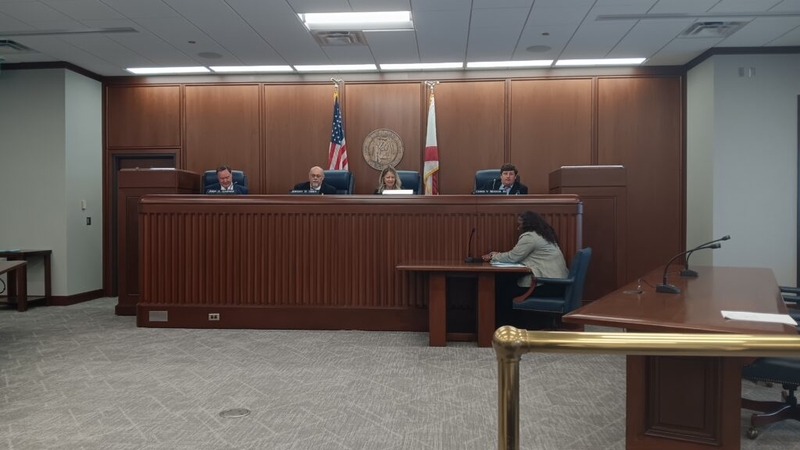
Members of the Alabama Public Service Commission prepare for the Tuesday, August 5, 2025 regular meeting. Republican voters Tuesday rejected one incumbent on the Alabama Public Service Commission and sent another to a runoff. (Ralph Chapoco/Alabama Reflector)
Republican voters Tuesday rejected one incumbent Public Service Commission member and sent another to a runoff Tuesday amid public frustration with Alabama’s region-leading residential electricity prices.
Cullman County Sheriff Matt Gentry defeated PSC Commissioner Jeremy Oden, who had served on the commission since 2012, with 311,845 votes (75%) to Oden’s 104,541 votes (25%) in the GOP primary.
In the other primary for PSC, former State Auditor Jim Zeigler got 189,724 votes (45%) to incumbent commissioner Charles “Chip” Beeker’s 103,835 votes (25%). The race will go to a June 16 runoff.
Messages seeking comment were sent Wednesday to Republican candidates who advanced from the primary election.
Gentry will face James Gordon, the Democratic nominee and a former state representative, for Place 1 on the PSC in November. Gordon received 187,983 votes in Tuesday’s contest, almost 58% of the total vote count.
“Back to work,” Gordon said on Wednesday about his primary election victory. He added that the Republican nominees received more votes than the Democratic candidates, so “the real fight begins.”
The winner of the runoff between Beeker and Zeigler will face Democratic nominee Sheila D. McNeil, who did not face opposition in the primary.
The results reflect mounting voter anger over Alabama’s residential electricity rates. According to the U.S. Energy Information Administration, Alabama residents paid 16.18 cents per kilowatt hour in February, the highest rates in the South and up from 15.83 cents a year earlier.
By comparison, Mississippi residents paid an average of 14.72 cents per kilowatt hour; Georgia residents paid an average of 14.13 cents per kilowatt hour and Tennessee residents paid 12.82 cents.
Mounting anger over Georgia’s power bills led voters in that state last year to elect two Democrats to the state’s Public Service Commission, the first time that had happened since 2006. A few weeks later, the Alabama PSC in Alabama voted to freeze electricity rates until 2027 in collaboration with Alabama Power.
“Alabama voters clearly care about energy costs,” said Daniel Tait, executive director of Energy Alabama, an organization that advocates for more renewable energy in the state, in a statement on Wednesday. “Last night’s primaries showed that voters understand that elected officials have a significant role to play in how utilities like Alabama Power are regulated.”
However, the Legislature moved to protect utilities from the threat of a formal rate case, a legal hearing in which utilities would have to justify the reasons for their electricity charges. The PSC currently uses a process known as Rate Stabilization that allows utility companies to propose rates to the PSC without having hearings or submitting input from the public. Critics say that lack of transparency has helped drive electricity rates up. .
Rep. Chip Brown, R-Hollinger’s Island, introduced legislation to end popular elections for members of the PSC and allow the governor to appoint members to the Commission from a list generated by leaders of the Legislature.
The bill initially moved quickly but stalled in the House chamber because it did not receive enough support in the Senate. Senate President Pro Tem Garland Gudger, R-Cullman, eventually declared the bill “dead.”
Rep. Mack Butler, R-Rainbow City, later introduced legislation to require the PSC to convene a rate case every three years.
The bill was approved unanimously in the House chamber but was then altered dramatically with another bill filed by Sen. Clyde Chambliss, R-Prattville, that froze base rates until 2029 but expanded the members of the PSC from three to seven, effectively swamping any PSC members elected by the public. The Governor’s Office would initially appoint the members, but they would be gradually replaced through elections.
The bill also placed the PSC under the direction of a secretary of energy who would set agendas for PSC members.
It also banned the PSC from holding a formal rate case hearing until 2029, and then only with the approval of the secretary or five and of the seven commission members.
Gov. Kay Ivey must appoint the new members by July 15.
Montgomery