Glastonbury trends blue, and a moderate Democrat is rejected
May 29, 2026 | 5:00 am ET

Description
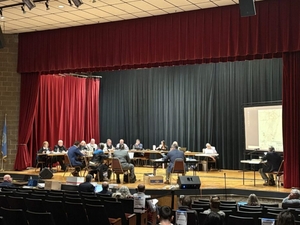
Photo courtesy of CT Mirror
The failure of Rep. Jill Barry, D-Glastonbury, to win the endorsement of local Democrats for a fifth term came six months after the left-leaning Working Families Party quietly identified the moderate lawmaker as vulnerable in a suburb where Donald Trump has become a catalyst for progressives.
A confluence of factors enticed a challenge from the left: notably, Barry’s habit of voting with Republicans against certain high-profile bills, including a gun-safety measure favored by many constituents; and Glastonbury’s shift from purplish to blue since Trump’s election in 2016.
A third and perhaps decisive factor was the decision of the local Democratic town committee to make the endorsement through a caucus open to any Democrat in the 31st House District — a method prone to upsets by a challenger backed by grass-roots organizers.
And last week, that challenger was Moise Carelus.
Carelus, 42, is a political newbie, a former teacher and youth soccer coach, married to a primary-care physician, Dr. Surayda Julissa Herrera. Each are products of immigrant communities on Long Island: Carelus’ parents are from Haiti; his wife’s emigrated from El Salvador.
His father, Cajuste Carelus, described himself as a refugee and exile in an interview with the New York Times in 1992, when he was the president of the Haitian Community Association in Huntington, N.Y. Moise Carelus said he grew up in Westbury, a home to struggling newcomers and, in Old Westbury, the Vanderbilts and Howard Stern.
“That’s not the part I grew up in,” he said, laughing.
Before entering school, he spoke Haitian Creole, a mashup of French and West African languages arising from the interactions of enslaved Africans and French colonists on the Caribbean island. Modeling his English after his teachers and the voices he heard on television, his voice has no trace of either Long Island or Haiti.
“I literally never heard my mom speak English until probably I was like 10,” he said.
His sister is a West Point graduate and veteran of Iraq. A brother, now a police officer on Long Island, also served in Iraq with the National Guard. Carelus was born in the U.S., but he lived in Haiti with his grandmother between the ages of 18 months and four, while his mother established herself after her relationship with his father ended.
Carelus and his wife chose Glastonbury for its schools when they moved to Connecticut nine years ago. The oldest of their two sons was 4.
“I feel like I was part of town politics, like in the super micro, or even nano, level before I moved here, because of my research in school districts and where was the best place to live,” he said.
Carelus, who had recently quit his job as an administrator at the Hartford Athletic soccer organization, was job-hunting when a friend, Michelle Riordan-Nold, suggested another path. He called the timing “kismet.”
“Her middle son is the same age as my older son,” Carelus said. “And she reached out to me and was like, ‘Hey, would you be interested in running against Jill Barry?’”
They discussed Barry’s voting record, including her vote against a budget last year that provided increased education funding for Glastonbury. She was one of two House Democrats who voted with the Republican minority against the budget. The other was Rep. Chris Poulos of Southington, who had won his seat in a conservative district by a single vote.
Democrats unhappy with Barry had begun tracking her votes, and they plotted 20 bills on a spreadsheet that they say were at odds with her constituents. They included votes against paid family and medical leave, a mandate on private employers to offer sick time and a bill banning the sale of firearms easily converted to illegal machine guns.
A candidacy was born. A disparate group of Democrats unhappy with Barry coalesced into a coalition: younger moms angry at the gun vote, older people active in Indivisible and a smattering of others, some involved with the Working Families Party.
“Folks had been meeting and bringing in other people in the community — many of which, honestly, are generally aligned politically but are not particularly politically active in various ways,” said Sarah Ganong, the state director of the Working Families Party.
Riordan-Nold said organizing around Carelus was a vehicle for residents deeply unhappy with Trump’s return to power.
“I have a group I’ve been geting together with since November 2024,” she said. “This is a group wanting to know how can we change things.”
Last Thursday night, they turned out 59 Democrats who voted for Carelus at the open caucus. Barry, who flipped an open Republican seat in 2018 and was unopposed two years ago, managed to bring only 35.
A week later, Barry remains silent on whether she will petition to force a Democratic primary or run as a Republican, an option that legislators in both parties say they believe was offered to her the same night Democrats declined to endorse. Barry left the Democratic caucus for a GOP meeting, where she was welcomed.

Marion Terry, the Republican town chair, could not be reached to confirm the GOP ballot line is Barry’s. Sarah Dzialo, a Republican, announced her candidacy for the seat in a posting on Facebook.
Barry has not returned phone calls or text messages from the Connecticut Mirror since last week. House Speaker Matt Ritter, D-Hartford, said he has not spoken to her about her plans.
Tyler Van Buren, a Democrat in Glastonbury, likened the political shifts in Glastonbury to those seen in Fairfield, one of the well-to-do suburbs that now vote reliably Democratic.
Barry’s predecessor in the House was a Republican, a popular allergist, Dr. Prasad Srinivasan. He was reelected with 68% of the vote in 2016, the last year he ran. Hillary Clinton carried Glastonbury over Trump that year, but every down-ballot Republican outpolled Democrats in town.
Glastonbury was one of the suburbs where Democrats flipped control of town councils in 2017, the year after Trump won the White House. The dynamic repeated itself in nearly 30 other suburbs in 2025, the first general election after Trump regained the presidency.
“We were red, then purple and now blue,” said Riordan-Nold, the friend who urged Carelus to make a challenge and signed up as treasurer of his campaign committee, Carelus for Us.
The district is 78% white, 8% Latino, 2% Black and 12% listed as other.
Newcomers to Glastonbury tend to be higher income and college-educated, a demographic that tends to vote Democratic. Twenty years ago, Democrats barely outnumbered Republicans, 6,546 to 5,971. By the last statewide election in 2024, Democrats had added more than 2,000 voters, while Republicans shrunk by more than 200.
Trump lost Glastonbury by 18 percentage points in 2016, 26 points in 2020 and 25 points in 2024. Riordan-Nold said the Trump years inspired activism at the local level, an energy that eventually became directed toward Barry.
Nick Paindiris, a former Democratic chair who supported Barry, said, “Things have changed. It’s a much more progressive town committee.”
He noted that 14 of Glastonbury’s 24 delegates to the Democratic state convention voted for Josh Elliott, the liberal lawmaker challenging Gov. Ned Lamont.
“So, the progressives are in charge of Glastonbury, without any doubt,” Paindiris said.
On every Saturday, he said, there are 30 to 50 activists in small park at the corner of Hebron Avenue and Main Street against ICE or other issues. The town has had its own No Kings Day events outside Town Hall.
Hartford, CT