Fuquay-Varina seeks new water source due to growth, drawing opposition
Apr 13, 2026 | 4:33 pm ET
Description
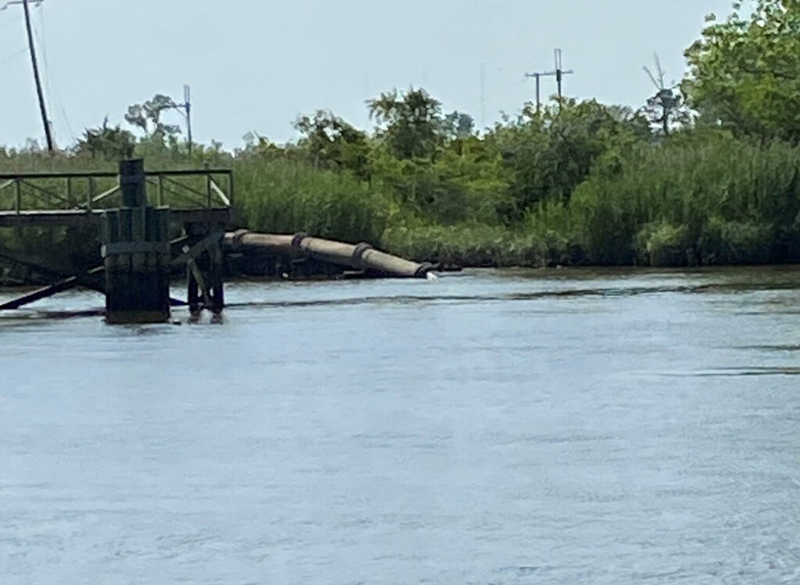
A pipe deposits water from upstream and discharges into the Cape Fear River in Wilmington. (Photo: Lisa Sorg/NC Newsline)
North Carolina’s population is growing quickly in metro areas like the Triangle, and that means more demand for water in towns like Fuquay-Varina.
While Fuquay-Varina, located a bit south of Raleigh, sits on two river basins, the town doesn’t have its own water source. At the moment, Fuquay-Varina buys wholesale water from Raleigh, Harnett County and Johnston County, according to the N.C. Dept. of Environmental Quality.
But the town’s current contracted water supply isn’t enough to meet projected future demands, so Fuquay-Varina wants its own permanent water supply.
Fuquay-Varina is requesting an Interbasin Transfer Certificate from the state, asking for approval to pull 6.17 million gallons per day from the Cape Fear River Basin, but release its treated wastewater into the Neuse River Basin. This would cost the town about $200 million less than returning the water to the Cape Fear River Basin, according to the environmental impact statement included in the request.
North Carolina law doesn’t allow systems to remove water from one river basin and put it back into a different river basin without permission from the state, because doing so reduces the volume of water available to downstream users in the donor basin and can be harmful to wildlife.
Lawmakers and environmentalists are pushing back against the proposal.
A bipartisan group of state senators whose districts collectively represent southeastern North Carolina wrote a letter to the state’s Environmental Management Commission on March 31 opposing the request. The Cape Fear River Basin is pivotal to their communities, they said.
“Nearly one million North Carolinians rely on this river for drinking water, jobs and quality of life. Permanently removing that water puts our communities and our future at risk,” Senate Majority Leader Michael Lee (R-New Hanover) wrote in an April 6 social media post. “We support responsible growth, but not at the expense of southeastern North Carolina.”
Lee did not respond to NC Newsline’s request for comment.
The University of North Carolina at Chapel Hill is currently studying surface water transfers in the state. The Southern Environmental Law Center wants the Environmental Management Commission to delay considering the certificate until the study is finished. In its public comments on the issue, SELC described the framework for considering surface water transfers as “outdated.”
The approval process currently includes an environmental impact statement. But Blakely Hildebrand, senior attorney at SELC, said it doesn’t present a “comprehensive or thorough” review of the proposal’s overall effects on surrounding areas.
“We are concerned about water quality implications as well as impacts to species and ecological flows, and the [environmental impact statement] does not get into any detail whatsoever on those key concerns,” she said.
Environmentalists have suggested the state should require Fuquay-Varina to return the water it draws from the Cape Fear River back to the Cape Fear. They say that would allow the town to use the water it needs for its growing population and mitigate harms to downstream communities by replacing treated water, although it would cost the town more.
“We support water within a hydrological unit staying within its watershed,” said Samantha Krop, Neuse Riverkeeper and advocacy director at Sound Rivers, Inc. “We ask for thoughtful consideration of how the town can grow but exist within the carrying capacity of our watershed, rather than seeking to pull water resources from other locations.”
Pulling water from one river basin into another can also damage aquatic ecosystems. Some species are endemic to the Neuse River Basin but don’t live in the Cape Fear Basin, Krop said. In particular, Middle Creek is home to several endangered species, like the Carolina madtom — a small catfish native only to the Neuse and Tar River basins.
“They’re already experiencing a lot of negative impacts from urbanization and stormwater runoff,” Krop said.
The public comment period for the transfer request closed on April 1, and staff at DEQ’s Division of Water Resources are reviewing the data to present to the Commission’s Water Allocation Committee in May, according to DWR public information officer Laura Oleniacz.
Raleigh, NC