Ford and Lombardo aren’t leading Nevada’s data center debate. They’re just trying to navigate it.
Sep 24, 2026 | 9:38 am ET
Description
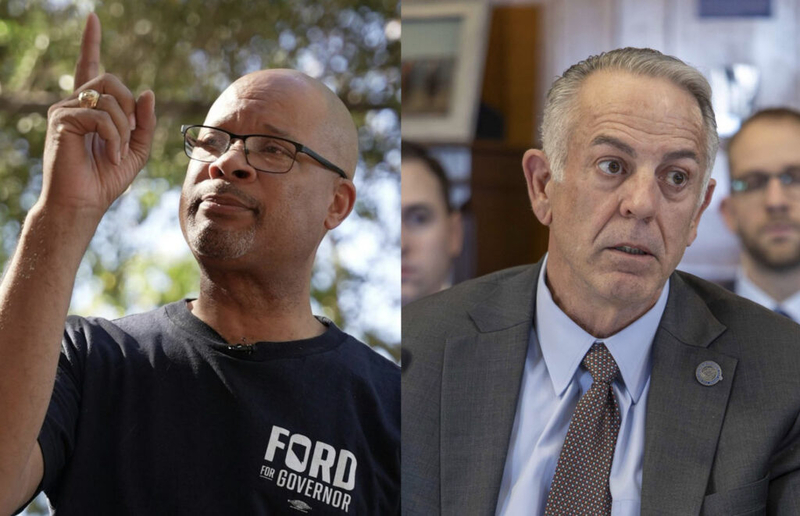
On data center tax breaks, as on economic policy in general, there isn't much daylight between Lombardo and Ford. (Photos: Ford's campaign; Lombardo's office)
Both Republican Gov. Joe Lombardo and the Democrat hoping to unseat him, Attorney General Aaron Ford, have been playing catch-up on data centers. Their positions have been reactive and unimaginative. It’s as if their hearts aren’t in it.
Most of the Nevada press, and some national outlets as well, generously gave Lombardo ad-ready headlines last week about the governor announcing “guardrails” on data center development.
Under an executive order accompanying Lombardo’s announcement, existing data centers would continue to get all the tax breaks they’ve always received, but new data centers would only get most of them.
Why remove just one slice of data center tax breaks. Why not toss out the whole tax break pie?
The order also creates a “community support commitment” under which new data centers wouldn’t be eligible for all those remaining tax breaks unless the facilities minimize water use and don’t stick the public with higher electricity bills.
Why tie those conditions to tax breaks? Why not just require data centers to meet those conditions or they can’t build in Nevada, period?
If we take Lombardo at his word, the answer to the aforementioned questions is in the second “WHEREAS” of his executive order:
“…data centers are the means by which Nevada will meet an unprecedented challenge and realize an unprecedented opportunity, one of the most significant for economic growth and fiscal diversification this State has seen in a generation…”
He seems genuinely all in.
But over the summer, Lombardo also seemed genuinely all in on the proposition that Nevada already had excellent guardrails to protect the state’s resources and citizenry from any ill-effects caused by data centers.
“You’ve probably seen stories in the news about local residents in other states reporting low water pressure or huge spikes in their energy bills after a data center gets built,” Lombardo wrote in a guest column for the Reno Gazette-Journal in June.
“But the truth is, it isn’t happening in Nevada – because we’ve made it clear that companies investing in Nevada must do so in a way that protects our resources, our communities and our quality of life,” Lombardo wrote, referencing requirements companies must meet to get tax breaks.
Two months later, in correspondence with Democratic U.S. Rep. Dina Titus over concerns about the state’s regulatory role regarding potential data centers on federal lands, Lombardo again gushed over the state’s wonderful process for permitting and awarding tax breaks to data centers.
“Abatements are an effective tool for attracting job creating projects that strengthen and diversify Nevada’s economy,” Lombardo wrote to Titus while failing to address her specific questions. “As you are aware,” Lombardo continued, “processes at the state and local levels have a high degree of transparency and offer significant opportunities for public participation and feedback.”
But Nevada must not have really “made it clear” to companies that they must do no harm.
And Nevada regulatory processes, let alone those dealing with tax breaks, must not have had such “a high degree of transparency” after all.
Or at least not enough to crow about while trying to neutralize a hot-button campaign issue.
Hence the governor’s executive order last week.
Ford, as you’ve no doubt heard and seen in countless attack ads by now, sponsored the original data center tax break bill enacted in 2015. (What you might not have heard, because it isn’t included in the attack ads against Ford, is that Republicans controlled both houses of the state Legislature in 2015 and the bill passed the state Senate unanimously; to reiterate, in 2015, Anthropic, OpenAI, and hyperscaling weren’t household terms.)
Ford had to be dragged kicking and screaming back to the data center issue over the summer, declining to answer a question about tax breaks in June, and saying “I will continue to look at this” in July.
But by August, scrambling just like Lombardo (and politicians coast to coast) to gain a toehold on the issue, Ford called for a pause on approving data center tax breaks until the effectiveness of the tax breaks could be reviewed.
At the same time, Ford released a “Data Centers Accountability Plan” outlining conditions data centers would have to meet to qualify for tax breaks. It could have served as a template for Lombardo’s executive order last week, except without the Lombardo campaign’s laughably gimmicky inclusion of eliminating one portion of the tax breaks.
And so once again we find that all the rhetoric and the breathless ads notwithstanding, on data center tax breaks, as on economic policy in general, there isn’t much daylight between Lombardo and Ford. Both say they want to use tax breaks to make data centers behave.
It can’t be said that either candidate is shaping the state’s data center discussion. They’re merely navigating it
Perhaps the discussion could be opened up a bit.
For starters, let’s never forget that data centers are being built to meet the demands of a tiny band of oligarchs. The fabulousness of their wealth is exceeded only by the creepiness of their personality disorders and the arrogance of their disregard for mere mortals who work for a living.
Instead of counting on tax breaks to coax good behavior out of data center owners, operators, and the oligarchs driving the data center infestation, demand good behavior. Stop giving them tax breaks, and penalize bad behavior with heavy penalties and fines. The AI-driven data center industry can afford it.
Instead of giving data centers tax breaks, tax them more. Gaming, mining, insurance … Nevada has a long history of imposing industry-specific taxes. Create and impose one on data centers. Again, they can afford it.
And it wouldn’t be a bad idea to make data centers owners post substantial reclamation bonds up front, just in case somebody cracks the cold fusion nut or otherwise renders them obsolete.
Ford and Lombardo may feel they’ve charted courses that will safely traverse data centers as a campaign issue. Maybe they have. But neither candidate comes anywhere close to adequately confronting the actual problem, let alone the deplorable tech lords who are inflicting it upon us.
Las Vegas, NV