Bring transparency back to Colorado courtrooms
Sep 24, 2026 | 5:30 am ET
Description
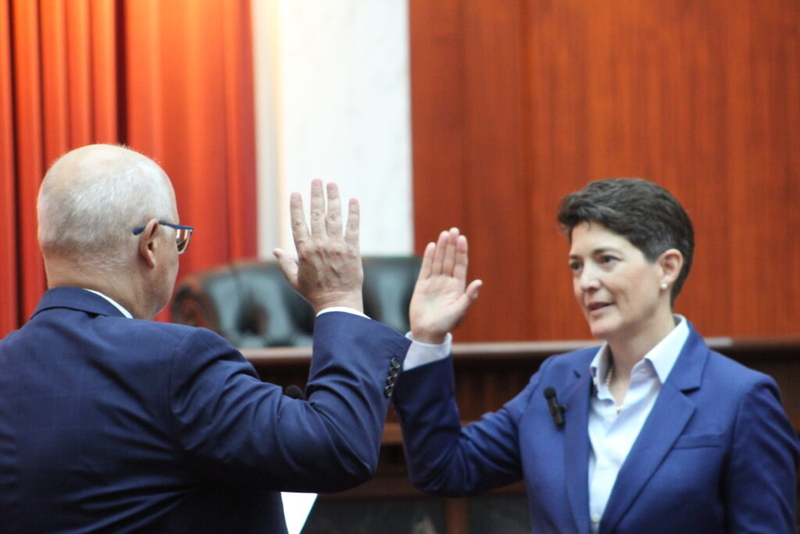
Former Colorado Supreme Court Chief Justice Brian Boatright swears in Chief Justice Monica Márquez in a private ceremony July 26, 2024. (Colorado Judicial Branch)
Colorado law says state criminal courts must offer livestreams of their proceedings, but the state’s top judge has little use for that mandate.
Citing abuse of the livestream feature, Monica Márquez, the chief justice of the Colorado Supreme Court, last week ordered a 90-day pause on the requirement that courts livestream their proceedings. It was a sweeping, unilateral elimination of transparency, which was especially alarming given that the activities at issue involve the awesome power of the state to deprive residents of their liberty.
Márquez’s very authority to take the action is uncertain. The law describes various circumstances under which a court might be exempted from the livestreaming mandate, but those circumstances are supposed to be evaluated on a case-by-case basis, not as part of a blanket directive to every court. The law explicitly says its livestream requirements “supersede any … judicial guidance, or chief justice directive limiting remote public observation of criminal courts.”
Márquez appears to acknowledge her own act of pulling rank in brushing aside the Legislature when in her directive she protests that the state constitution gives her “superintending” control of Colorado courts. In other words, “You think state laws will stop me? Go ahead and try.” Her directive could be legally challenged, but the case likely would end up before Márquez’s court, and the outcome’s not hard to foresee.
So what about the problem that prompted the pause?
It’s real. Viewers are strictly forbidden to record livestream audio or visuals. But unscrupulous users have repeatedly violated that rule, and they regularly post recordings to social media.
“The livestreaming technology that was intended to promote access to the courts has been subverted as a tool of disruption, disparagement, harassment, and private economic gain that is rapidly eroding the proper functioning of our system of justice,” Márquez wrote.
Participants in legal proceedings are due fairness and safety. Illegally recorded hearings have included derogatory comments about participants, threats and other conduct that would never be permitted in person.
“I cannot overstate the negative effects of this activity on our courts over the past two years,” Márquez wrote. “Hearings and trials have been thrown into disarray, delaying routine processes and preventing the efficient administration of our system of justice.”
That’s unacceptable, and a solution is necessary.
Jeff Roberts, executive director of the nonprofit Colorado Freedom of Information Coalition, has some ideas. He notes that Colorado district courts already offer permission-granted access to case filings in civil and other matters through the judicial branch’s Remote Public Access Terminal. Members of the public can request access by signing a user agreement and providing basic biographical information, such as name, email and phone number.
“What about having something similar for this?” Roberts asked.
Such a system to grant access to court livestreams likely wouldn’t eliminate misuse, but it could significantly deter it.
In her directive, Márquez said the judicial department needs time to consider better ways to manage online access, and she invited input from other “stakeholders.” Roberts wants in.
“We would like to be part of the conversation over the next 90 days to try to work out a solution,” he said, adding, “We’re not discounting the fact that there’s a problem, and that we want to find a solution to that problem.”
He wouldn’t be surprised to see legislators revisit state law around livestreamed court proceedings when they reconvene in January.
Open courts are among the features that characterize a free society.
“It is the public policy of the state of Colorado to maximize transparency and accessibility of criminal court proceedings,” says the bill that established the livestream requirement. “All Coloradans benefit from consistent, predictable access to observe criminal court proceedings remotely.”
This is all the more important as the number of Colorado reporters, who often serve as the public’s eyes and ears in the courtroom, dwindles. Remote access helps ensure shrinking newsrooms can inform communities about cases they care about.
“This is a really important tool for making sure there are more eyes on the judicial system, and to make sure that the courts get adequately covered by journalists, because it’s so difficult these days for overloaded journalists to cover everything they need to cover,” Roberts said.
Márquez says she’s committed to providing public access to Colorado courts. The next several months will be a test of that commitment.
Denver, CO