Finger-pointing abounds from Michigan House, Senate leaders as July 1 budget deadline looms
Jun 18, 2026 | 3:55 pm ET
Description
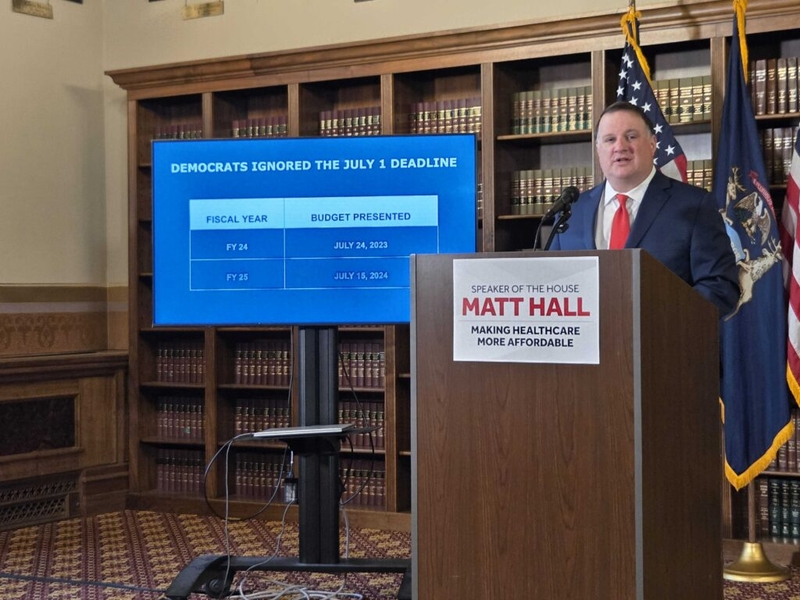
Michigan House Speaker Matt Hall (R-Richland Township) addresses reporters in Lansing. June 18, 2026. | Photo by Ben Solis/Michigan Advance
As Michigan lawmakers race toward a July 1 budget deadline, leaders in the House, Senate and governor’s office are increasingly blaming one another for slowing negotiations, even as they insist a deal remains within reach.
Budget negotiations had been progressing, but are slowing down as Michigan inches closer to July 1, the statutory deadline to have a budget presented to Gov. Gretchen Whitmer. That target is the ideal for schools, who start budgeting and begin the new fiscal year before the start of each school year in the fall, although the deadline has no real consequences for the lawmakers who often miss it.
The Legislature has missed the target for the last several years, both during divided government and single-party rule. Last year’s budget fight went past the Oct. 1 constitutional deadline, resulting in a brief, hours-long government shutdown. Prior to that, the Democratic trifecta that controlled both chambers and the governor’s office, didn’t present the full budget to Whitmer until at least two weeks after July 1.
That said, this year’s budget fight has the potential to yet again go down to the wire, and the status of the current negotiations has been up in the air. Lawmakers and legislative staff who spoke to Michigan Advance over the past few weeks have said that there was demonstrable progress being made up until last week, and that Whitmer had been involved in the discussions.
GOP Property tax proposal emerges as sticking point
Democrats have said that the holdup was a large property tax reform proposal from House Speaker Matt Hall (R-Richland Township). Gongwer News Service, an insider Capitol news publication, reported on Wednesday that the delay was Hall’s problem and that her team had been actively talking to the speaker about his property tax plan, but that she essentially called it a nonstarter.
Hall, in a press conference on Thursday, called that reporting into question, however, and said that this week was the first time that he and Whitmer’s team had a substantial conversation on the property tax proposal, and that the conversation unlocked a path to actually putting it on the negotiating table.
Hall has for the last several months touted his working relationship with Whitmer and trumpeted that there was a potential for the governor and the speaker to work out a deal if the Senate was unwilling to come to the table. At the same time, Hall has said that it would take all three of the respective leaders — including Senate Majority Leader Winnie Brinks (D-Grand Rapids) — to get a deal done.
Whatever progress had been made appears to have stalled as of last week.
That was evident as Hall, in his June 11 press conference, said he would be willing to let budget talks lapse past the July 1 statutory deadline and even potentially past the Oct. 1 constitutional deadline. Hall insinuated then that he would consider a four-month continuing resolution to keep spending at its current levels in the upcoming 2026-27 fiscal year, and negotiate a complete fiscal year budget in the early months of 2027. That scenario would require Michigan voters to have, by then, elected a Republican governor, elected another GOP House majority and moved the Senate’s Republicans into a position of power.
When asked how they felt about that proposition, a spokesperson from the Senate Democrats declined to directly comment on Hall’s commentary, but also pointed to last year’s protracted budget fight and the possibility of facing one again. Senate Democrats also said they were committed to reaching the July 1 deadline.
Hall’s willingness to miss both deadlines also came to a shock to those who noted that last week was the first time in this year’s process when the respective negotiators were starting to feel some doubt that lawmakers wouldn’t meet the July 1 target.
On Thursday, during this week’s press conference, Hall again noted that the Democrats failed to meet the July 1 deadline both in 2023, when a budget was presented to the governor on July 24, and 2024, when the Legislature presented a budget to Whitmer on July 15.
He also shifted gears on how well his office was working with Whitmer and her staff on the budget. Whitmer is currently on an overseas economic mission, similar to one she embarked on this time last year. In 2025, Hall refused to criticize Whitmer for being out of the state during the budget battle, which ran counter to those in his caucus who castigated the governor for being absent at a critical time.
Hall on Thursday said there was a reason for that — several of the bigger negotiating decisions were either hammered out or on their way to be hammered out before she left on last year’s trade mission. However, he asserted that was not the case this year, saying that he had not spoken with the governor on property tax until this past weekend, and that State Budget Director Jen Flood was not authorized to speak on budget matters in Whitmer’s absence.
A phone call and a text message requesting comment from the State Budget Office were not returned at the time of publication. This story will be updated once a comment is received.
Hall said all three of the principal negotiators needed to get together in a room to hash out a deal if it was going to be meaningful, but the House has its priorities.
“How much money are we going to raise in taxes? We’ve seen all the Democrat proposals from the governor to raise $800 million in new taxes,” Hall said. “The governor and I and Winnie Brinks haven’t figured that out. My position is no taxes, but you’ve got to figure that out. And the third piece is, are we taking money from the rainy day fund? The Senate Democrats and the governor both proposed taking hundreds of millions of dollars out of the rainy day fund to our budget, so without really those three pieces of critical information, no one else can work around that.”
Seeing a new lapse in his working relationship with Whitmer, Hall pivoted to a position of potentially making a deal with the Senate without the governor at the table if the holding pattern continued once she returned.
“I will say that from the meetings and conversations, I do see the Senate Democrats as more serious about trying to make a deal right now than the governor’s office, which is in a holding pattern until the governor gets back sometime later this week,” Hall said.
In an interview with the Advance, state Sen. Sarah Anthony (D-Lansing), chair of the Senate Appropriations Committee, said she agrees with Hall that all three arbiters need to be at the table. She also poured cold water on the assertion that the Senate was ready to make a deal with Hall outside of those bounds.
Still, Anthony was hopeful that a deal could be made by July 1.
“Regardless of the speaker’s appetite today to work with the Senate and tomorrow to work with the governor, it requires consensus among all three,” Anthony said. “I do think we can get this done. The pieces are on the board. We have found areas of alignment, areas of disagreement. That’s what budget negotiations are all about.”
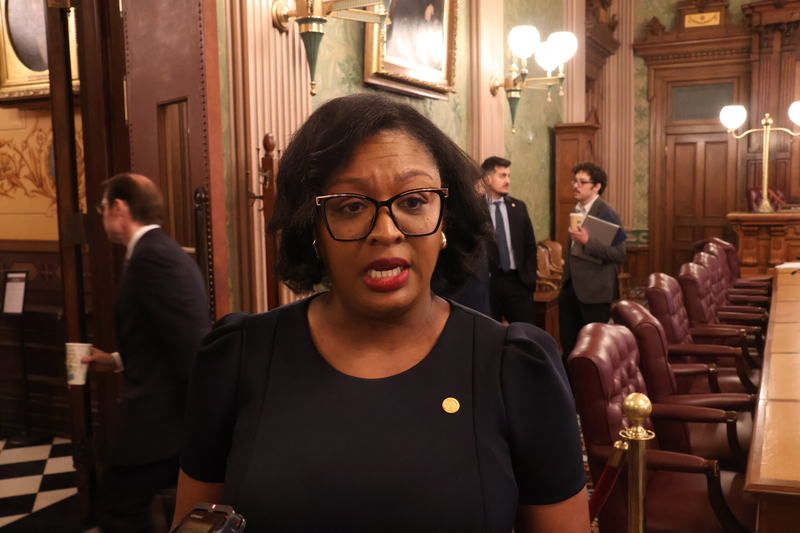
Anthony also agreed with what the Advance had heard regarding the status of the negotiations — that all three parties have been actively talking, both at the staff level and the leadership level.
“Even when the governor is out of town, there’s still plenty of work that gets done,” she said. “It’s unreasonable to think that the governor would be a part of every single conversation. That has never happened. I know she’s probably briefed. Last year, we were in the same boat. Things got done, so I don’t see this as an impasse.”
Anthony also rejected the premise that the property tax piece was the only major priority holdup in the negotiations, as both sides could say that about any number of policy issues that need funding this year. Anthony brought up the Senate’s continuing push to subject the governor’s office and the Legislature to the bounds of the Freedom of Information Act, which Hall has resisted.
“We could come in and say that FOIA is the most important thing to us, and if that doesn’t get done … we can say a lot of things,” Anthony said. “It’s one part of a larger conversation. Property taxes are something everyone in Michigan is concerned about; they’re also concerned about clear air and water, and healthcare, and making sure kids eat breakfast and lunch each day.”
School leaders warn another late budget would be costly
While Hall, Anthony and Whitmer continue working on the budget and contemplating potentially meeting the July 1 deadline, the stakeholders most affected in the lag would be Michigan’s K-12 schools.
Robert McCann, executive director of the K-12 Alliance of Michigan, told the Advance that the speaker’s initial assertion that he would let the budget talks lapse because negotiations weren’t producing the outcome he wanted was “infuriating for every educator across the state.”
McCann added that planning for a budget lapse or a continuing resolution this early on was worse, possibly, than inaction from the Legislature to get a deal done.
“We had 60-some superintendents up at the Capitol to talk to legislators and say, ‘you’ve done real damage to public education in the state by not getting a budget done until October last year,” McCann said of the fallout schools are still experiencing from last year’s fight. “Doing that again would be catastrophic for school when you don’t have budgets in place. Remember, all schools are working with their school boards right now to pass their own budgets because they have to, and they take their responsibility seriously — unlike the Legislature.”
Lansing, MI