Population decline erodes quality of life in rural Kansas counties as property tax base shrinks
Oct 29, 2026 | 6:46 pm ET
Description
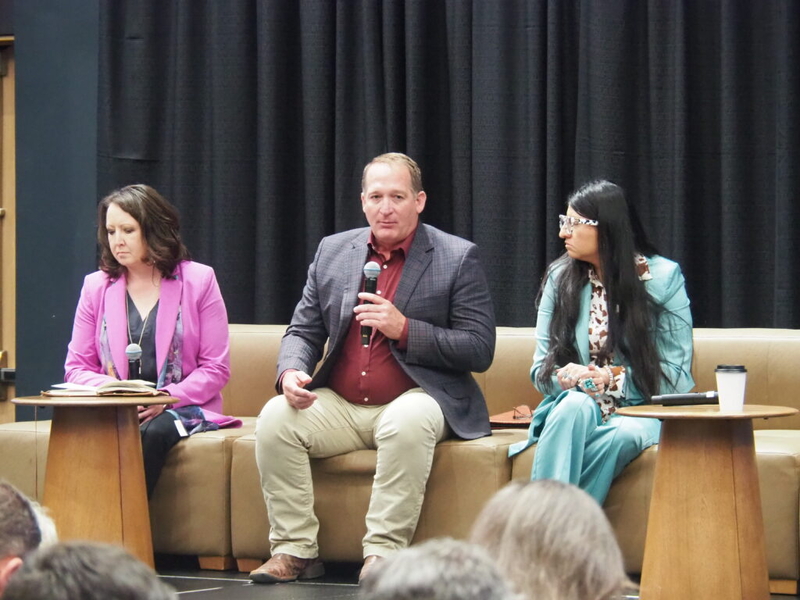
Rural economic development specialists, from left, Shonda Anderson, director of the Kansas Office of Registered Apprenticeship; Scott Sproul, president of the Northwest Kansas Economic Innovation Center, and Deb Minkler, executive director of the Northwest Planning and Development Commissioner, discuss the issue during a conference at the University of Kansas. (Photo by Tim Carpenter/Kansas Reflector)
LAWRENCE — Former state Rep. Josh Svaty says decades of declining population makes it impossible to rely on property tax revenue to finance local government in rural Kansas.
The U.S. Census Bureau says 78 of the state’s 105 counties lost population since 2020, a trend that replicated shrinkage in 80 counties during the previous decade. Population losses and the resulting financial struggles within local government gradually undermine the ability of communities to deliver housing, child care, healthcare and other quality-of-life amenities demanded by residents.
“We’re at sort of a crisis point,” Svaty said. “As long as you have growth, you have property tax base growth and it can pay for the services that you want for your community. In areas that have extended contraction, the model is full-blown broken. It simply can’t keep up.”
Svaty said rural communities were vulnerable to mandated, expensive infrastructure projects. It would be impossible to split the cost of a $30 million water treatment plant among a town’s 400 residents, he said.
He shared his theory during the 2026 Kansas Economic Policy Conference at the University of Kansas. Participants delved into the fate of the rural economy as well as the influence of artificial intelligence, role of university research and entrepreneurship, and the state’s technology and manufacturing future.
Shonda Anderson, director of the Kansas Office of Registered Apprenticeship, said she appreciated Svaty’s perspective that property tax revenue could no longer sustain communities.
“I’m going to come out and probably be the one that everybody gets angry at, but I would agree with that,” she said.
Anderson said another key to the viable future of communities was creation of a reliable workforce to serve companies in rural Kansas. Placing young people in apprentice programs allowed them to support their own post-secondary education without taking on massive student loan debt, she said.
Current strategy
Scott Sproul, president and CEO of the Northwest Kansas Economic Innovation Center, said the core objective of the 26-county entity was to advance economic opportunity in an area comprising one-fourth of the state’s land mass but a mere 8% of the state’s population. He said another answer to the problem of depopulation was investment on high-speed internet and other technology enabling folks to work remotely in Kansas.
“The outmigration from the (Colorado) front range to Kansas, because of the way of life we have in Kansas, has been really productive,” he said.
In response to a moderator’s question, Sproul said the federal crackdown on immigrants living in Kansas had a negative impact on business stability. Agents with the U.S. Immigration and Customs Enforcement swept into southwest Kansas in September.
“We’ve talked to the economic development directors there,” Sproul said. “It’s been a real challenge for them to have security of their workforce. Some of these communities that know how to integrate populations, I think, they should continue to do so.”
Deb Minkler, executive director of the Northwest Planning and Development Commission, said the 18-county organization was involved in construction and rehabilitation projects that addressed the critical shortage of housing in rural Kansas. The first question asked by prospective residents was about housing, she said, and the second was about access to daycare.
“I can see where we need to keep that strength to get our youth back,” she said.
Another options
Svaty, who was grew up in Ellsworth, has a business serving interests of wind, solar and, more recently, data center developers. He said the injection of capital tied to data centers could change the fortune of rural communities yearning for jobs and people. The construction of data centers would broaden the property tax base, he said.
“We are in a boom cycle with the build out of data centers and the associated generation needed to do that. We are 100% in it,” Svaty said. “It’s the only thing I’ve seen that really fundamentally alters the course that we’ve got, which is a century-long contraction of population across two-thirds of the state.”
He’s been part of the Google data center project in Barber County, which has a population of about 4,500 people. The tax structure of the county could be transformed by the Google project. Property tax revenue from the data center would be funneled to the K-12 public school district and county government, he said.
“It’s finally the thing that doesn’t just sort of dance around helping everybody’s residential property taxes,” Svaty said
A new statewide survey by Fort Hays State University indicated more than half of Kansans were concerned that data center expansion would trigger increases in energy costs and consume excessive amounts of water.
In 2025, the Kansas Legislature approved a bill granting developers of data centers a 20-year, 100% exemption on sales taxes for land improvements, buildings, equipment, remodeling materials, lease payments and maintenance labor services.
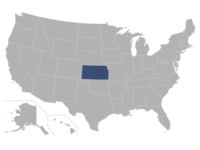
Topeka, KS