Lierman seeks another term, Dunn just wants an ear in subdued comptroller’s race
Oct 30, 2026 | 5:00 am ET
Description
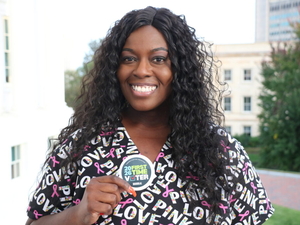
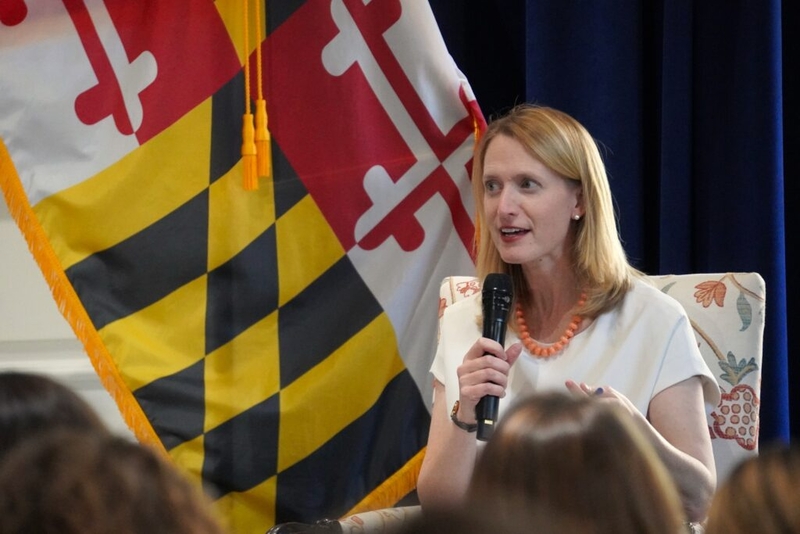
Comptroller Brooke Lierman invited women's advocates and laid-off federal workers to an Oct. 19, 2026, event to discuss a new report on how women fare in Maryland's economy. (Photo by Danielle J. Brown/Maryland Matters)
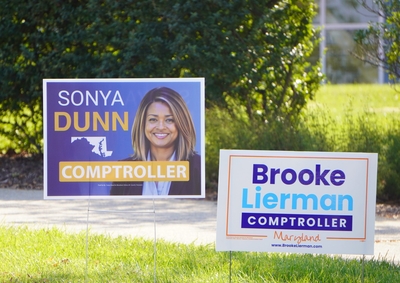
Republican comptroller nominee Sonya Dunn acknowledges she’s got her work cut out for her in her bid to unseat Maryland Comptroller Brooke Lierman (D), the first woman to hold the office when she was elected in 2022.
Dunn, a first-time candidate with little name recognition, has just a fraction of the campaign funds raised by Lierman, a two-term member of the House of Delegates and the daughter of a prominent Maryland Democrat. And besides that, Dunn has to cope with what she calls “the scarlet R” — being a Republican candidate in a deep-blue state.
“It is hard running with the scarlet R behind my name — I call it the scarlet R on my chest,” Dunn said in a recent interview. “But I’m trying to let people know that when you meet one Republican, you don’t meet every Republican.”
For her part, Lierman — who beat former Harford County Executive Barry Glassman, a Republican, by about 23 percentage points in 2022 — is looking ahead to expanding on the changes she’s made to the office in her first four years, including updates to the decades-old computer systems that Maryland uses to collect taxes and handle its payroll.
With a second term, she’s hoping to think bigger, she said.
“Now, we have a platform to jump off of and build from in my next term, so that we can really do big things, be imaginative, creative about how we can really make government work better for people and small businesses,” Lierman said.
Dunn, who describes herself as a moderate, fiscal conservative, hopes Maryland voters can see past the GOP. She also hopes that her background in IT services will make her a compelling alternative to Lierman, given the technological challenges faced by the comptroller’s office.
Dunn runs a technology and communications consulting company named JEMH Enterprises — for the first initial of each of her four children’s names.
“We can do better, Maryland,” Dunn said. “And I feel that I can bring what Maryland needs, especially from a technology standpoint in operations management, to get that on the right track.”
Lierman acknowledges that updating the technology that powers the comptroller’s office has been an arduous four-year battle. She brought on a chief information officer and other staff members, who she says have completed more than 100 information technology modernization projects in the past three years.
“That includes everything from rebuilding the fiber under our building that was so old it was breaking and we were losing connectivity, to moving 4 billion records from our old tax system to our new tax system,” Lierman said.
In early September, the state launched an upgraded Maryland Tax Connect website, which for the first time allowed individual taxpayers — not just businesses — to go online to file tax returns, make payments and check the status of their refunds. It replaced several internal systems that had been used for the better part of three decades.
Dunn points to complaints she’s heard from individuals and tax professionals with Tax Connect gripes, including about desired features that the system doesn’t offer. But Lierman argues she’s the perfect person to guide any continued work on the system.
“Now that we’re in that new system, we’ll be able to constantly improve that system and make it easier to use and simpler to use,” Lierman said.
Another focus for her presumptive second term will be reaching more low-income Marylanders with word that they are eligible to file for the “Earned Income Tax Credit,” which returns up to $4,000 per year to eligible filers.
Under Lierman, the percentage of eligible Marylanders to actually apply for the credit has been slowly climbing, from 84.2% in 2023 to 86% in 2026.
“The Earned Income Tax Credit is one of the most effective anti-poverty tools that the government has. It’s one of the few tools that actually helps with upward economic mobility in America today,” Lierman said. “We’ve got to make sure, though, that it is actually reaching the people who need it.”
Lierman said she’ll also be working to improve the state’s collection and auditing systems, to ensure that unpaid taxes are collected — especially as the state faces budget shortfall after budget shortfall.
In September, an audit performed for the legislature pointed to problems with collecting unpaid taxes, arguing that the comptroller’s office could be using tactics such as wage garnishments more frequently to obtain owed funds.
The audit identified 1,900 individuals with balances totaling $25.5 million who collectively earned $280.7 million during 2024 and 2025, but were not subject to wage garnishments.
Between fiscal year 2022 and 2025, the outstanding individual taxes owed to Maryland increased from just over $1 billion to $1.58 billion, according to the audit.
Lierman contends that, early in her tenure, she determined that her office needed more personnel, and better technology, to perform audits to uncover unpaid taxes. She argues that the office has come a long way.
These days, the comptroller’s office can scrape publicly available data to locate Airbnb owners, NFT sellers and others who aren’t reporting all of their income to the state government.
“We have done some of our first cryptocurrency capital gains audits in the agency’s history,” Lierman said. “We have really modernized our ability to audit.”
On the other hand, Lierman says she “fundamentally disagree[s]” with the audit’s contention that the office should be garnishing wages more frequently. The state has a duty to collect what is owed, Lierman says, but also to make sure that consequential enforcement actions against individuals and businesses are warranted.
Her office has prioritized other enforcement tools, like instituting payment plans and referring delinquent taxpayers to the Motor Vehicle Administration so they face administrative penalties, like being unable to renew their driver’s license.
“Our goal is compliance, not punishment,” she said. “We should not be in the business of bankrupting people. We should be in the business of helping make sure that they can stay open so they can pay what they owe.”
Annapolis, MD