Discussion of economic ‘headwinds’ in South Dakota includes falling labor force participation
Oct 29, 2026 | 6:29 pm ET
Description
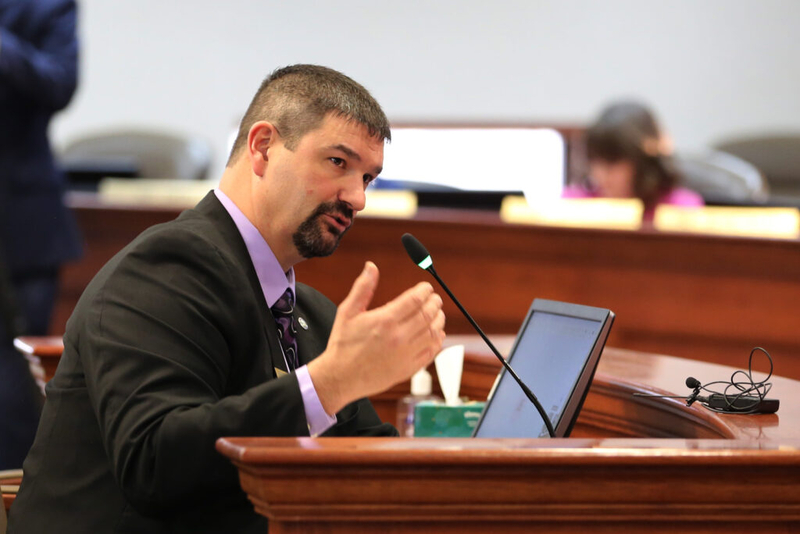
Jim Terwilliger, commissioner of the state Bureau of Finance and Management, speaks during a House State Affairs Committee hearing on March 4, 2026, at the South Dakota Capitol in Pierre. Terwilliger spoke with the Governor's Council of Economic Advisors this week. (Photo by Meghan O'Brien/South Dakota Searchlight)
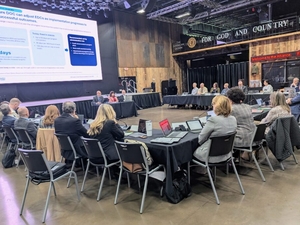
The South Dakota Governor’s Council of Economic Advisors discussed concerns Thursday about the shrinking share of residents in the workforce, struggling farmers and rising costs.
Jim Terwilliger, commissioner of the state Bureau of Finance and Management, said there are “some headwinds out there, no doubt about it.”
“But as we, I think, have shown historically in the past, some of those headwinds will come and go, but we’ve shown to be pretty resilient as a state,” Terwilliger told council members from across the state during their virtual quarterly meeting.
Labor force participation
The share of South Dakota residents 16 or older who are working or actively looking for work — known as the labor force participation rate — fell to 66.3% in September. That’s down from 68.2% in September 2025.
The number remains above the national rate of about 62%, but the recent dip accelerated a downward trend in South Dakota from a peak of 73.4% in 2003.
State Economist Derek Johnson said South Dakota also has at least three job openings for every unemployed person, with an unemployment rate of 2%.
The commissioner of the Governor’s Office of Economic Development, Bill Even, said part of the decline in workforce participation is due to an aging population. About one-quarter of South Dakota residents are over 60, and he said a quarter of residents over 65 are still working.
He said the state should emphasize automation and productivity in its future economic development strategy to help businesses.
“I think this presents a pretty big opportunity for South Dakota to rethink economic development here over the next couple of years, while we still have a little bit of time to get in front of these demographics,” Even said.
Farmers’ safety net
Council members discussed a recently announced $8 billion federal assistance package for farmers. The assistance is intended to help with high diesel expenses.
Evert Van der Sluis, a South Dakota State University ag economist, said the assistance comes as farmers face not only higher diesel prices but also higher fertilizer and equipment prices, plus drought and an uncertain export market.
Van der Sluis said the assistance could push annual U.S. federal farm payments up to about $55 billion, surpassing the previous record of roughly $45 billion in 2020.
That was during the COVID-19 pandemic, and Van der Sluis said it was “twice as high as had been the record before, which was in the neighborhood of about $29 billion. These are high numbers, in an absolute and relative sense.”
Johnson shared data showing that South Dakota farmers received about $1.1 billion in government payments for various programs in 2025, compared with $1.8 billion in 2020.
Rising costs, declining visitation
Brookings council member Carla Gatzke reported new construction is happening across the city. However, she said federal tariff policies are raising the cost of doing business for local manufacturers who import materials and must pay tariffs.
“This variability in tariffs, this up and down with Canada, impacts manufacturing,” Gatzke said. “A lot of metal is imported from Canada.”
Sioux Falls council member Shawn Pritchett reported sales tax collections were up through September. But he warned inflation is beginning to hurt consumer spending, as shown by softer concert ticket sales.
“I feel like the consumer is feeling inflation more now, and they’re pulling back,” Pritchett said. “The only consumer sector, I would say, that’s still robust is remote retail sales.”
Pritchett said people are “turning online, I think, to find cheaper prices, and obviously, for convenience.”
Higher prices are also taking a toll on tourism in the Black Hills. Council member Caleb Arceneaux of Rapid City reported that visitation to Mount Rushmore and Badlands National Park is down. He said regional visitor spending is also down, calling it “a pretty significant drop for us.”
Arceneaux said the Black Hills are “heavily dependent on the leisure traveler” and that “we’re really seeing the effect of energy prices on that visitor.”
He said visits from Canada fell about 35%, “so we’re seeing a lot less of that international travel from the north.” He added that the National Park Service lost 20% to 25% of its full-time staff in 2025 due to federal cuts, and “that’s creating some challenges,” too.
Arceneaux said Sturgis experienced a 24% decline in its “booze tax” collections, attributed to a “very soft” Sturgis Motorcycle Rally.
He said September sports betting in Deadwood was down about 31% year-over-year, driven by online prediction markets such as Kalshi that let users wager on almost anything, including sports.
“And of course, they say it’s not betting: ‘You’re buying a contract,’” he said. “But it’s very interesting that it would have such a tremendous effect on actual sports betting.”
Despite all that, state government’s fiscal-year general fund revenue of $704 million through September was about $350,000 above the state’s forecast, according to Johnson, who briefed the council on the state budget’s status.

Pierre, SD