Fighting for the New Orleans agenda during the 2026 legislative session
Mar 10, 2026 | 2:34 pm ET
Description
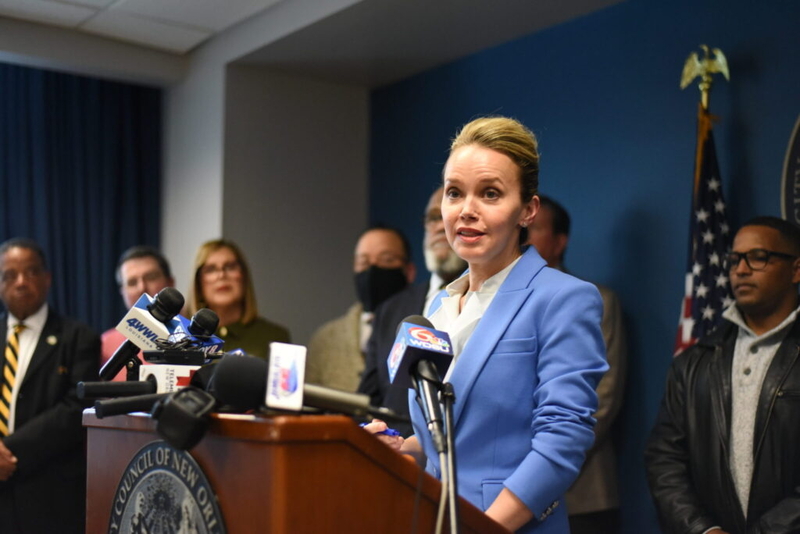
New Orleans Mayor Helena Moreno holds a news conference to discuss the city's 2026 legislative agenda. (Photo by Robert Stewart/Verite News)
As the Louisiana Legislature convenes in Baton Rouge this week, many battles will revolve around New Orleans.
While more than 1,300 bills have been filed statewide, a smaller group of proposals on finance, governance and public safety will help determine whether the city can finally stabilize after years of crisis.
At the center is Mayor Helena Moreno, whose specific legislative agenda is aimed at easing the city’s financial pressures, improving oversight of troubled agencies and strengthening public services. The outcome will test whether the state gives the city more flexibility or steps in more aggressively.
The biggest fights will involve New Orleans’ finances. Several bills address the city’s obligations to the Municipal Police Employees’ Retirement System and the Orleans Parish Communications District, which operates the city’s 911 system. City leaders say those costs are putting increasing pressure on the budget.
The police retirement system restructuring bill, House Bill 26, is by Rep. Aimee Adatto Freeman, D-New Orleans. The bill would make it harder for routine reductions in the size of the New Orleans Police Department to trigger large, immediate pension payments to the retirement system. City officials say the change would help prevent sudden costs that strain the city budget.
Another police retirement-related bill, House Bill 31, by House Republican Majority Leader Michael Echols, R-Bastrop, would allow cities to stop enrolling newly hired police officers in the pension system. Cities would still have to pay their existing pension obligations but could choose a different retirement plan for future hires. While the bill applies statewide, it could significantly affect New Orleans.
House Bill 463, by Rep. Dixon McMakin, R-Baton Rouge, would raise the monthly fee charged to cell phone users’ bills to fund 911 services. The bill would increase the cap from $1.25 to $2.00 per line. Supporters say the change could generate roughly $10 million annually for the Orleans Parish Communication District and strengthen emergency dispatch operations.
Tourism will also be a major focus of the session. Since tourism drives much of the city’s economy, control over tourism-related agencies means influence over significant revenue.
Senate Bill 286, by Sen. Royce Duplessis, D-New Orleans, would change the structure of New Orleans Downtown Development District Board. The bill would require board members to be confirmed by the New Orleans City Council, and dedicated district tax proceeds would go directly to the Downtown Development District, rather than the City Board of Liquidation.
Infrastructure problems are also driving legislation this year. After years of criticism over billing issues, power failures at pumping stations, and recent water main breaks, the Sewerage and Water Board is again under scrutiny.
A top priority for the mayor is House Bill 573, by Rep. Stephanie Hilferty, R-New Orleans. That bill would allow the City Council to make reforms to the S&WB without approval of the state legislature. Since the Sewerage & Water Board is a state agency, any changes in structure currently need to be done by the legislature. This bill would transfer that power to the City Council.
To promote economic development, the mayor’s priorities include a bill by Sen. Jimmie Harris D-New Orleans, Senate Bill 384, creating a “Pilot Innovation Hub,” which allows local governments to provide city-owned property to private industry for technology development and testing.
A controversial bill not on the mayor’s legislative agenda, but would have a large impact on the city, is House Bill 911, by Rep. Dixon McMakin, R-Baton Rouge. It would combine the Orleans Parish civil, criminal and juvenile courts into a single court system and reduce the number of judges. Supporters say the change would save money and improve efficiency. Opponents warn it would increase an already heavy case backlog and grind the criminal justice system to a halt. The mayor has not yet taken a position on the bill.
The 2026 session will be the first major test of Moreno’s influence, as the city’s mayor, at the state capitol. Although Moreno is a Democrat trying to influence a legislature where Republicans hold supermajorities in both houses, she is a former member of the Louisiana House of Representatives. The question now is whether she can use those relationships to advance legislation that stabilizes the city’s finances and increases local control over public infrastructure.
In Baton Rouge this spring, the question is simple: Will the legislature give New Orleans the tools it needs to govern itself more effectively, or will the city remain caught in recurring cycles of financial stress, infrastructure failures and public safety challenges? The answer could shape the city for years to come.
This commentary first appeared on Verite News New Orleans and is republished here under a Creative Commons Attribution-NoDerivatives 4.0 International License.

Baton Rouge, LA