Fed Chair Warsh vows to fight inflation even as new CPI report shows 3.5% rise
Jul 14, 2026 | 3:42 pm ET
Description
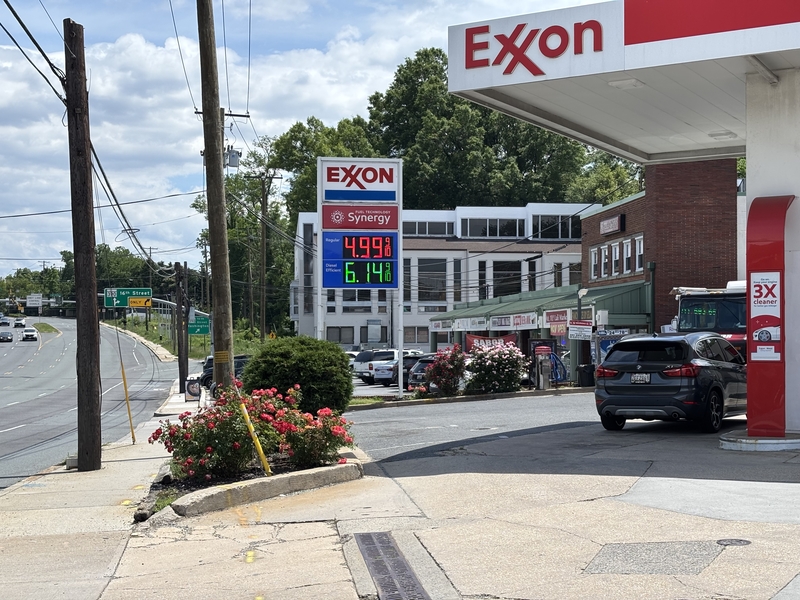
The new Consumer Price Index released on July 14, 2026, showed gasoline prices cooled, compared to $4.99 a gallon at this station in Silver Spring, Maryland, on May 17, 2026. (Photo by Jane Norman/States Newsroom)
WASHINGTON — Federal Reserve Chair Kevin Warsh promised Tuesday to “put these years of high inflation behind us” and lower prices, including mortgage rates, for everyday Americans as inflation remains at the highest level in two years.
Warsh appeared before lawmakers on Capitol Hill just after the government’s latest monthly inflation data showed a slight drop, led by falling gas prices as the war in Iran cooled.
But routine costs like food and fuel remain 3.5% higher compared to a year ago, a level of inflation last seen in May 2024, according to the Bureau of Labor Statistics’ Consumer Price Index for June. The report comes as the United States and Iran again ramped up the exchange of rocket fire last week in the Strait of Hormuz, a chokepoint for a significant portion of global oil.
The grilling by members of the House Committee on Financial Services marked Warsh’s first time before Congress since being confirmed to lead the central bank.
The nation’s top banker faced questions not only about inflation, but also how he plans to insulate the Fed from President Donald Trump, following the U.S. Supreme Court’s decision to increase the president's authority over agencies.
Warsh told lawmakers he will ignore political pressure and “follow the data” when deciding monetary policy decisions.
Warsh’s appointment was made after Trump’s long and public pressure campaign on former Fed Chair Jerome Powell to lower interest rates, and his firing of Fed Board Governor Lisa Cook. Trump also targeted Powell with a federal investigation over renovation costs, but eventually dropped the probe.
‘A potential second surge in inflation’
Financial Services Committee Chair French Hill, an Arkansas Republican, warned during questioning “a potential second surge in inflation is appearing due to factors outside the Fed. What the Fed can control is how it reacts.”
Hill said he was “encouraged” to hear Warsh commit to lowering inflation to the Fed’s target of 2%.
“Inflation affects Americans in the here and now, not in some hypothetical future composed of long-term projections. … How do you and your colleagues on the open market committee plan to accomplish that?”
Warsh said the Fed will examine interest rates and the central bank’s assets and liabilities to harness inflation.
“We have the tools to deliver that. So it's a function of commitment, responsibility, and tools, and we're three for three, and we'll deliver,” he said.
Hammering on the topic of high costs of living, Rep. William Timmons, R-S.C., said “the people I represent should not have to endure another sustained period of elevated inflation.”
Warsh said he agreed with Timmons’ “diagnosis” that American households and businesses have suffered an “undue hardship.”
“What I would also say is I’m not in the business of trying to prejudge what the (Federal Open Market) committee I’m honored to lead decides,” Warsh said. “I think we need to have a continued good family fight on this subject. That’ll start again in a couple of weeks, and when we have news for you about exactly the methods of solving this problem, we’ll be very clear about what they are and so will the American people.”
Communications with public
Several questions from committee Democrats centered on how Warsh plans to communicate with the public after he announced plans to pare back press conferences and announcements.
Rep. Nydia Velázquez, D-N.Y., asked Warsh if he can “commit today to creating a fixed public standard for which (Federal Open Market Committee) decisions and procedural changes trigger a press conference rather than deciding case by case which ones might be worth it?”
Warsh said it is “immediately important to think about reforms, including communications.”
“I don't expect any of the changing communications to be about hiding the ball,” he said.
Rep. Andy Barr, a Kentucky Republican, cited a Wall Street Journal article criticizing the “constant yammering, long policy statements and press conferences” to signal future policy moves.
“Chairman Warsh, why is it important to do away with the dot plot and end once and for all forward guidance?” Barr asked, referring to a graph displaying data as dots.
Warsh said his Fed will not share “every passing thought.”
“I think being somewhat more circumspect in our communications, at least for me, is a better way of calling balls and strikes,” he said.
Will he ‘follow the president’s wishes’?
Warsh also faced numerous questions from Democrats on his commitment to protecting the Fed from Trump’s attempts to interfere.
Rep. Gregory Meeks, a New York Democrat, said “If the president publicly pressures you to pursue a different course than the one you believe the economic data supports, will you follow the president's wishes or follow the data?”
“My commitment to you is to follow the law and follow the data, follow our very best judgment,” Warsh answered.
Meeks shot back: “Even if he publicly criticizes you for doing it? … Publicly criticizes you and tells you how disappointed he's in you and all of that? Will you still do what the data tells you to do? … You ready for that?”
“I'm ready to follow the law, and I'm ready for the Fed to deliver on the expansive remit that you gave us,” Warsh replied.
All States Newsroom content is free to republish. Read our republishing policy for more information.