Favoritism determining which security guards carry guns in Nevada, critics say
Jul 02, 2026 | 8:00 am ET
Description
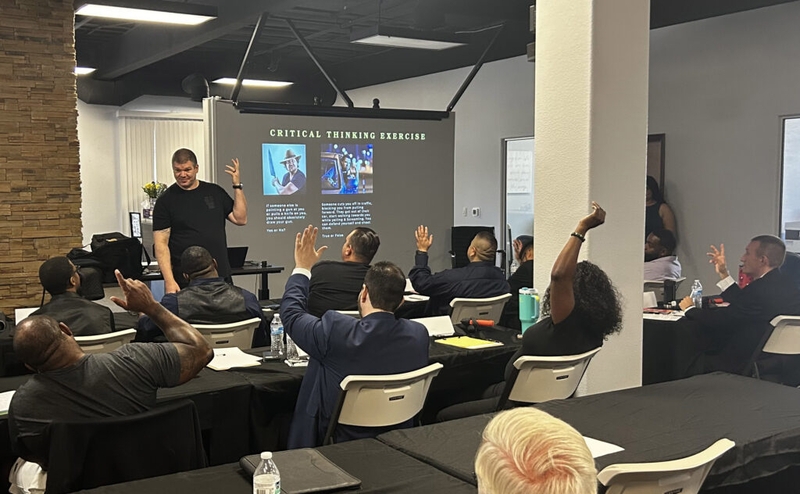
Certified firearms instructor Andrew Cowie speaks with students seeking to qualify as armed guards. (Photo: Dana Gentry/Nevada Current)
The state board that regulates security guards is throwing up roadblocks to advancement for guards seeking to become armed, based on a policy that doesn’t appear in law and was never formally adopted, say firearms instructors and students calling for changes to board policy.
The state Private Investigators Licensing Board should focus on safety rather than facilitating employment gatekeeping that is based not on merit but on cronyism, the students and instructors say.
Since at least 2010, the PILB has required guards who want to attend certified firearm training to become armed to first obtain permission from their employers. The process fosters tacit discrimination, especially against women and minorities, and is preventing qualified guards from earning as much as twice their current pay, say critics.
“There was a time I felt if I did not laugh at certain jokes, or boost someone’s ego, my career in this industry could be affected,” Finesha Thompson, an armed security guard whose previous employer denied her access to firearm training by refusing to sign a required employment verification form, told the board in June.
Having to seek permission to advance one’s skills gives employers too much power over employees, she says.
“If I flirted back, I’m pretty sure I could have gotten what I wanted,” Thompson told the Current. “It’s degrading. No woman should feel that her ability to provide for herself or feed her family depends on keeping an employer happy. That is not professionalism. That is power being used the wrong way.”
Andrew Cowie, president of the Nevada Association of Certified Firearms Instructors and CEO of Counterforce Solutions, says the PILB’s adherence to the policy is inconsistent. Cowie says when he initially inquired about the form, PILB Executive Director Vincent Saladino told him not to worry about it.
“The director printed out a version of a form without that requirement and said ‘go teach’. The next 60 people who wanted to train were able to come to me. And then the director said, ‘Hey, I made a mistake, you need to go back to doing it the other way.”
Saladino did not respond when asked about Cowie’s assertion.
In 2019, the PILB considered eliminating the form, according to board meeting minutes.
Instructors, Saladino said at the time according to the minutes, were opposed and voiced concerns that armed guards would show up for unarmed jobs, guards would seek employment outside the scope of their work cards by acting as independent contractors without the proper license, and people who are prohibited from having firearms may gain access to firearms classes.
Cowie says it’s up to the certified firearms instructor to teach “the legal limitations of licenses, the scope of their authority, and what they can and cannot lawfully do while employed. Restricting access to that training does not prevent unlicensed activity—it limits access to the very education designed to prevent it.”
Qualified individuals, Cowie says, “are being denied access to state licensure without due process, while private employers are effectively gatekeeping access to a state-regulated license.”
Cowie says the PILB’s “house is on fire.” On Tuesday, state lawmakers learned from Saladino that the state agency allows armed guards to carry shotguns and automatic rifles – weapons they are not permitted to carry on the job under Nevada law.
‘Barrier to advancement’
Employer-sponsored credentialing is not unique to security guards. Police-issued work permits, known as Sheriff’s cards, are issued to some hospitality employees and special events workers, and are only issued at the request of an employer. It’s the same for gaming establishment employees and real estate agents. But unlike the PILB employment verification, those prerequisites have been formally adopted.
Roughly 25,000 Nevadans are employed as security guards, according to the Bureau of Labor Statistics. They stand watch at day cares and schools, patrol synagogues and casinos, and shoo away homeless people seeking respite inside a McDonalds or hospital waiting room.
The U.S. market for armed security is valued at roughly $50.4 billion and employs more than 1.1 million officers. It’s expected to grow at more than 5% a year.
The card that allows security guards to be armed “is not just a piece of plastic. It represents rent, groceries, gas money, and taking care of our children. It represents our ability to survive,” Thompson said during public comment at the June meeting of the PILB. “The difference between making $13 or $15 an hour as an unarmed guard, and making $20 to $30 as an armed guard can completely change someone’s life.”
The employer verification requirement is “a barrier to professional advancement,” security guard Justin LeFleur told the PILB at the meeting. Applicants, he noted, can be denied a form “for a number of reasons unrelated to an individual’s qualifications, character, or ability to safely carry a firearm.”
The form must be reissued by an employer to armed guards twice a year for requalification.
“Every six months our careers, our income, and our ability to provide for our families can be placed back into someone else’s hands,” Thompson told the PILB. “Who do I have to smile at?” she quipped.
“Some guards who are in between jobs can’t get the verification form to come in and requalify,” says certified instructor Stephanie Costello of Archangel Solutions, who says she doesn’t have strong feelings about the requirement, but acknowledges it has drawbacks for guards. “They want to maintain their qualification standards but they can’t get that form. If they miss two requalifications in a row, they have to take the armed guard class all over again, and that’s expensive.”
The two-day course runs between $100 and $250, plus a $25 fee to the PILB.
Hugo Martinez took a hiatus from his job as an armed guard. When he came back, his employer refused to provide the form he needed to renew his license.
“Employers get to pick and choose their friends for those positions,” he said, adding cronyism poses liability issues and endangers the public. “They let qualified guards hang in the wind until they decide to sponsor them.”
“Security guards are going to their supervisors and saying ‘I want to go armed.’ They’re being told ‘You have to work for me for 90 days. You have to work for me for 12 months,’” Cowie told the PILB in December 2025. “Or they’re being told ‘You have to hop, skip, jump, leap, song and dance’ only to be denied at a later time.”
Saladino, the PILB director, acknowledged at that meeting the requirement is not found in Nevada Revised Statutes or in administrative code, and said the board was considering eliminating it.
Board chairperson Tammy Nixon, the regional vice-president of Allied Universal, the largest security company in America and one of the nation’s largest employers, said it’s her company’s policy to require that employees obtain permission to train, and suggested all companies have the option.
While Nixon “acknowledged that the State does not mandate these employer policies,” she “failed to address the practical consequence that employers are effectively deciding who may access state-required firearms training and certification,” says Cowie.
Nixon and other board members could not say, when asked directly by Cowie at the December board meeting, whether an instructor is breaking the law by accepting a student for armed security training absent the form.
‘This is illegal. I’m not doing it anymore,” Cowie said he told Saladino in December. “It’s discriminatory.’” Cowie now approves “anyone who is qualified for instruction, based on objective, not subjective, criteria.”
“I want to know who’s working for me,” Peter Nelson, the owner of a security company called On Watch, said in support of PILB’s current employment verification procedure during public comment in March.
Nelson added a proprietary suggestion that employees who train through his company be required to remain there. “If I do the training, you work for me solely. You can’t go to work for another company.”
Nixon, the chairperson and Allied Universal executive, commiserated with Nelson. “We provide training. We provide an academy for folks, and we lose them for the same reasons.”
Employees of Allied Universal, however, attribute high turnover to a lack of training, uncertain payment, and other conditions.
“I’m a single mom of five,” says Tiffany Brackens, an Allied Universal employee who says she’s been told she’ll have to work unarmed before she can train for an armed position. Brackens, in an interview, says she got the same pitch from Allied, her employer in California before she moved to Las Vegas. “I’ve been given the runaround. I want to move up in life and better myself, better my position for my family.”
Attorney Sagar Raich, who represents Cowie and the firearms instructors’ association, wrote to the board in May, demanding it take action.
“The individuals most harmed by this practice are working people, many of them in economically vulnerable positions, who are trying to meet the State’s own requirements for armed security work,” Raich wrote. “They cannot move forward in their careers not because they lack the qualifications, but because an employer has not signed a form.”
The policy, Raich asserted, “has created a systemic barrier to training and certification. Similarly situated individuals are treated differently based solely on the discretion of private entities rather than their competency or qualifications under Nevada law.”
Attorney General Aaron Ford’s office disagrees that the policy “constitutes an unlawful requirement or an unpromulgated regulation,” Deputy Attorney General Stephanie Itkin-Goodman wrote to Raich. “The Board maintains that its policies and procedures, including those related to firearms certification and armed work authorization, are within its statutory and regulatory authority under applicable provisions of Nevada law.”
Itkin-Goodman, a Democrat who is running for Public Administrator in Clark County, declined to respond to questions from the Current and directed them to Saladino.
Raich contends employers are not held accountable for their decisions to authorize or deny employees the opportunity to train.
The board voted in June to hold workshops on eliminating or tweaking the requirement.
“It would be easy for me, and actually probably fundamentally cheaper for my company, to not have this form,” said Nixon, the board chairperson and Allied Universal executive. She cited the need to avoid “unintended consequences” such as “weaponizing an entire force of individuals” with no way to monitor them.
“If the board’s mission is to protect the public, the focus should be on actual misconduct, actual safety violations, and actual threats to the public and security professionals,” armed guard T.J. Washington told the board. “Not permission slips that restrict access to training and licensure.”

Las Vegas, NV