Ethics lawyers: Search of Rep. Ilhan Omar’s home may have violated Hatch Act
Oct 14, 2026 | 11:49 am ET
Description
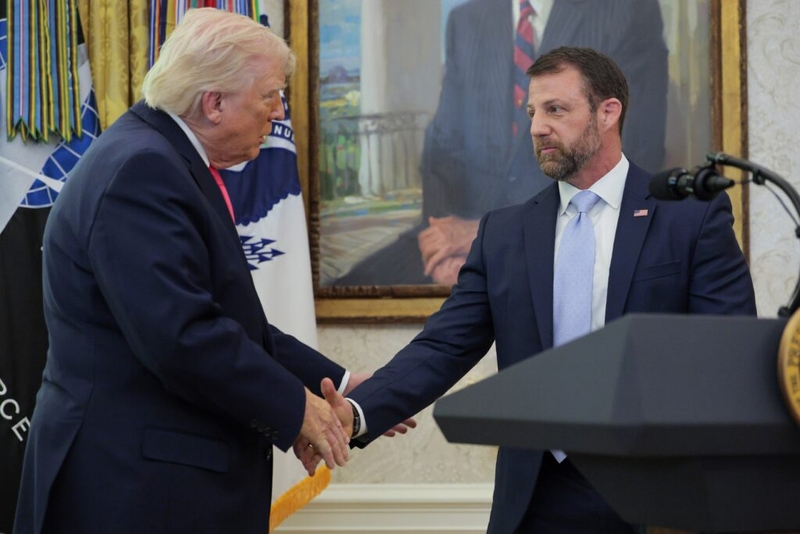
President Donald Trump shakes hands with newly sworn in Homeland Security Secretary Markwayne Mullin during a ceremony in the Oval Office on March 24, 2026. (Photo by Chip Somodevilla/Getty Images)
Editor’s note: Below is an except of a letter written by a group of ethics lawyers to the U.S. Office of Special Counsel calling for an investigation into whether the recent raid on the Washington, D.C. home of U.S. Rep. Ilhan Omar violated the Hatch Act, which prevents the use of official authority or influence for the purpose of interfering with or affecting the result of an election.
Dear Special Counsel Baldis:
We respectfully request that your office investigate whether Department of Homeland Security Secretary Markwayne Mullin, U.S. Citizenship and Immigration Services Director Joseph Edlow, Attorney General Todd Blanche, or any other employee of the Department of Justice or Department of Homeland Security, violated the Hatch Act by orchestrating a predawn raid of Minnesota Rep. Ilhan Omar’s Washington, D.C. home on October 12, 2026.
This unprecedented raid occurred a mere four days before general early voting begins in Minnesota and appears to be timed to influence voters in the upcoming midterm election, in violation of 5 U.S.C. § 7323(a).
DOJ’s Justice Manual advises prosecutors and agents that they “may never select the timing of any action, including investigative steps, criminal charges, or statements, for the purpose of affecting any election, or for the purpose of giving an advantage or disadvantage to any candidate or political party.”
That direction is not a simple policy directive: choosing to investigate or prosecute someone for the purpose of affecting an election violates the Hatch Act, 5 U.S.C. § 7323(a)(1), which prohibits any officer or employee of the executive branch from using their “official authority or influence for the purpose of interfering with or affecting the result of an election.” DOJ has further instituted a longstanding “rule of forbearance” that dictates that DOJ will not take overt investigative steps against a candidate in the run up to an election for fear of affecting or influencing election results.
…
The Department of Justice secured a warrant to allow the Department of Homeland Security to raid Omar’s home just weeks before the election, purportedly based on accusations that her father made misrepresentations on her asylum paperwork over 30 years ago when she was 12 years old. DOJ and DHS’s decision to instigate this raid at this very moment and for these alleged reasons is unexplainable — except for as a politically motivated use of power to influence the Minnesota congressional election in violation of the Hatch Act. A review of this matter is therefore immediately necessary.
…
The Hatch Act places restrictions on the political activities of all federal executive branch employees, excluding the president and vice president. The Hatch Act was enacted to prevent the government from becoming a “corrupt political machine” and to ensure against both the practice of “political justice” but also the appearance of political justice. As the Supreme Court said in the seminal case Civil Service Commission v. National Association of Letter Carriers:
“It seems fundamental in the first place that employees in the Executive Branch of the Government, or those working for any of its agencies, should administer the law in accordance with the will of Congress, rather than in accordance with their own or the will of a political party. They are expected to enforce the law and execute the programs of the Government without bias or favoritism for or against any political party or group or the members thereof.”
…
DOJ has long recognized that investigations of political candidates during an election year, particularly close in time to an election, can affect voter behavior. That is why DOJ has traditionally abided by an internal “rule of forbearance” against engaging in overt investigative or prosecutorial steps in the immediate 60 to 90 days prior to an election. That unwritten rule has been respected across administrations.
For example, on October 16, 1992, Charles Banks, the Republican-appointed U.S. attorney for Little Rock, Arkansas, refused to open a grand jury investigation that could implicate presidential candidate Bill Clinton in the Whitewater scandal. As he said at the time:
“[T]he insistence for urgency in this case appears to suggest an intentional or unintentional attempt to intervene into the political process of the upcoming election…. For me personally to participate in an investigation that I know will or could easily lead to the above scenario… is inappropriate. I believe it amounts to prosecutorial misconduct and violates the most basic fundamental rule of Department of Justice Policy.”
The administration’s raid of Omar’s home has many of the earmarks of official action that is scheduled and designed to influence the current midterm election — the exact concern that longstanding DOJ policy was instituted to protect. Departure from this longstanding norm itself raises serious concerns that the investigation was politically motivated.
Further, there appears to be no non-electoral reason why DOJ or DHS would have instituted this search right as Minnesotans are heading to the polls. There is certainly no evidence that DOJ or DHS had a compelling, exigent circumstance supporting the need to search Omar’s home. There was no emergency at hand, no imminent risk of physical harm was to befall any person, and there is no indication that the failure to wait a mere three weeks would result in spoliation of evidence. Nor is there apparently a pressing deadline to meet the statute of limitations. If, as reported, the warrant is focused on documents signed when Omar entered the country, the statute of limitations appears to have long passed. Neither 18 U.S.C. § 1015 or 18 U.S.C. § 1546 provide a statute of limitations that would cover actions that occurred 30 years ago.
Notwithstanding the lack of urgency, the decision was made to initiate this raid after absentee ballots had been sent out and mere days before general early voting begins in Minnesota, when it would have the greatest impact on voter behavior. As one of us said in a complaint to OSC raising concerns about former FBI James Comey’s communication of information to Congress related to the investigation of Hillary Clinton’s investigation ahead of the 2020 election: “A public communication about a pending FBI investigation involving a candidate for public office that is made on the eve of an election, or as in this case, while voting is in progress, is very likely to be a violation of the Hatch Act.”
That is doubly so for initiating overt investigatory acts, like the raid of a candidate’s home.
Finally, these facts cannot be taken outside of the greater context of the administration’s ramp-up of questionable activity in the past few weeks. Three weeks ago, the administration began airing propaganda ads using Department of Homeland Security appropriations. Those ads were the basis of several Hatch Act complaints, as well as subject to two lawsuits.
The administration is temporarily enjoined from airing those advertisements, which a court determined the plaintiffs were likely to prove were “purely partisan” propaganda.
As the Supreme Court wrote over 50 years ago, “the impartial execution of the laws” is the ‘great end of Government.’”
DOJ and DHS’s decision to push forward with an invasive, multi-hour search of a sitting member of Congress and political candidate’s home in the very throes of election season, purportedly related to allegations concerning conduct that purportedly occurred 30 years ago, has all the hallmarks of the type of “political justice” prohibited by the Hatch Act.
The use of any employee’s “official authority or influence for the purpose of interfering with or affecting the result of an election” is a serious offense in violation of 5 U.S.C. §7323(a)(1). But potential manipulation of the law enforcement system for political gain strikes at the very core of our system of representative democracy. For that reason, it is imperative that your office open an investigation into the timing of this investigation as soon as possible.

Saint Paul, MN