Disappointed by Trump, dubious of Talarico: This Rio Grande Valley health official mulls his midterm vote
Oct 29, 2026 | 12:00 pm ET
Description
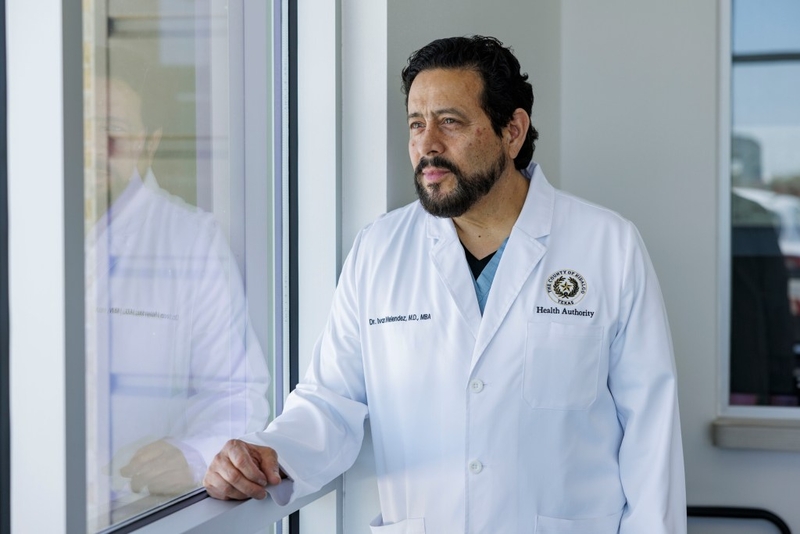
Hidalgo County Healthy Authority Dr. Ivan Melendez at the Hidalgo County Health and Human Services office in Edinburg on April 14, 2025. Dr. Melendez oversaw the local response when COVID-19 first spread through the region in 2020. (Michael Gonzales for The Texas Tribune)
Subscribe to The Y’all — a weekly dispatch about the people, places and policies defining Texas, produced by Texas Tribune journalists living in communities across the state.
McALLEN — Dr. Ivan Melendez was among the 110,000 voters in Hidalgo County who voted for Donald Trump in 2024 in a historic swing that amounted to the first time the predominantly Hispanic county has gone for a Republican presidential nominee in more than 50 years.
In the Rio Grande Valley, Melendez serves as the county’s health authority, responsible for enacting health laws in an area with one of the highest uninsured rates in the country.
Naturally, healthcare is a top issue for the top medical official for the region. He cast that vote in large part because he viewed Trump as a major force in expediting the COVID-19 vaccine in early 2020. And after already enduring four years with Trump in the White House, Melendez thought he knew what he was getting with the tempestuous leader.
Today, he regrets that vote.
Melendez says he’s been completely disappointed by Trump because of cuts to federal programs that have gutted health departments in the Valley and made insurance coverage harder to obtain.
“It’s a simple question. When it comes to access to healthcare, am I able to do more now than I was before he became president?” Melendez said. “And the answer is no, I’m doing less.”
But earlier this month, with Election Day approaching, he had yet to decide whether his disillusionment with the Republican party would translate into support for Democrat U.S. Senate nominee James Talarico, a candidate he worried was too far-left.
Melendez, who says he doesn’t identify with a political party, is among the state’s most politically valuable voters. He’s independent, undecided and Hispanic — which is the state’s largest ethnic bloc. Following the trends of Valley voters, Melendez had previously aligned with Democrats, but moved with conservatives in recent elections.
In 2024, exit polls showed 55% of Texas Latinos supported Trump in a massive victory for Republicans who have spent decades wooing those voters. Trump also prevailed over Kamala Harris in 14 out of 18 border counties, which is a number that doubled from the four years prior.
This midterm election, all eyes are back on the Rio Grande Valley’s voters again. Two years of higher prices from tariffs and the war in Iran, coupled with aggressive deportation tactics often targeting Texas’ border, have moved an increasing number of Latinos away from Trump. About a quarter of Hispanic voters who picked Trump say that if they had to do it over, they would not vote for him again, according to a survey by UnidosUS, a nonpartisan Latino civil rights group.
With what is expected to be Texas’ most competitive election in decades, Democrats are unlikely to succeed in their statewide bids without a major surge of Latino support.
But Melendez notes that being anti-Trump doesn’t equate to being against other Republicans running atop the ticket in Texas.
As hundreds of Valley voters were already rushing to the ballot box for early voting, reaching participation levels matching the 2024 presidential election, Melendez was still agonizing over his choice.
“I support the policies on healthcare of Talarico, but I do support some of the more fiscal issues with [Attorney General Ken] Paxton,” Melendez said of the Democratic and Republican candidates for U.S. Senate.
“My soul is torn,” he said.
From left to center
Melendez, who grew up in the border city of McAllen, has been surrounded by people on the political left his entire life. His parents were liberal and now his adult children are, too.
He said he’s always considered himself fiscally conservative, while more progressive on social issues.
His daughter, Ivana Melendez, 30, sees him that way, too. He’s always been supportive of her openly gay sibling and he has opposed outlawing abortions, she said.
“We would always joke around with my dad being like, ‘How could you vote for Donald Trump?’” said Ivana, a law student at Suffolk University Law School in Boston.
In her view, she said her father was primarily motivated by low taxes.
“I really think he was just a one-issue voter in that way because, in other regards, my dad is not conservative,” she said.
She recalled that her mother had a framed photo of her and Melendez meeting President Bill Clinton at a fundraiser in the Valley.
Though Melendez supported Clinton in the 1990s, he said he couldn’t bring himself to vote for Hillary Clinton when she and Trump faced off in the 2016 presidential election.
He had supported the majority of Democratic policies up until that point but, as a veteran who served as a flight surgeon in the U.S. Army, he was disappointed in Clinton’s handling of the attack on a U.S. consulate in Benghazi, Libya, in 2012, when she served as U.S. Secretary of State under President Barack Obama.
He decided not to vote for a presidential candidate that year at all.
Over the years, Melendez has been drawn in by Republican messaging around securing the border.
A majority of Latino voters don’t approve of Trump’s use of mass deportations, according to an NBC News/Telemundo poll. Melendez isn’t one of them. He believes that people with a final deportation order should be subject to removal.
“The law’s the law,” he said.
Melendez said Hispanics and Latinos, especially those who have spent many years in the U.S., put their American values ahead of their heritage, which is why Trump prevailed with those voters in 2024.
“I think that Latinos that were raised in the States … we’re just Americans with Hispanic last names,” Melendez said. “Yeah, we have our own little idiosyncrasies of our culture — tortillas, abuelitas, quinceñeras — but I don’t think that our ethnicity is that big of a deal anymore.”
Melendez said he was unswayed by Harris, the 2024 Democratic nominee, who he felt was inconsistent on her policy positions.
With Trump, he believed he knew what he was getting.
“But guess what? We didn’t get it,” Melendez said. “He turned out to be more disappointing.”
Richard Gonzales, chair of the Hidalgo County Democratic Party, said he understands why some people might remain unconvinced to vote for their candidates.
“We haven’t exactly done the best job of doing things that we need to do, and our messaging has been a little bit messy,” Gonzales said, though he added they’ve done a lot better recently by focusing on the economy and affordability. “I think that these people who are still weary of the party just need to give us an opportunity to show that we’re going to change things.”
The pandemic hits the Valley
In 2020, the global pandemic exploded into the Valley, where high rates of chronic health issues meant people were more susceptible to complications.
The region, where more than half of adults are uninsured, quickly became a hotspot for COVID-19, which brought the Valley’s medical community to its knees.
At the height of the pandemic, 10 out of 12 hospitals in Hidalgo and Cameron County were at capacity. The death rate there more than doubled the state average.
“People were dying every 7 to 10 minutes,” said Melendez, who was thrust into the national spotlight speaking regularly to national media about the mounting deaths and devastation.
As the top doctor for the county, Melendez was charged with enforcing health laws to try to slow the spread of the coronavirus. He was responsible for issuing recommendations for people to stay at home and to avoid getting together with friends and family. He also urged preventive measures such as wearing masks and, later, getting vaccinated, but that was an uphill battle.
That role would eventually put him at odds with Republican leaders in the state and nationally who downplayed the need for COVID precautions and falsely questioned the safety of vaccines.
Eventually, the Trump administration would use COVID as an excuse to turn away asylum seekers from the border, fueling right-wing talking points that COVID was being spread by migrants entering the U.S. At the time, Melendez ardently pushed back.
“Is this a pandemic of the migrants? No, it’s a pandemic of the unvaccinated,” Melendez said in August 2021.
Despite those headwinds, Melendez didn’t see Trump as the originator of COVID misinformation. He recalled Trump as someone who followed most, if not all, of the recommendations from Dr. Anthony Fauci, the director of the National Institutes of Allergy and Infectious Diseases and adviser to Trump during the pandemic.
Republicans in the current Trump administration have since turned on Fauci. Trump himself suggested recently that his former adviser should be prosecuted, after Sen. Rand Paul, R-Kentucky, made a criminal referral to the Department of Justice after Fauci did not answer questions during a hearing.
Melendez also credited the first Trump administration for the accelerated development of a COVID vaccine through Operation Warp Speed.
“Did we find a resistance to solid policy? Absolutely. Did it come, most of the time, from people on the right? It did. But I don’t necessarily feel that it was fed by an organized MAGA system,” Melendez said. “I think it was just fed by anger and just distrust.”
A brief run for office
In 2022, Melendez decided to run for Congress — and he initially wanted to do it as a Republican.
He was inspired to run following his experience with managing politics during the COVID-19 pandemic. He hoped to be an independent voice that truly represented what the community needed.
“What we need down here, in my opinion, is more resources to teach people how to fish,” he said. “And what we have are candidates that just want free fish.”
Texas’ 15th Congressional District had just undergone its decennial redistricting, and the historically Democratic district had been redrawn to tilt in favor of Republicans.
He approached the Republican Party first, but was told the party would not support him, Melendez said. They were already backing Monica De La Cruz, they explained, who had already come close to victory two years prior.
Rebuffed by the Republican Party, Melendez decided to run as a Democrat instead, but his campaign lasted all of two months before he became disillusioned by the process.
Opposition researchers had dug up legal infractions he’d had when he was younger, such as a charge of public intoxication when he was 17, and they were digging into his family.
“I tried to tell my dad that this is going to get ugly and he was, I think, naive,” Ivana said.
He came away from the experience believing the entire political system was corrupt and viewed the candidates as people who were willing to play the game.
But he saw Trump as someone who operated outside of that political infrastructure — at least in the beginning. He believed Trump had enough money that he would be unswayed by donors and could do what he wanted.
“[Trump] didn’t play the game,” Melendez thought at the time.
Buyer’s remorse
When Melendez voted for Trump in the 2024 election, he did so believing the healthcare status quo would remain the same.
He was also aligned with Republicans in opposing Democratic proposals to expand Medicare, a bad program, in his view, because he doesn’t believe it adequately covers the cost of healthcare for most people.
But he did not expect this administration to implement the cuts to health programs that have come to pass since the beginning of Trump’s second term. The Trump administration cut more than 760,000 people from the Affordable Care Act, President Barack Obama’s milestone healthcare expansion that allowed Americans to access a health plan without going through an employer. Additionally, about 5 million people dropped their coverage after the Republican-controlled Congress did not extend premium subsidies for ACA plans.
Locally, federal cutbacks led to a staff reduction of more than 30 people at the county health department that had a staff of about 225, Melendez said.
He was also disappointed that the administration had made cuts to vaccine research and changed recommendations for child vaccinations under Health and Human Services Sec. Robert F. Kennedy Jr., Health and Human Services secretary whom Melendez referred to as a “kook.”
“All that stuff is, not only counter-science, it just produces a sicker community, and that’s what’s kind of so frustrating,” Melendez said.
He realizes now that, when it comes to healthcare, he is more aligned with the Democrat Party.
Talarico, in July, visited McAllen to share his views on healthcare, participating in a fundraiser for a woman diagnosed with cancer who has been relying on GoFundMe campaigns to pay her medical bills. He said if he wins, he’d reverse cuts to the Affordable Care Act to protect coverage and lower premiums, and he’d support efforts to expand Medicare for all people, regardless of age.
Paxton, who as attorney general, led a coalition of states in a lawsuit to dismantle the ACA, is touting an economic plan that hinges on a tax deduction of $25,000 per taxpayer and their dependents for all medical expenses, including health insurance premiums.
The 2026 midterm elections
Late last week, Melendez made his way to the polls — but he wasn’t excited to cast this vote.
In the hotly contested U.S. Senate race, Melendez said he had two bad options.
He views Paxton — who has been plagued by accusations of bribery and malfeasance that he’s never been charged with — as corrupt.
But he worries Talarico is too far to the left when it comes to gender issues like transgender athletes in women’s sports. Talarico had expressed support for trans athletes during his time in the Texas House but recently reversed course, saying he opposed their participation in girls’ sports “if it endangers safety or fairness.”
Ultimately, Melendez decided to put aside what he described were cartoonish depictions of the candidates being pushed in attack ads and vote for the person that best aligned with his healthcare priorities.
He cast his ballot for Talarico.
Talarico’s support for expanding healthcare access won out over any culture war concerns Melendez was carrying. And, in some ways, he decided to cast a vote in protest of the last two years under Trump.
“I think the Republicans really did a lot of harm to us,” Melendez said.
Reporting in the Rio Grande Valley is supported in part by the Methodist Healthcare Ministries of South Texas, Inc.
Austin, TX