Abortion stance a ‘tell’ for candidates, Slotkin says in pre-election podcast
Oct 29, 2026 | 12:12 pm ET
Description
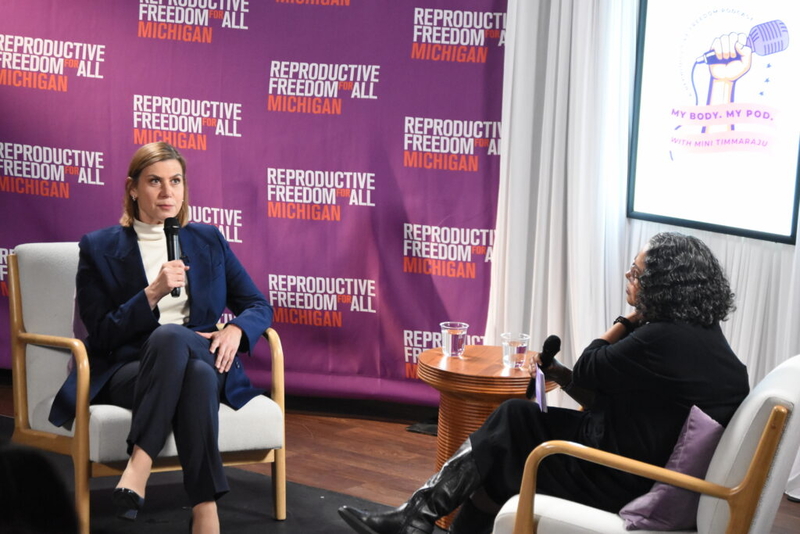
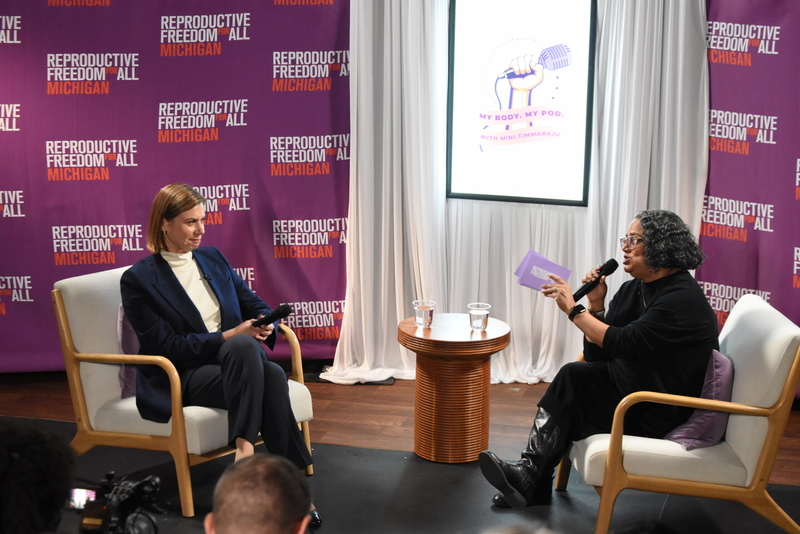
U.S. Sen. Elissa Slotkin (D-Holly) and Mini Timmaraju, president and CEO of Reproductive Freedom for All, record a live taping of the My Body, My Pod podcast in Detroit on Oct. 27, 2026. (Photo by Katherine Dailey/Michigan Advance)
U.S. Sen. Elissa Slotkin and Mini Timmaraju, president and CEO of Reproductive Freedom for All, agreed that a candidate’s stance on abortion can signal a candidate’s beliefs more broadly, with Slotkin calling it a “shorthand for extremism” if a candidate supports an abortion ban, especially one without exceptions.
“I think a woman’s right to choose that one for me is usually a good tell on what people think is the role of government in our lives,” Slotkin (D-Holly) said. “Ironically, the people who claim they believe in small government when it comes to controlling women’s bodies and their health, they become big government champions, and I think it’s a tell on what kind of legislator they will be.”
During a live taping of Reproductive Freedom for All’s My Body, My Pod podcast in Detroit Tuesday, Timmaraju similarly said that the issue is a “signal to voters on how extreme they are” and “an immediate way to disqualify candidates.”
The full podcast is set to air on Nov. 2, the day before the general election.
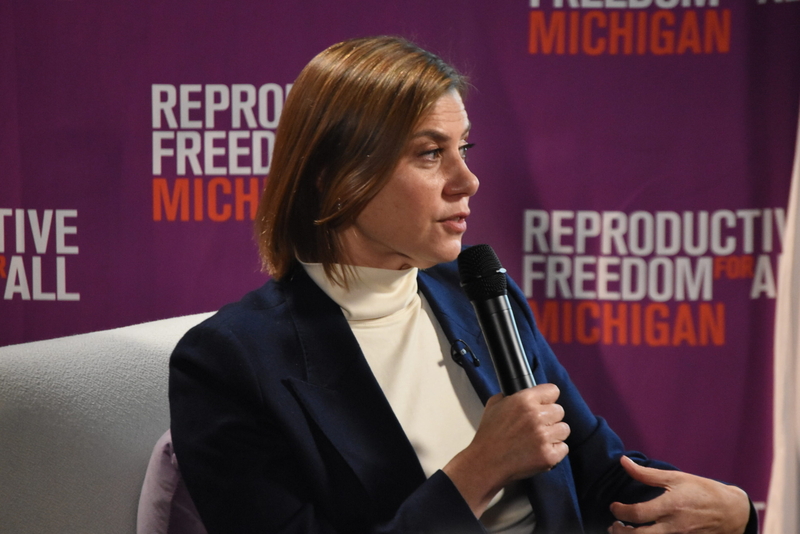
The issue of reproductive rights is still salient, even in Michigan, Slotkin emphasized — telling reporters after the podcast recording that the continued conversation about the issue in competitive races, including her former congressional district in mid-Michigan, shows just how much voters still care about it.
“I think it’s interesting that Abdul just put out an abortion ad, and I think that you don’t do paid media at the end of a campaign, a tough campaign like this, without that being a deeply salient issue,” she said of another highly competitive statewide race, the U.S. Senate race between Democratic nominee Abdul El-Sayed and former Republican Congressman Mike Rogers. “He’s in the closest race I think in the state, and that’s one of his closing messages.”
Slotkin was also critical of what she called an attempt by Rogers to “cover up” his voting record on reproductive rights in response to public opinion.
“Just own your record, dude. Just own it,” she said. “You ran on it, and you fundraised off of it, and the whole thing. I think that’s what’s happening now for him, on a whole bunch of issues — tariffs and Canada and gas and the war in Iran and all these things that literally six weeks ago he was championing, he’s now flipped on, which again is part of that character issue.”
Recorded a week before the midterm elections that will determine control of Congress as well as Michigan’s executive and legislative branches, Slotkin also discussed the importance of discussing abortion even in extremely conservative areas — and how her experience running in Michigan and in a swing congressional district taught her that.
“In Michigan we understand that you can’t just win by going to really blue places, okay? You have to go to the Upper Peninsula. You have to go to the west side of the state. You have to go to the Thumb of Michigan,” Slotkin said. “You have to go everywhere and compete for people’s votes. And if you don’t show up in those places, like don’t be surprised when they don’t vote for you.”
Slotkin emphasized to Timmaraju that, though some Democrats may feel demoralized by the state of the country, she has seen in visits to more conservative states, including Kansas, Indiana and Idaho, the need to engage with swing voters and independents, and to encourage Democrats taking risks by running in red states.
She spoke about Idaho specifically in relation to its upcoming ballot proposal vote on whether or not to retain the state’s abortion ban — one of four states that will vote on the legality of abortion in 2026.
Michigan is also facing a referendum in 2026 that advocates have warned could impact reproductive freedoms in the state, which were enshrined in the state constitution in 2022 — a vote on a constitutional convention.
Slotkin and Timmaraju did not address that ballot measure during the podcast taping, but speaking with reporters afterward did note that in conversations with voters leading up to the election, Reproductive Freedom for All members are encouraging Michiganders to vote against the constitutional convention.
“I think it’s just really important for us to remind folks to again fill out the whole ballot, and to make sure we’re protecting our democratic institutions,” Timmaraju said. “Making the connection to the integrity of their prior votes, every state that’s tried to change the rules midstream has faced political consequences. Voters do not like that.”
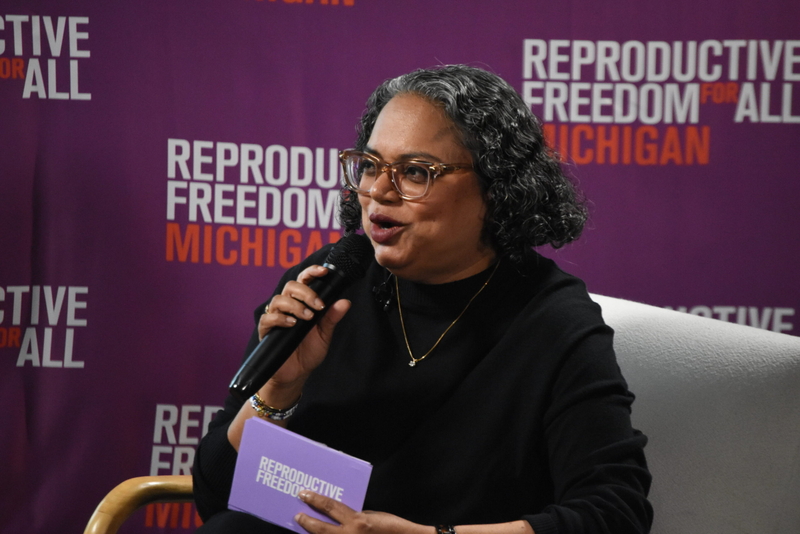
Shanay Watson-Whittaker, Reproductive Freedom for All’s director of Michigan campaigns, also referenced past comments from Republican lieutenant governor candidate and state Rep. Jay DeBoyer suggesting that a constitutional convention might be used to roll back reproductive freedoms, as well as the recent closures of Planned Parenthood locations, as reasons to vote against that ballot measure when talking to reporters.
“We have a problem with access right now in the state, as a result of the big ugly bill, and if we continue to have someone who talks like that and money that’s spent to actually do that, we’re in trouble,” she said. “What we did in 2022 will be for naught, and we don’t want to do that. So we don’t want to go backwards. We don’t want to pass Proposal One.”
The Democratic divide: ‘team fight’ vs. ‘team flight’
Outside of the issue on abortion, Slotkin reiterated her idea of division in the Democratic Party — not along ideological lines of progressive versus moderate, which she called “very 2019,” but instead about “team fight versus team flight.”
“For this country to be the country we know it can be, you have to fight for it, right? Because this guy’s trying to tear down our democracy, ruin our economy,” Slotkin said, referring to President Donald Trump. “Or are you like a lot of you know Democrats I serve with who are kind of like ‘Elissa, just wait, politics is cyclical.’”
Slotkin discussed this divide in relation to Michigan’s U.S. Senate race and her own relationship with El-Sayed, and the need for a new generation of Democrats in Congress.
“I’m interested in working with anyone who is interested in thinking about new ways of exerting pressure and oversight and accountability,” she said. “Because the strongly worded letter that worked 30 years ago, that might have meant something 30 years ago, when a ton of senators wrote a strongly worded letter to the president. It doesn’t work. Let’s stop repeating, rinsing, and repeating the things that don’t work, and let’s think about new models of accountability.”
She also told Timmaraju that she sees two visions of America emerging in politics right now — an inclusive vision based around decency and ensuring that everyone has a right to participate, and a “dark vision of corruption” embodied by Trump where there is not a belief that America can be a good and decent place.
“When you have leaders, up and down the ballot, there is no law that says you have to agree with everything they say,” Slotkin said. “You’re not looking for perfection in the people on the ballot. You’re looking for who stands up for that vision of America, integrity, and who’s going to fight. That, to me, is more important than any one difference you may have with an elected leader.”

Lansing, MI