Detroit residents urge delay as city council advances RenCen redevelopment agreement
Nov 13, 2026 | 5:00 am ET
Description
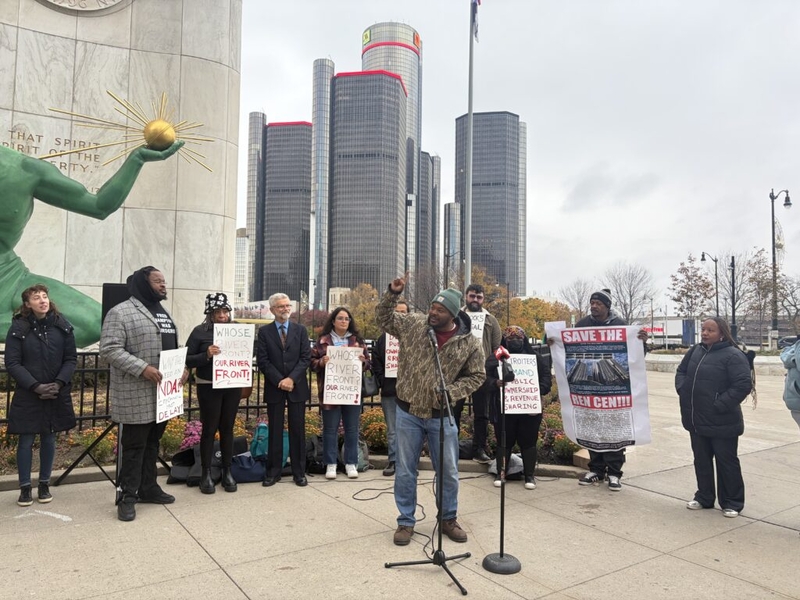
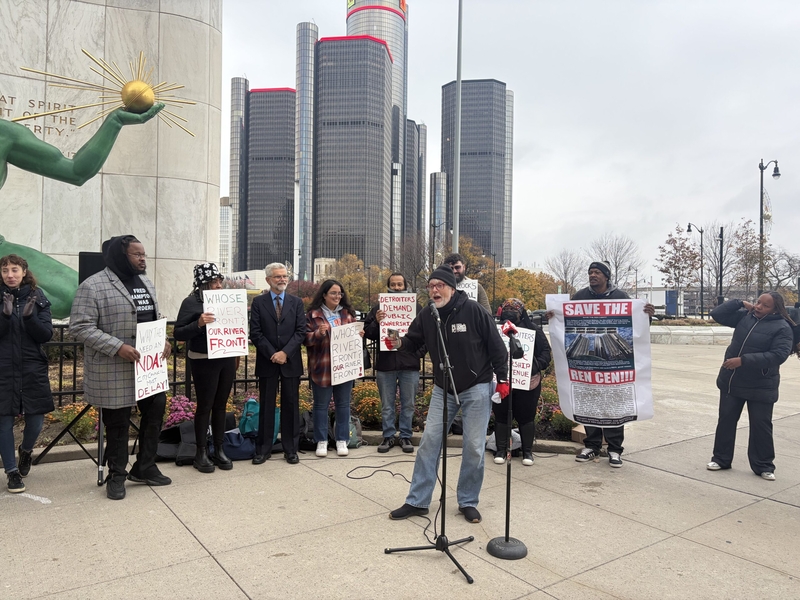
Teron Haynes Jr. was amongst the protestors demanding that the city council delay its Nov. 12, 2026, vote on the $43.5 million community benefits agreement. He is the only member of the NAC who didn't approve the agreement. (Photo by Janelle D. James/Michigan Advance)
DETROIT – City council members advanced an agreement between developers and residents tied to a $2.2 billion plan to transform Detroit’s Renaissance Center and surrounding East Riverfront into a residential and entertainment district.
In a 3-2 vote, the City Council’s Planning and Economic Development Committee voted to send the community benefits agreement to the full council without a recommendation.
Committee Chair Latisha Johnson said sending the agreement to the full council would allow members to raise additional questions and concerns during a public discussion.
“If we determine that we’re not ready to move forward, then we know how to address that in the committee of the whole,” Johnson said.
Councilmember Gabriela Santiago-Romero opposed advancing the agreement, saying she wanted more time to review the proposal and ensure questions raised by council members and residents are answered.
“People don’t move to cities for their downtowns. They move to cities because of their transportation, their neighborhoods, their culture, their people, all of that,” Santiago-Romero said. “That’s what I’m trying to make sure that we have at the forefront here and this does feel very, very rushed.”
Detroit Mayor Mary Sheffield joined members of the project’s nine-member Neighborhood Advisory Council at a press conference on Nov. 5, where they signed the CBA, which dedicates $15 million to housing, $10 million to small businesses, $8 million to a community hub, $6 million to workforce development and education, and $4.5 million to parking, totaling $43.5 million.
Developers also pledged an additional $90 million in voluntary payments in lieu of taxes or “PILOT” payments over 30 years, bringing the total announced commitments to $133.5 million.
Dozens of residents, community organizers and business owners urged the city council to delay its vote on the community benefits agreement and give the community more time to provide input.
“There are things that we have asked for over the last 10 weeks and all of a sudden they have disappeared out of the CBA,” said Nicole Small, of Save the RenCen, during a rally outside of the Coleman A. Young Municipal Center Thursday morning. “This is not a community benefits agreement, this is a developer benefits agreement. The mayor should be outraged. City Council should be outraged and the people of Detroit should definitely be outraged,” Small said.
The agreement is part of the city’s Community Benefits Ordinance, which requires developers of large-scale projects to engage residents who could be affected by the development. The Neighborhood Advisory Council is responsible for representing residents throughout that process. Its nine members include three City Council appointees, four appointees from the city’s Planning and Development Department and two elected neighborhood representatives.
Still, some residents felt that they were left out of the process, especially after released text messages between council members showed they agreed not to make public the recordings or transcripts from closed negotiations with developers, at least until after the council voted to approve the CBA.
“We got two months of public input on this process for a project that’s about to exist for the next 50 years,” said Jeremiah Wheeler of Detroit Action during the rally. “The money is coming from all around the city but the benefits are not going all around the city. The benefits are limited to … downtown and that’s not acceptable,” Wheeler said.
Not every member of the NAC is in support of the agreement. Teron Haynes Jr. was the only council member who didn’t sign the CBA.
“Those buildings don’t look obsolete to me. They’re standing and I’m not waiting for them to collapse,” Haynes said during the rally, pointing to the Renaissance Center. “We shouldn’t be waiting for Detroit to collapse either but that’s what’s going to happen if we keep giving billionaires this money and not investing into the community.”
The agreement follows weeks of negotiations between the council and developers Bedrock Detroit and General Motors. During Thursday’s committee meeting, officials described it as the largest community benefits agreement in Detroit’s history.
“We have community benefits in the agreement but the reason why I voted no was because I did not think that the benefits were substantial enough for, what we are giving to these developers but also what people in Detroit … have missed out on in the past decade as far as community development and investment,” Haynes told the Michigan Advance.
The project calls for the demolition of two of the complex’s five towers, with plans to convert the remaining three into 934 mixed-income housing units and office space. Additional plans include a marina, an observation deck and 18 acres of proposed civic space across the broader 46-acre development site.
Bedrock and GM are expected to invest more than $1.6 billion in the project, while the Downtown Development Authority will contribute $75 million. The remaining $505 million is expected to come through debt.
Developers are also seeking more than $473 million in tax breaks over 30 years. Additional commercial tax incentives would bring the total requested subsidies to approximately $548 million.
If approved by Detroit City Council, demolition work is expected to begin next summer. The project is expected to take at least 10 years to complete. City Council members are aiming to approve the plan before Thanksgiving, when the council will go on recess until next year.
Billionaire Dan Gilbert, who founded Bedrock, pledged an additional $1 billion to establish a new nonprofit organization dedicated to redeveloping and operating the Renaissance Center and East Riverfront.
Despite the donation, protesters said they would rather the new development be publicly owned and that there be more investment into developing housing throughout the city instead of downtown.
“If the word philanthropy meant anything, then he (Dan Gilbert) would pay property taxes,” said Russ Bellant, of Detroiters for Tax Justice during Thursday morning’s protest. “Why isn’t he using those tax benefits that he’s looting from us … for an investment instead of coming back to us and saying, ‘Let me screw you for another half a billion dollars.’”
Bedrock is the largest private property owner in Detroit, operating roughly 100 properties, most of them in the downtown area.
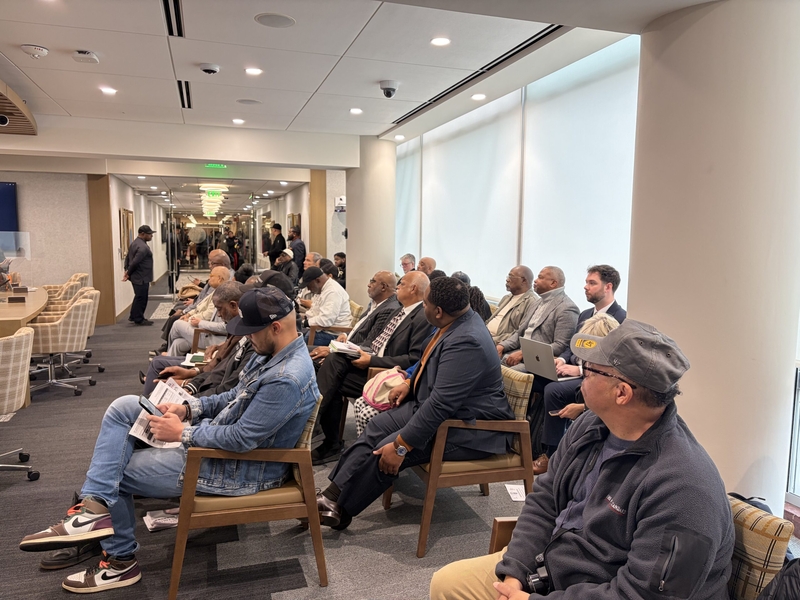
The redevelopment has drawn both support and concern from residents. Some question whether the project represents another major investment in downtown Detroit while neighborhoods elsewhere in the city continue to grapple with vacant lots and deteriorating homes.
Another major concern, especially early in the community benefits process, was that the estimated area of impact was too small and did not include residents in surrounding areas. The Renaissance Center, located along Woodward Avenue in the city’s downtown area, is in District 5. Developers estimate that nearly 4,700 residents live in the impacted area.
“The NAC should have considered bus riders who use Jefferson as a route. If this project goes through without any consideration, it would jeopardize access to jobs, access to city and county services and transit connections across Detroit and our county,” said Renard Munchinski, an organizer with Detroit People’s Platform, during virtual public comment at Thursday’s committee meeting.
Supporters view the development as an investment in Detroit’s future.
“In TechTown we see every day that local entrepreneurs don’t lack talent. They lack affordable storefronts, capital and coaching and this CBA delivers all three,” said Ned Staebler, President and CEO of TechTown.
Ryan Sullivan, CEO of the Detroit Riverfront Conservancy also spoke in support of the project and urged the committee to pass the agreement.
The project marks a significant turning point for one of Detroit’s most recognizable landmarks.
The Renaissance Center opened in 1977, featuring a 73-story central hotel tower surrounded by four office towers. Two additional office towers opened in 1981. General Motors purchased the entire complex in 1996 for $73 million and established its global corporate headquarters there.
But as hybrid work schedules became more common following the COVID-19 pandemic and office occupancy declined, GM announced in 2024 that it would relocate its global headquarters to Hudson’s Detroit, another Bedrock development. The 49-story skyscraper was also developed by the Detroit-based real estate firm, owned by billionaire Dan Gilbert.
GM’s planned departure raised questions about the future of the Renaissance Center. Now, those questions have evolved into a multibillion-dollar redevelopment proposal that could reshape Detroit’s riverfront for decades.
Lansing, MI