A rare request for clemency in Rhode Island could help 2 refugees fight deportation
Nov 13, 2026 | 5:00 am ET
Description
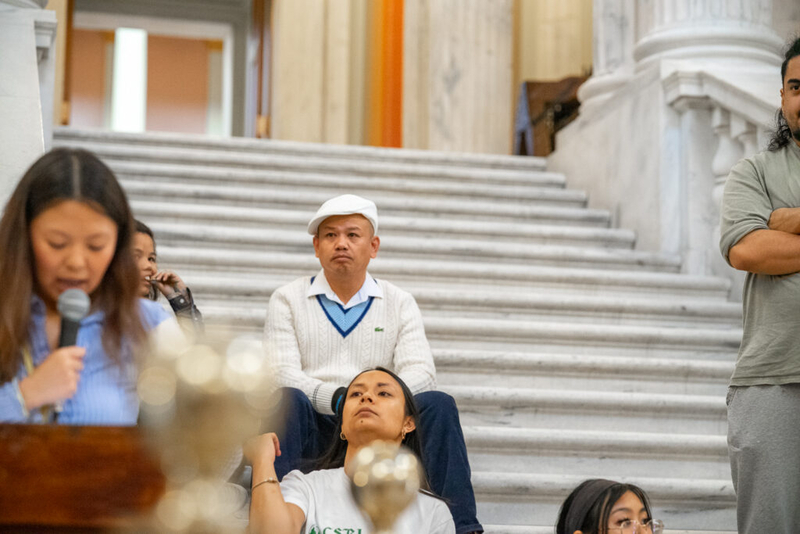
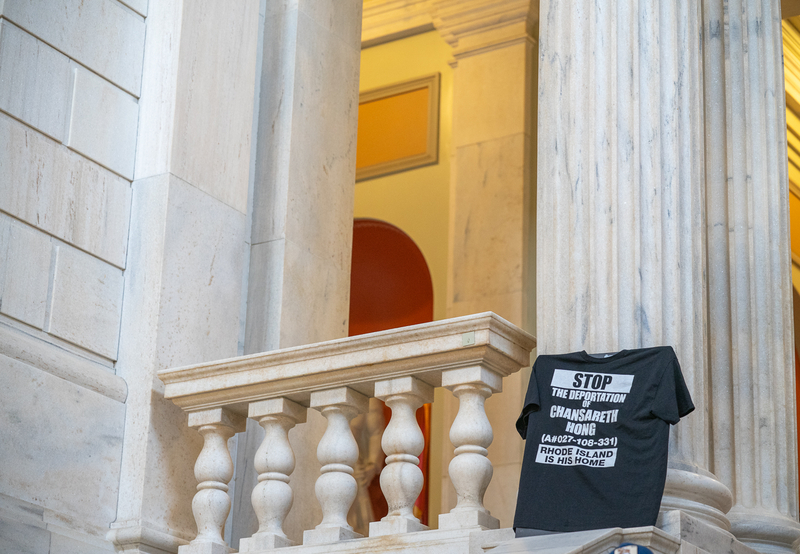
Chansareth Hong, center, sits on the steps of the Rhode Island State House as advocates call for pardons for him and fellow Cambodian refugee Thorng Chann on Nov. 5, 2026. Both men face possible deportation stemming from decades-old criminal convictions. (Photo by Christopher Shea/Rhode Island Current)
For two Cambodian refugees fighting to remain in the U.S., an extraordinary request made to Rhode Island Gov. Dan McKee could help them overcome criminal convictions that have put their ability to stay at risk.
They’re asking for pardons in a state where the power of clemency has largely gone unused for decades.
Chansareth Hong and Thorng Chann filed their requests Nov. 2 and 3, seeking relief from convictions dating back roughly 30 years. U.S. Immigration and Customs Enforcement (ICE) said in court filings it intends to deport Hong because of convictions in 1995 and 1997 for possession of heroin with intent to deliver. Chann is also facing deportation over convictions including 1995 possession of cannabis with intent to deliver and a 1997 assault with a dangerous weapon.
Hong came to the United States as an infant in 1976, and Chann arrived at the age of 7 in 1985 as hundreds of thousands fled the aftermath of the Khmer Rouge’s rule in Cambodia. Under the regime, an estimated 1.7 million people were killed through executions, forced labor, starvation and disease between 1975 and 1979. Hong and Chann have spent decades building lives in Providence.
Now their refugee status has been revoked and they face the prospect of being deported to a country they have never really known.
“I made some serious mistakes as a teen and young adult. Mistakes that resulted in my convictions,” Hong, 50, wrote in his appeal to the governor. “I never could have imagined being at immediate risk for deportation now 29 years later for those same convictions.”
Andrea Palagi, a spokesperson for McKee’s office, confirmed receipt of the pardon requests and told Rhode Island Current the governor’s legal counsel was reviewing them.
“As a reminder, unlike in many other states, granting a pardon in Rhode Island requires the advice and consent of the Senate, which means the Senate must be convened to consider and act on the matter,” Palagi wrote in an email.
Court documents show Hong was scheduled to be removed from the country by ICE by Thursday. But on Tuesday, a Rhode Island federal judge temporarily barred the government from deporting Hong while the court considers his request to reopen his immigration case.
An ICE spokesperson declined to comment on the ruling, citing pending litigation.
Federal immigration officers took Hong into custody during a July 22 check-in and transferred him to the Donald W. Wyatt Detention Facility. A federal judge ordered his release nearly two weeks later.
Chann, 49, said he has been advised that he faces an immediate risk of deportation ahead of an ICE check-in scheduled for Nov. 17.
A power rarely used
Rhode Island’s most recent pardon came in 2011, when then-Gov. Lincoln Chafee, an independent, granted clementy to John Gordon, who was hanged in 1845 for the murder of Amasa Sprague. Before that, the only successful pardon the State Library could identify in its review of Providence Journal archives was granted in 1956.
But Rhode Island governors once granted pardons with some regularity.
A State Archives ledger of state prison discharges records dozens of pardons between the 1860s and 1920, for offenses ranging from murder and manslaughter to obstructing railroads, passing counterfeit U.S. Treasury notes, “mingling poison with drink” and “sending obscene literature by mail.”
Records show at least one pardon request a year was considered by the Rhode Island Senate until around the late 1950s.
Steven Brown, executive director of the American Civil Liberties Union (ACLU) of Rhode Island, said the absence of a formal process for seeking a pardon may help explain why the state has granted so few in recent decades.
“It’s completely open-ended,” he said in an interview.
While the Rhode Island Constitution gives the governor exclusive authority to exercise pardoning power and requires the advice and consent of the Senate, it does not spell out how pardon requests should be evaluated or what standards should guide the decision.
Rep. Cherie Cruz, a Pawtucket Democrat, said she ran into uncertainty when she unsuccessfully tried to seek a pardon for herself around 2010 for a 1993 felony drug conviction.
She recalled being told to submit a letter of intent and supporting materials, such as letters of recommendation, but said she never received clear instructions on whom to contact or how to move the request forward.
“There was nothing,” Cruz said in an interview.
Which is why Cruz co-sponsored a 2024 bill that would have created a nine-member Commission on Pardons to oversee applications and recommend candidates for clemency to the governor. The commission would have been responsible for establishing eligibility standards, deciding what documents applicants needed to submit, setting timelines for decisions and creating an appeals process.
“We really need to work to get this process transparent and working because it’s not working now,” she said.
The 2024 proposal failed to advance out of committee during the legislative session. Cruz said she intends to reintroduce the bill after the 2027 legislative session begins in January.
Rhode Island once had a Senate committee devoted specifically to pardons. The standing Senate Committee on Pardons appeared in state government manuals from 1900 through 1968, according to the State Library — though staff found few records documenting its work or explaining why it became inactive.
One glimpse into the panel’s work comes from 1943, when the committee was asked to study ways to allow some people serving lengthy prison sentences to be released sooner. A Providence Journal editorial at the time criticized the proposal, arguing that people convicted of the most serious crimes should not be released after only a few years behind bars.
Sen. Sam Bell, a Providence Democrat who represents Hong’s district, said he hopes a resolution won’t be needed to get the governor to take action.
“I have every expectation the governor’s treating it seriously, giving appropriate vetting,” Bell said in an interview. “I think it’d be a great legacy move for him.”
McKee has already intervened once on Hong’s behalf, writing to ICE in July urging officials not to detain him at a scheduled check-in. Immigration officials detained him anyway.
Hong and Chann both read their requests to the governor aloud inside the State House rotunda on Nov. 5.
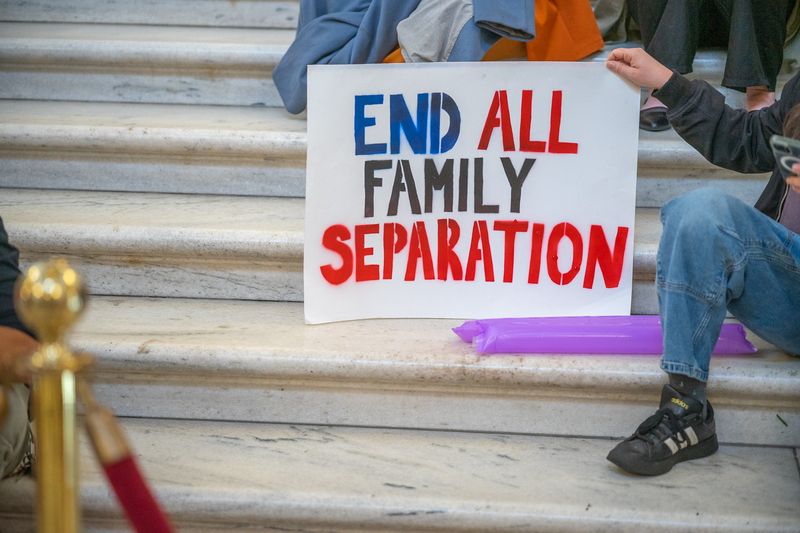
Dozens of advocates organized by the Pardons for the People campaign joined the two refugees, chanting to the beat of a lone drum and urging state leaders to consider the clemency requests.
The campaign is led by Providence Youth Student Movement and supported by a coalition that includes the Immigration Coalition of Rhode Island, the Rhode Island Deportation Defense Network, Cambodian Society of Rhode Island, ARISE, Clean Slate Rhode Island and AMOR.
Speaking to advocates after a chamber floor session on Nov. 5, Senate President Valarie Lawson said the Senate was prepared to review the requests, but that the process had to begin with the governor’s office.
A pardon isn’t a shield
For Hong, deportation would mean leaving behind a son who is nonverbal and requires around-the-clock care, as well as his 79-year-old mother who depends on him for housing, transportation and financial support. Chann has four children with his wife and is the parent responsible for much of their daily transportation and activities.
“My family means everything to me,” Chann wrote in his pardon request to the governor. “I want to be there for my children, watch them grow, and support them. I want to give them a better life and be the father they need.”
A pardon would not automatically stop Hong and Chann’s deportations. But Amy Romero, chief legal counsel for the Lawyers’ Committee for Rhode Island, said it could give their attorneys another way to challenge the removal orders that have kept them at risk of being sent to Cambodia.
Romero said a pardon could provide grounds for asking an immigration court to reopen and vacate an order based on a criminal conviction that has since been pardoned.
“They were kind of complying with their order of supervision,” Romero said of Hong and Chann. “They were checking in, and they were allowed to remain here for decades. But now we have repatriation agreements, and we also have an administration that is very hell-bent on sending people to third countries.”
In New York, Gov. Kathy Hochul pardoned a Laotian refugee in July 2025 whose decades-old manslaughter conviction had left him facing deportation. His lawyers said the unconditional pardon blocked his removal and restored his lawful permanent resident status, according to The New York Times.
A different outcome followed in Minnesota. The state’s Board of Pardons unanimously granted a full pardon in June to Tou Lue Vang, a Laotian immigrant convicted of sexually abusing a 10-year-old girl. But federal authorities deported him the following month, despite the pardon.
Hong said in his request to the governor that a pardon could help him remain with his son and mother. If allowed to stay, he hopes to establish a nonprofit teaching young people electrical skills and other life skills to help them find work.
“I will always have remorse for my convictions, and I have spent the rest of my life trying to make it right — by working hard, taking care of my family, my neighborhood, and my community,” Hong wrote.
Chann said a pardon could improve his employment prospects and give his family a better chance of staying together. He wants to be here as his four children grow up and to provide them with the parental support he lacked as a child.
“I have learned from my mistakes,” Chann wrote. “I want to continue being a good father, a responsible person, and a positive part of my community.”

Providence, RI