Black voting advocates in the South say the midterm surge was not just a ‘blue wave’
Nov 13, 2026 | 5:00 am ET
Description
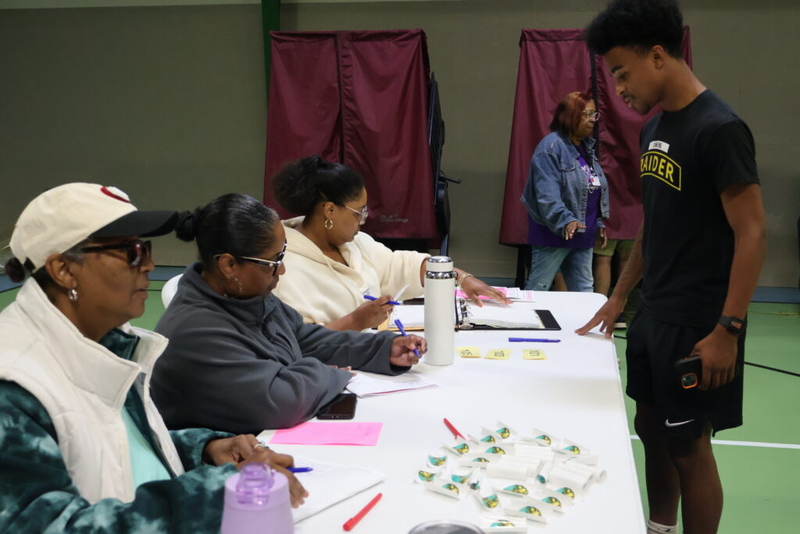
Election commissioners check the identification of a voter at the BREC Church Street Park polling location in Zachary on Tuesday, Nov. 6, 2026. (Photo by Elise Plunk/Louisiana Illuminator)
States across the Deep South, a region steeped in a legacy of racially-based voter suppression, reported high and in some cases historic Black voter turnout for the Nov. 3 election, contributing to the Democratic takeover of the next Congress.
But advocates who worked to ensure all voices were heard on Election Day say this strong showing should not only be labeled as part of the “blue wave.” Rather, they see it as the fruit of a decades-long effort to boost Black voter access.
“If your analysis on what happened Tuesday is that this is a mandate against Trump, I think it’s a bit lazy. Dig deeper,” said Charles Taylor, executive director of the Mississippi NAACP. “… Because this is not just about Trump. This is about years in the making.”
Taylor and four other voting rights activists from the South spoke with reporters in a video conference Thursday, a day after the Associated Press declared Democrat Scott Colom the winner of Mississippi’s U.S. Senate race over Republican incumbent U.S. Sen. Cindy Hyde-Smith.
Colom will be the state’s first Black U.S. senator since the Reconstruction era.
Black voters cast 33% of Mississippi’s ballots on Nov. 3, up from 30% in the 2024 presidential election, according to New York Times estimates. Colom’s narrow victory over Hyde-Smith came in a state President Donald Trump won by 24 points two years ago.
His win also comes after Mississippi election officials, just days before the election, declared more than 230,000 voters inactive after Secretary of State Michael Watson used questionable Experian credit rating data to vet voters’ addresses.
In North Carolina, 23 of its 100 counties eliminated early voting on Sundays for this election cycle. Chris Shenton, senior counsel for the Southern Coalition of Social Justice, said this was a direct tactic from elections officials to lower Black voter participation, as many churches in the state organize “Souls to the Polls” events to bring people to early voting locations.
“You see all sorts of tools, mechanisms, old poison in new bottles being used to suppress Black turnout,” Shenton said. “ … Despite that, black voters increased their share of early voting turnout in the state.”
Democrats in North Carolina flipped four U.S. House seats and will represent nine of the state’s 14 districts, including five that had been drawn to favor Republicans.
Official data reflecting voter turnout in North Carolina through Nov. 3 have not been made available, but Black voters outpaced the white counterparts 39% to 36% in the early voting period, according to an analysis from Shenton’s organization.
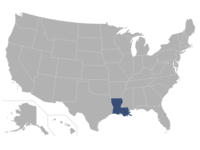
Louisiana also reported record turnout among Black voters during early voting, making up 33% of participants. Their showing resulted in a tighter-than-expected U.S. Senate race, in which Black Democrat Jamie Davis finished less than 2 percentage points behind Rep. Julia Letlow, R-Baton Rouge.
Ashley Shelton, founder and CEO/president of the Power Coalition for Equity and Justice, said she believes voters looked past party affiliation throughout the South to propel their preferred candidates to wins.
“Voters went out and voted for their families, for their communities and themselves,” Shelton said. “They did not go hit an R-button or a D-button. They picked the candidate that was going to give them the best opportunity at a better life.”
Jace Woodrum, executive director of the South Carolina ACLU, said the Election Day results in his state reflect years of frustration from Black voters. Earlier this year, they fought to block an attempt from Republicans to take away one of the state’s two majority-Black U.S. House districts out of its seven seats.
“Black voters were still pissed off and still turned out,” Woodrum said. “I do think (Republicans) will be dissuaded because I think they have seen what will happen when you threaten our democracy. These are the voting rights that people have been fighting for for generations, and voters are standing up and saying, “We’re not going to let you keep chipping away at this.”
South Carolina reported its highest Black voter turnout for a midterm election, with a 29% increase from 2022. It contributed to Democrat Annie Andrews’ U.S. Senate win over Trump-endorsed Republican candidate Darline Graham, who was an interim replacement for her late brother, Sen. Lindsey Graham.
Rep. Joe Wilson, South Carolina’s longest-serving Republican in Congress, narrowly avoided an upset, winning by less than a percentage point over Democrat Zyon Khalifa, a 25-year-old Southern University law school graduate.
Democrats also flipped 10 seats in the South Carolina House of Representatives, ending the GOP’s supermajority in the chamber.
Alabama gained a Democrat in Congress through redistricting, only after a U.S. Supreme Court decision forced legislators to add a second majority-Black seat, which Shomari Figures won. Voters also flipped four seats in the Alabama Legislature to Democrats and elected their first transgender state lawmaker, though Republicans still hold supermajorities.
Anneshia Hardy, executive director of the civic engagement group Alabama Values, said Figures’ victory should not be seen solely as a triumph for Black voters through redistricting.
“We weren’t fighting for permission to participate in somebody else’s democracy,” she said. “We were fighting for the right to exercise collective power in a country that our ancestors helped build but whose institutions have repeatedly tried to deny us that power, and that struggle doesn’t disappear because of an election victory.”
The Black voting surge for the midterms should also not be labeled as retaliation for the Supreme Court’s Callais decision, which gutted a key part of the 1965 Voting Rights Act, or other measures that have diluted minority voting strength, Hardy said. Reducing Black political participation to simply backlash overlooks generations of political organizing and action, she added.
“This moment is bigger than a blue wave,” Hardy said. “It’s bigger than any political party because a democracy that cannot protect Black political power cannot claim to have resolved the question of equal representation, and that is why this struggle should matter to every person in this country.”
Baton Rouge, LA