Scout Motors’ SC factory is 85% complete and first test vehicles are rolling off the line
Nov 13, 2026 | 5:00 am ET
Description
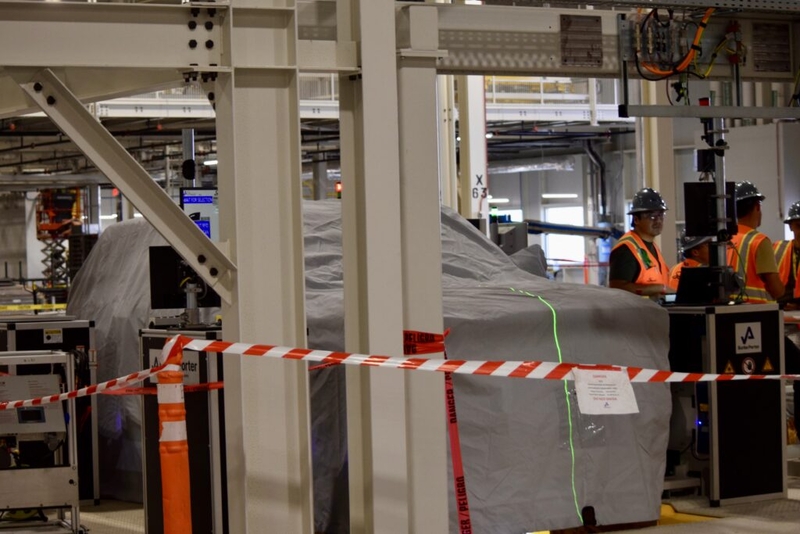
Covered by a sheet, one of Scout Motors' first test SUVs undergoes testing for wheel and headlight alignments Thursday, Nov. 12, 2026, at the nearly complete electric vehicle assembly plant in Blythewood. It marks one of 30 test vehicles to be assembled this year at the plant, with more planned for early 2027. This vehicle is not a finished product that will be sold to customers in 2028. (Photo by Jessica Holdman/SC Daily Gazette)
BLYTHEWOOD — South Carolina-based electric vehicle maker Scout Motors has started its transition from building a factory to building vehicles, with plans to hire a few hundred more assembly line workers over the course of the next year.
The Volkswagen subsidiary is nearly finished putting together its first round of 30 to 40 test vehicles and will begin a second round of testing in early 2027, CEO Scott Keogh said Thursday, following a tour of the nearly complete $2 billion assembly plant in Blythewood.
“This is the very first prototype, the prototype that’s working its way out to America to get the software installed, start going on roads, and testing and validating things like durability, things like safety, and all of the electronic hardware,” Keogh said.
Testing will continue in phases throughout 2027. The first vehicles are now expected to hit the market in 2028.
At full capacity, Scout plans to produce 200,000 vehicles annually. That will include a mix of fully electric and hybrid-like models.
Some 212,000 people have already signed up and paid the deposit to buy the first Scouts that roll off the line, Keogh said. Most of those are asking for the Scout Traveler SUV and 95% want the combination gas and electric option.
Today, Scout employs upwards of 18,000 workers across its three locations — the Blythewood assembly plant, corporate headquarters in Charlotte and an engineering and design center in Michigan.
Of those employees, 900 work in South Carolina: 600 in engineering and management and 300 factory workers.
That South Carolina number will grow to 4,000 workers when the assembly plant reaches full capacity.
Meanwhile, German-headquartered Volkswagen, the financiers of the Scout project, and Swedish automaker Volvo, which has an assembly plant in the Lowcountry, are both struggling financially.
Volvo posted larger-than-expected operating losses last month and Volkswagen’s profit margin fell to its lowest in at least a decade, as both face joint headwinds from increased competition in China — the world’s largest electric vehicle market — and global tariffs increasing the cost of vehicles in the U.S.
“We are not in a naive position. We quite know the automotive dynamics are tough and you have to compete,” Keogh said.
But unlike Volvo’s Ridgeville plant, which is operating at less than 20% of its capacity as it shifts from building electric vehicles for export to building them for the U.S. market, Keogh said Scout won’t need to be at full capacity — or even 80% capacity — before it expects to start turning a profit.
And unlike other startup electric vehicle brands, such as Rivian, Scout benefits from the cost savings that come with tapping into Volkswagen’s bulk buying power.
While Keogh declined to name the capacity percentage the factory needs to reach before its profitable, he said “we can make money at dramatically less volume.”
Scout did face a recent setback in its plans to sell its vehicles directly to consumers, similar to Tesla, rather than through the traditional dealership network.
Tennessee, this month, denied the company a license, and legislation allowing direct sales in South Carolina stalled in a House committee in February 2025. The bill officially died earlier this year with the end of the legislative session. To renew the effort, the bill would need to be reintroduced next year.
Laws governing direct sales vary by state — 18 expressly allow it and 17 expressly ban it, with the rest falling somewhere in between, according to the National Conference of State Legislatures.
Still, Scout is confident it can still reach all buyers, even if customers have to cross state lines to test drive them and have them shipped at a later date.
Columbia