Despite earlier hesitation to campaign, DeSantis hosts event supporting Amendment 3
Oct 21, 2026 | 5:36 pm ET
Description
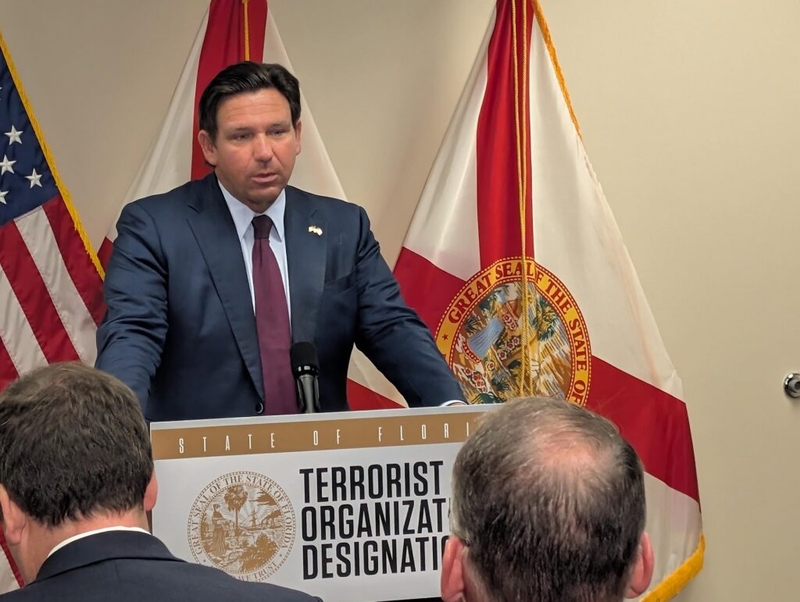
Florida Gov. Ron DeSantis speaking in Tampa on July 1, 2026. (Photo by Mitch Perry/Florida Phoenix)
Gov. Ron DeSantis for more than an hour Wednesday sat at a table with Miami leaders in front of TV cameras and advocated for the proposed constitutional amendment to increase homestead property tax exemptions.
In June, having spent months proposing some form of property tax reductions, the governor said he didn’t think he would campaign for the amendment.
Now, with the election less than two weeks away, DeSantis assembled a group of locally elected Miami officials to talk in support of the amendment — reminiscent of the news conferences he hosted in advance of the 2024 election when he advocated against amendments to legalize recreational marijuana and enshrine the right to abortion in the Florida Constitution.
“You’re seeing a lot of local governments basically coming out of it and try to tell people that the sky is going to fall. ‘You’re not going to have any services, you can’t do this, it’s just the worst thing ever,’” DeSantis said at the event billed as a “roundtable” at the Miami-Dade Sheriff’s Office Wednesday.
“And I really want to commend folks here who work in local government who are saying just the opposite. They’re saying, ‘We reject fear-mongering, we reject some of these fake narratives.’”
The governor insisted that local governments’ budgets have ballooned faster than population growth and inflation would justify.
DeSantis had said he likely would refrain from campaigning for the amendment, although still vote for it, in part because it wasn’t the version he’d asked for. The amendment was written by the House of Representatives and the Senate went along.
A University of North Florida poll released Wednesday found 50% of likely Florida voters would support the amendment, falling short of the 60% threshold required to pass it.
A September UNF poll compared voters’ main concerns from 2022 to early 2025. Last year, “property insurance, specifically, has been consistently listed among voters’ top issues, along with housing costs and property taxes,” it reads. In 2022, “housing costs” were the top issue for 2% of surveyed voters.
“I wish we could snap our fingers and say next time you go to Publix you’re going to pay what you were paying back in 2019,” DeSantis said. “We don’t set those prices at the state level or any government level but this tax is one thing that we do control.”
DeSantis said he “would encourage” Floridians to vote against Amendment 1, which would increase the capacity of the state’s budget stabilization fund — a rainy day account.
Savings and avoided costs
Flanking DeSantis were Miami officials including Rep. Alex Rizo, a Republican running for Florida Senate, and Miami-Dade Sheriff Rosie Cordero-Stutz.
Senate President Ben Albritton says he’ll vote ‘no’ on property tax cuts
“Before asking taxpayers for more, we have a responsibility to examine what we are spending, what we are paying for, and where we can do better,” Cordero-Stutz said.
Cordero-Stutz listed off more than $30 million in “savings and avoided costs” during her time as sheriff.
To the contrary, on Tuesday outgoing Senate President Ben Albritton issued a statement of opposition to Amendment 3 via social media accounts of the Florida Sheriffs Association, which also opposes the amendment, as do the Florida State Fraternal Order of Police and the Florida Association of Professional Firefighters.
In June, Albritton celebrated when Senate voted to place the amendment on the ballot.
Opponents have warned that loss of tax revenue could put damaging pressure on local budgets for public safety and other community services. State economists estimate that, if passed, Amendment 3 would reduce revenue by $5 billion in its first year and as much as $12 billion annually when fully implemented.
Tallahassee, FL