North Dakota Supreme Court justices ask why they should upend voters’ will in candidacy dispute
Oct 21, 2026 | 5:12 pm ET
Description
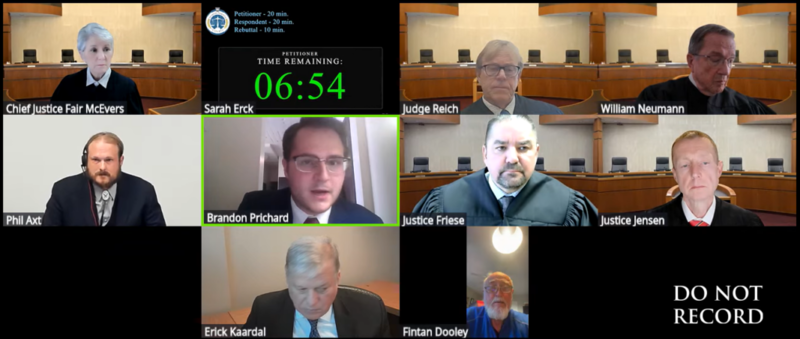
North Dakota Citizens Alliance Executive Director and law student Brandon Prichard, at left of center, speaks during oral arguments in front of the North Dakota Supreme Court via videoconference on Oct. 21, 2026. (Photo screenshot via North Dakota Supreme Court YouTube page)
Justices of North Dakota’s Supreme Court appeared skeptical during arguments Wednesday over why they should overturn the will of the voters in a case that asks them to basically void the election results if any of four challenged Republican House nominees is elected this fall.
Three Republican officials are asking the court to declare the seats vacant and order them filled by appointment, a process that would favor the challengers. Two of them lost their primaries to three of the candidates they allege are ineligible due to primary petition errors they said Secretary of State Michael Howe’s office wrongly allowed to be corrected without the original signers’ consent.
Lawsuit challenges legality of 4 North Dakota legislative candidates
The challengers are District 25 GOP Chair Matt Evans, Rep. Jeff Hoverson, R-Minot, and District 7 GOP executive committee member Douglas Pearson. They are challenging the eligibility of candidates Blaine DesLauriers and Tim Mihalick of Minot-area District 3, Steve Sauter in Bismarck-area District 7 and Terry Goerger in Richland County’s District 25. Evans and Hoverson lost their primaries to Goerger, DesLauriers and Mihalick.
The justices asked Citizens Alliance of North Dakota Executive Director and law student Brandon Prichard about the timing of the court case so close to the general election and what basis the court has to do what the challengers ask.
“There’s nothing in the North Dakota Constitution, North Dakota statutes or North Dakota decisional law that authorizes this extraordinary remedy that the petitioners are seeking,” Justice Mark Friese said.
Prichard said the court should keep the candidates on the ballot but state they were improperly listed and, should they win, go to the process in state law for filling vacant legislative seats by appointment of the local legislative district party committee.
Friese said, “But our elections have, throughout the history of our state, been decided by votes of the voters, not local committees.”
Voters can’t vote for someone who was “not properly listed on the ballot,” Prichard said. He cited a 2020 case of a House nominee who died about a month before the general election and subsequently won a seat that was ultimately filled by appointment of the district party.
“That gives the political party the final say if the candidates are invalid and the remedy as a matter of law would go back to that local Republican committee,” said Prichard, who was a Republican state lawmaker from 2022-2024.
Arguments set in court case challenging 4 North Dakota legislative candidates
Chief Justice Lisa Fair McEvers said the challengers knew about the issues for at least a couple of months before filing their court petition about a month after the general election filing deadline. She wondered why that shouldn’t be a reason for the court to deny the case.
Prichard said there is still a way to “correct this without causing extreme burden,” and it took the challengers time to gather evidence and go through a process to petition the court. The challengers moved “as quickly as we possibly could” to bring the case, he said.
The chief justice asked why that same type of work could not have been done before the June 9 primary.
“If you’re looking for some technical error of your opponent, you can look at any time, can you not?” McEvers said.
Prichard said the open records request that found the alleged errors was not a “gotcha” but an “information-gathering process.” The challengers did their best to bring their case in time, he added.
North Dakota Solicitor General Phil Axt, arguing on behalf of the secretary of state, said what the challengers want the court to do is improper and unprecedented in the U.S. Presumably, the district parties would fill the vacant seats with the same people the voters rejected in June, he said.
The court has long applied a rule that the will of the voters won’t be undone based on technicalities unless specific allegations arise, none of which the challengers have alleged, Axt said.
Prichard cited laws requiring specific information from petition signers, including a complete residential address, and a 1970 court case he said means corrections are only valid if done or directed by the signer.
Signers could have given consent for petition corrections when they signed or when reached by phone sometime later, he said. And it’s reasonable that petition signers wanted their signatures counted and implicitly consented to additions to the forms, he said.
“Even if the court concludes the secretary made errors in accepting any of these petitions, those errors, to the extent they were errors, provide no basis for undoing the will of the voters,” Axt said.
McEvers said the court took the case under advisement. It’s unclear when the court will act.
Justices Douglas Bahr and Jerod Tufte recused themselves from the case, replaced by former Justice William Neumann and former state district judge David Reich.
The case centers on a flash point in North Dakota’s dominant but divided Republican Party: how candidates get on the primary ballot, either with the GOP endorsement or by petition signatures. Ultraconservatives who control much of the party say candidates should be endorsed. Longtime and traditional Republicans have increasingly gathered petition signatures, arguing it’s better to let voters decide than party activists.
Reach North Dakota Monitor reporter Jack Dura at [email protected].
Bismarck, ND