After successive damaging ex-typhoons, Western Alaska considers future storms
Oct 21, 2026 | 5:41 pm ET
Description
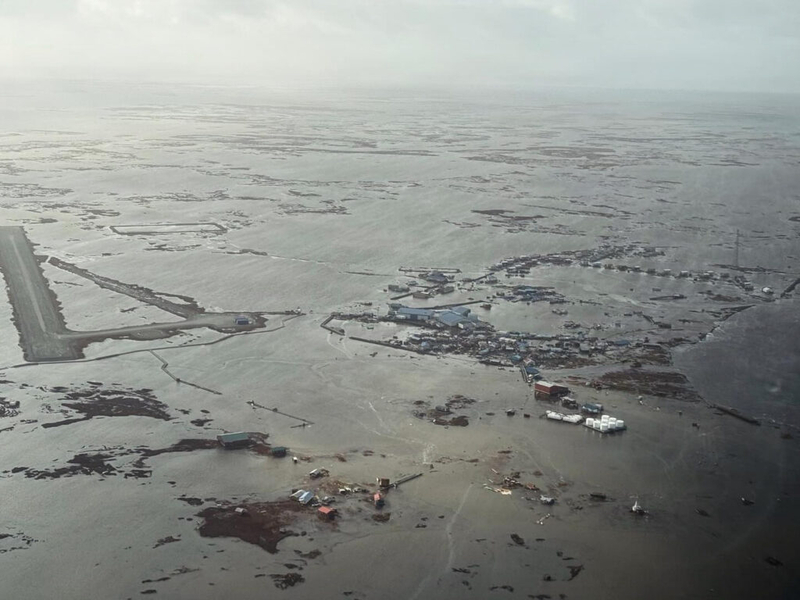
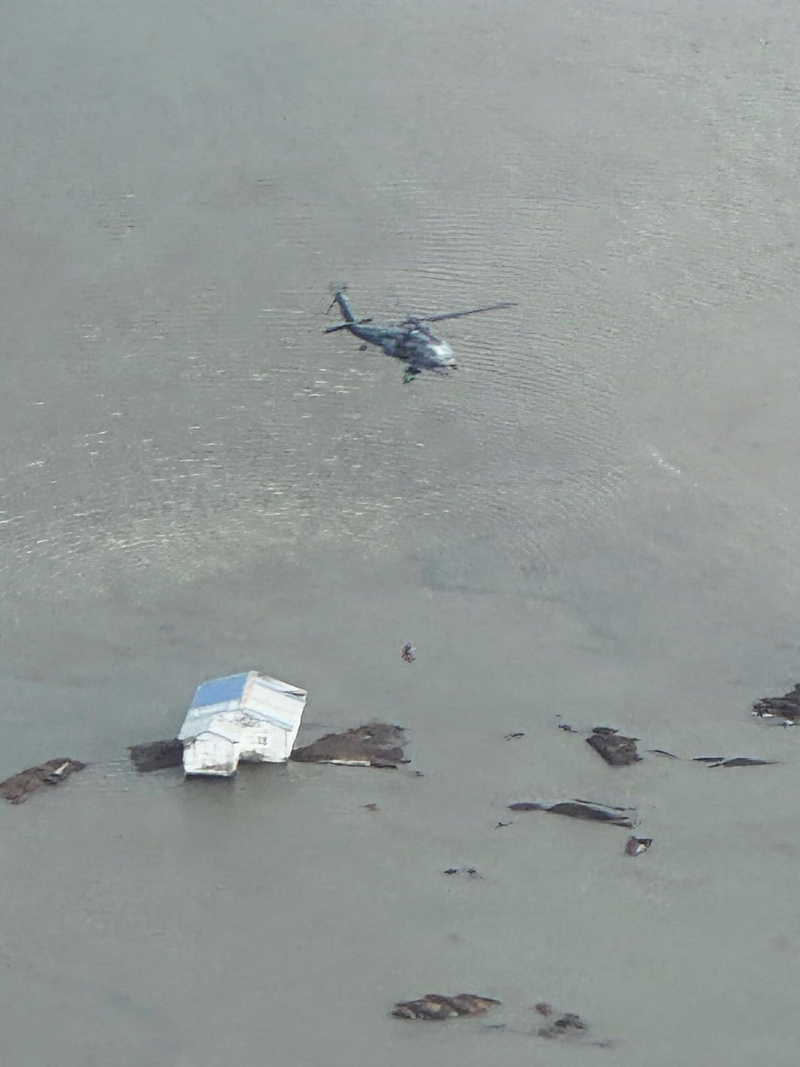
Alaska Air National Guard rescue personnel, assigned conduct a search and rescue mission in support of storm response operations over Western Alaska on Oct. 13, 2025., The villages of Kipnuk and Kwigillingok were evacuated in the aftermath of ex-Typhoon Halong, and other communities suffered damages as well. The region's residents worry more storms like ex-Typhoon Halong in 2025 and ex-Typhoon Merbok in 2022. (Photo provided by the Alaska AIr National Guard)
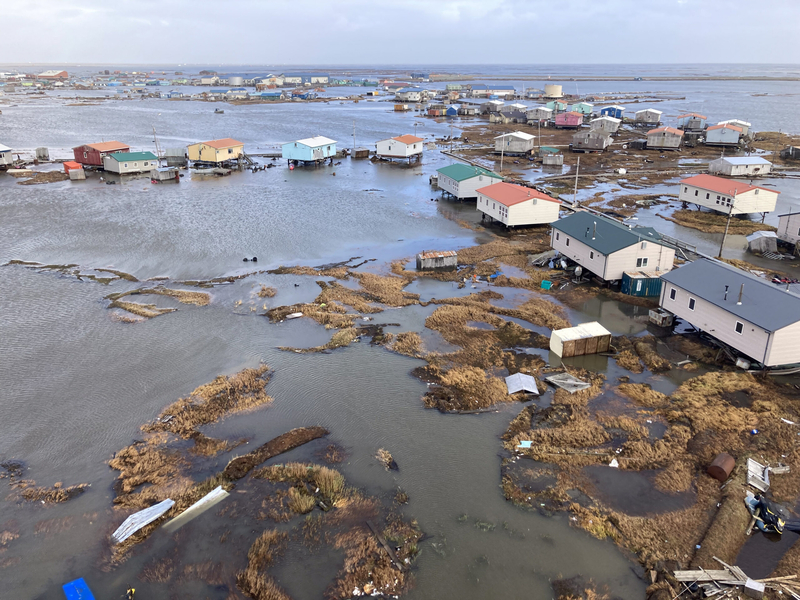
A year after a Pacific storm largely destroyed villages in Alaska’s Yukon-Kuskokwim Delta and prompted the biggest air evacuation in state history, people in the region are bracing for repeat occurrences.
Among them is Johnny Andrew Jr. of Kwigillingok, a Yup’ik village of about 400 people, most of whom were evacuated when the storm hit. Calling into a special radio program aired by Bethel-based public broadcasting station KYUK last week, Andrew said in the past, people assumed that massive storms like ex-Typhoon Halong would be rare, separated by several years.
That is no longer a safe assumption, said Andrew, who is one of the small number of residents still in Kwigillingok and trying to clean and restore the village.
“Our world is changing, so not the same as what it used to be back then,” he said in his call to KYUK.
Three years before Kwigillingok, Kipnuk and other Yukon-Kuskokwim villages were wracked by ex-Typhoon Halong, a previous storm, ex-Typhoon Merbok, slammed into Alaska. It affected almost all of Western Alaska, but its track was a little farther north, with particularly dire impacts to the Norton Sound and Bering Strait region,
Monica Price, a member of a Yup’ik dance group that performed at last week’s Indigenous Peoples Day celebration at Alaska Pacific University in Anchorage, said people around the region are worried.
“How do we prepare for something like this? Because if it’s not Kipnuk or Kwig, it’s going to be someplace else,” said Price, who is from Bethel.
Ex-typhoon defined
The term “ex-typhoon” is specific to a type of Pacific storm. Although the official meteorological name may seem benign, ex-typhoons can be more consequential in certain circumstances than the typhoons that spawn them.
Typhoons are cyclones caused by heat and water evaporation. They become ex-typhoons when they leave the tropics — and when they do so, they expand dramatically.
Typhoons and hurricanes have very strong winds that are concentrated in relatively small geographic areas. Ex-typhoons tend to have winds with peak levels that are not quite as strong, but they are spread over much farther distances. While typhoons draw their energy from warm ocean waters, ex-typhoons get their energy from the differences in air temperatures in the atmospheric layers. The contrast between warm and cold air causes the transition to broad-ranging ex-typhoons.
Ex-typhoons in the Pacific waters west of Alaska are actually plentiful, though the vast majority do not reach past the Aleutians to the Western Alaska mainland, much less cause damage there. In the last 50 to 75 years, there have probably been 100 former typhoons that have had an impact in Alaska, Brettschneider said.
Just this month, ex-Typhoon Choi-wan prompted an alert about higher winds and water levels in the Bering Strait’s Seward Peninsula.
“The disasters unleashed by ex-Typhoon Merbok in 2022 and ex-Typhoon Halong last year involved “a lot of moving parts,” Brettschneider said.
“You need a confluence of events to happen simultaneously to have a Halong or a Merbok to impact Alaska,” he said.
Those events converged for both of those two ex-typhoons, said Rick Thoman, a scientist with the Alaska Center for Climate Assessment and Preparation at the University of Alaska Fairbanks.
In the case of Merbok, the typhoon formed far east of the normal spot, and was fueled by much-warmer-than-normal waters.
In the case of Halong, the ex-typhoon became especially strong before it slammed into Western Alaska. It took an unusual track, and as it moved, “everywhere was warmer than normal, and that increased the intensity,” Thoman said.
A changed environment
The statistical record does not show a pattern of an increasing number of fall storms or of increasing storm intensity, Thoman and Brettschneider said.
Researchers in the future might be able to look back and see a pattern that hasn’t emerged yet, Thoman said.
“The environment that these storms are occurring in is different,” he said.
Higher North Pacific temperatures that have persisted since about 2020, even discounting effects from El Niño cycles, he said.
Meanwhile, permafrost thaw has softened coasts and riverbanks, making them erode more easily. Permafrost thaw has also caused the ground to sink — at the same time that ocean levels are rising, adding volume to storm surges. Delayed sea ice formation leaves coastal areas more exposed to wave action.
“What really matters is that we’re going to have more events that produce catastrophic damage,” Thoman said.
El Niño questions
This year, there is a curveball in the storm picture: an ultra-strong El Niño cycle, with record-high sea surface temperatures in the central Pacific Ocean and associated amplification of tropical Pacific storms.
Both Thoman and Brettschneider have been fielding frequent questions about what to expect this season in Alaska from El Niño.
It is hard to say whether this year’s El Niño will cause ramp up storm damage risks in Western Alaska because the cyclical phenomenon has some contradictory features, the scientists said.
During strong El Niños, tropical cyclones tend to be farther north and east, thus closer to Alaska, Brettschneider said. At the same time, there isn’t as much cold air coming from Siberia during a strong El Niño, meaning a lack of one of the ex-typhoon ingredients. The temperature and density difference between warm tropical air and colder continental air is the factor that will “supercharge” a decaying typhoon into a powerful ex-typhoon, he said.
For Thoman, who recently traveled to Bethel to participate in the KYUK call-in program and make other local presentations — including one specifically about El Niño — said worries about effects in that region are understandable.
“People are very sensitive to big storms,” he said. So when they read or hear about “the super-duper-duper El Niño, it’s perfectly reasonable to be like, ‘Well, how is this going to affect me? Do I have to be worried about yet another terrible storm?’”
On the ground
Whatever the current season holds, big changes in the landscape in the Yukon-Kuskokwim region are already evident.
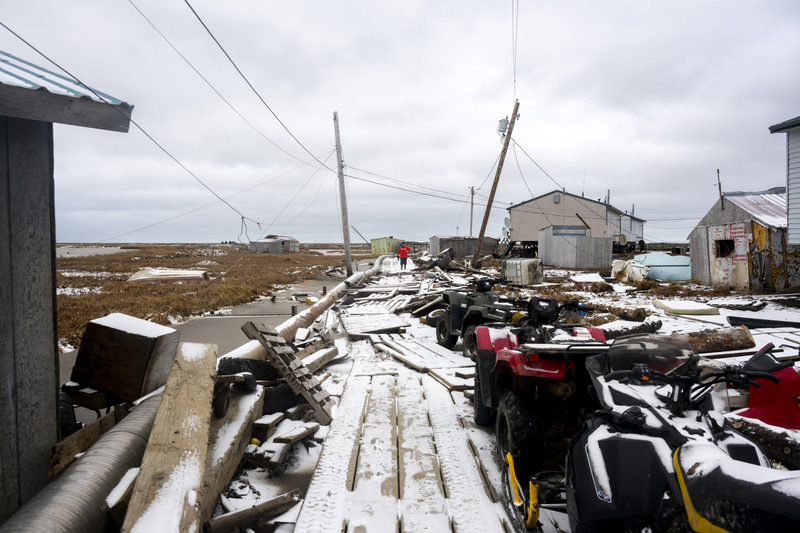
Burt Paul, one of the Kipnuk residents who has stayed in the damaged village of about 700 people to help with the cleanup and recovery work, said storm-driven mud and clumps of terrain remain spread widely.
“The surface of the land, it’s like a fresh crust on the land,” he said.
The region’s hydrology had changed, too, Paul said.
Major lakes have drained a lot of their water, leaving them shallow, difficult and probably worse for fish. “All summer, the level is low, like bathwater,” he said.
Chunks of land loosened by the ex-typhoon have also drastically altered river flows, he said. “Some rivers are so clogged with these patches of surface material, they’re unable to receive water,” he said.
For those still in the village, regular routines are now altered, as he described it. People who tried to use the rivers and lakes for traditional subsistence food-gathering ran into problems, he said, and usual practices may have to be adjusted in the future — for example, switching nets for hooks.
“We might have to change some strategies to fish,” he said.
Juneau