Deputy Health Secretary Briskin stepping down in December, as state braces for Medicaid changes
Nov 19, 2026 | 12:17 am ET
Description
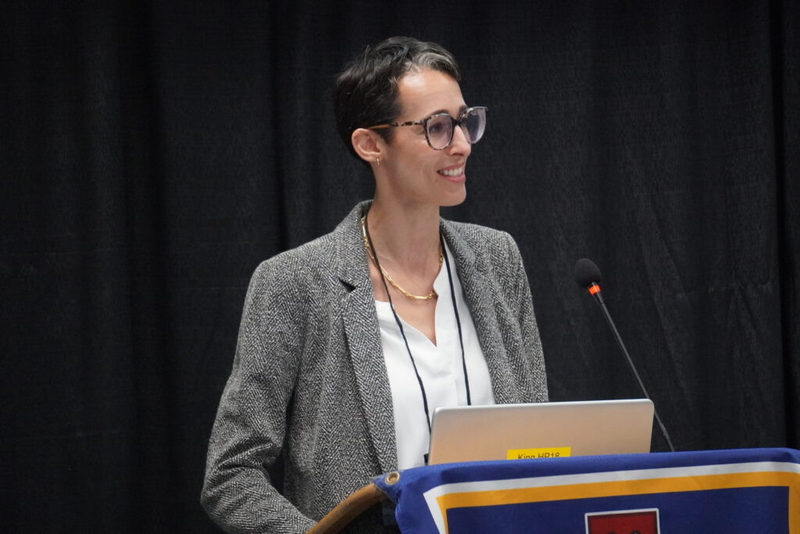
Deputy Secretary Perrie Briskin giving an overview of how Medicaid operates in Maryland during her first week on the job in August 2025. (Photo by Danielle J. Brown/Maryland Matters).
Deputy Health Secretary Perrie Briskin, the top official for the state’s Medicaid program and healthcare financing, will step down from the position at the end of the year, officials with the Maryland Department of Health announced this week.
Maryland Health Secretary Meena Seshamani notified department staff of Briskin’s departure in an email Tuesday, thanking the deputy secretary for “her service and commitment to advancing health coverage across the state over the past two years.”
“Over her tenure, Perrie has provided exceptional leadership and dedication to Maryland Medicaid, guiding critical policy and operational initiatives that serve more than 1.4 million Marylanders,” Seshamani said in the email.
Deputy Medicaid Director Rayva Viginkar will “serve as Healthcare Financing and Medicaid interim leader during this transition,” the department said in a statement Wednesday.
Briskin said she is planning to step away at the end of December to spend time with her family.
Health official warns that future Medicaid cuts could lead to $2.7 billion loss in federal funding
The announcement comes as the state braces for new Medicaid eligibility requirements Congress approved in the 2025 budget reconciliation legislation known as HR 1 – sometimes referred to as the “One Big Beautiful Bill Act.”
Medicaid is a joint federal-state healthcare plan for low-income households, with state officials administering the program. Come January, Medicaid recipients will need to prove that they’re working at least 80 hours per month, unless they meet certain exemptions, and they need to renew their coverage twice a year instead of annually, among other changes.
Those changes are expected to force thousands of Marylanders off the Medicaid rolls, due largely to administrative churn. Federal officials recently gave states an extra six months, until July, to prepare for the changes, but advocates said job No. 1 for Briskin’s replacement will be to ensure that as many people as possible retain coverage in the face of the changes.
“It’s a tough job,” said Gene Ransom, CEO for MedChi, the Maryland State Medical Society.
Vincent DeMarco, president of the Maryland Healthcare for All Coalition, echoed those concerns.
“The next person will have a very tough job to continue to protect Maryland from the attacks from the federal government,” he said. “Medicaid is important for the people on it and for all of us, because when everyone has healthcare, we all benefit.”
But DcMarco said he believes Briskin has built a strong strong framework to ease the transition.
“She and her team at MDH have done a terrific job of protecting Marylanders from the horrors created by HR 1 and the Trump administration’s attacks on Medicaid,” he said.
Briskin started with the department in January 2025 as chief of staff for Maryland Medicaid, and became deputy secretary for healthcare finance and director of Maryland Medicaid in August 2025.
Before her time with the state, she was the senior adviser to the director of Medicaid and the Children’s Health Insurance Program Services at the Centers for Medicare & Medicaid Services.
Administration gives states 6 more months to implement Medicaid work requirement
Briskin started her tenure as deputy secretary at a transitional time for the health department. Several high-level officials had stepped away, including her predecessor, Ryan Moran. State officials were starting to untangle how steep cuts to Medicaid and similar programs under HR 1 would impact Marylanders. And the Maryland hospital system was transitioning to a new payment model after long negotiations with federal officials.
In her time as deputy secretary, not only has she overseen the administration of Maryland Medicaid and helped guide the health department through frequent federal policy changes, she also helped to improve internal administrative processes for Medicaid eligibility and fill leadership vacancies within the department.
“I am incredibly proud of the work we have accomplished at Maryland Medicaid and grateful for the opportunity to serve Marylanders alongside such a dedicated team and so many committed partners,” Briskin said in a text Wednesday.
“I have tremendous confidence in the team’s leadership and ability to carry this work forward, and I know Maryland Medicaid’s commitment, priorities and work will remain unchanged through a smooth transition,” she said.
While that may be, DeMarco said she will still be missed.
“She’s just done a terrific job at MDH, had really hard times,” he said. “We’re going to miss her and wish her well on her new endeavors.”
Annapolis, MD