Democratic-led states ramp up protections in reproductive health shield laws
Nov 19, 2025 | 2:33 pm ET
Description
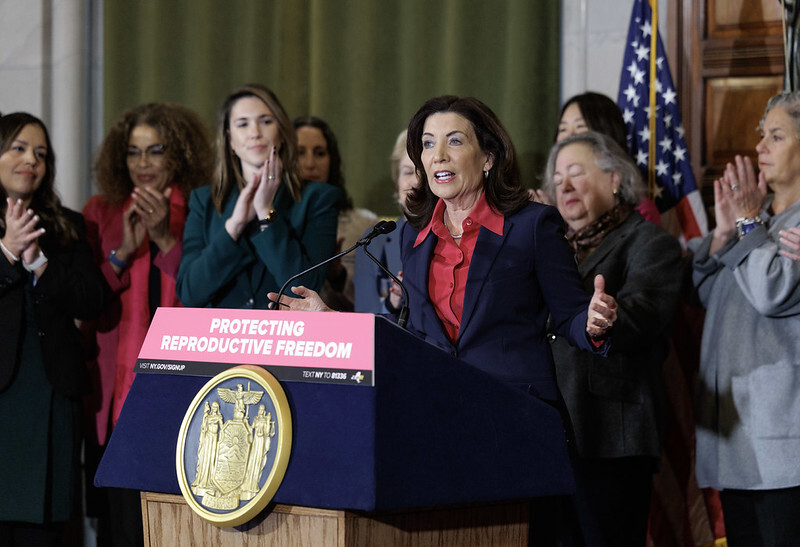
Democratic New York Gov. Kathy Hochul speaks alongside lawmakers and abortion-rights advocates on Feb. 3, 2025, when she signed legislation that strengthened her state’s shield law by allowing providers to remove their names from abortion medication prescriptions. New York is one of 18 states that has laws protecting reproductive health care providers and patients from out-of-state investigations. (Photo by Mike Groll/Office of Governor Kathy Hochul)
Shield laws that protect abortion providers and patients from out-of-state prosecutions have become a point of contention in the fight over access to abortion medication. These measures popped up in nearly two dozen states in the years since the U.S. Supreme Court overturned federal abortion rights.
Connecticut was among the first states in the nation to enact a shield law in 2022, shortly after the Dobbs v. Jackson Women’s Health Organization decision.
“I am very appreciative to the majority of lawmakers in Connecticut who had the foresight to draft this legislation at a time when the right to a safe and legal abortion in America is in jeopardy,” Democratic Gov. Ned Lamont said in May 2022, when the legislature passed the bill and a draft opinion of the Dobbs ruling leaked.
More than three years later, a total of 18 states and Washington, D.C., have laws that safeguard abortion providers and patients from out-of-state investigations.
Arizona, Michigan, North Carolina and Pennsylvania sometimes get included in this tally, but they do not have shield laws. Instead, Democratic governors in those swing states have issued executive orders barring agencies and departments from cooperating with investigations into reproductive health care and refusing to comply with extradition requests from other states. But they face Republican-led legislatures or divided statehouses where the passage of shield laws is unlikely.
The executive order Arizona Gov. Katie Hobbs issued in June 2023 is unique: She directed authority of all abortion-related investigations to the attorney general’s office.
“Together, we will continue to do what the voters of Arizona elected us to do — fight like hell to protect the rights of Arizonans to make their own private medical decisions without interference from extremist politicians and anti-choice groups,” Attorney General Kris Mayes, a Democrat, said after Hobbs signed the order.
Eight states — California, Colorado, Maine, Massachusetts, New York, Rhode Island, Vermont and Washington — allow providers to prescribe abortion medication to patients in states where abortion is banned.
Telehealth is key to these measures, and abortion-rights advocates say they have helped maintain access to abortion nationwide despite 13 states having near-total abortion bans and four states having six-week bans.
Abortions provided via telehealth accounted for 25% of all abortions in the U.S. last year, according to the Society for Family Planning #WeCount report released in June. Nearly half of telehealth abortions were provided by doctors or other qualified health care professionals in shield states, according to the findings.
Republican leaders in states with abortion bans have taken notice and sought to crack down on the availability of abortion medication and prosecute shield law providers. A group of GOP attorneys general asked Congress to take action this summer.
“These laws are blatant attempts to interfere with States’ ability to enforce criminal laws within their borders and disrupt our constitutional structure. Therefore, we are asking Congress to assess the constitutional authority it may have to preempt shield laws,” they wrote in a letter to congressional leaders on July 29.
Democratic lawmakers in six states — California, Colorado, Maine, Massachusetts, New York and Washington — responded by adding safeguards that allow doctors to remove their full names from prescriptions for privacy.
Dr. Angel Foster, co-founder of the Massachusetts Medication Abortion Access Project, told States Newsroom in July that telehealth abortion providers treating patients in states with bans “always envisioned that there would be legal challenges to the work that we're doing.”
“You can't put this genie back in the bottle,” Foster said. “Medication abortion pills are here to stay, regardless of what happens with these pills and how they're regulated in the United States.”
Arizona — Democratic Gov. Katie Hobbs signed an executive order in June 2023 that gave total authority over any abortion-related criminal prosecutions to Arizona’s attorney general. The order also prevents Hobbs from complying with out-of-state extradition requests and bans state agencies from assisting out-of-state investigations into reproductive health care providers or patients.
California — Laws adopted in California after the U.S. Supreme Court overturned Roe v. Wade in June 2022 protect abortion patients and providers from civil prosecutions. They also prevent local law enforcement from cooperating with interstate investigations into reproductive health care.
In 2023, California rolled out legal protections for providers’ medical licenses against attacks from out of state related to abortion, and banned California tech companies from complying with search warrants for reproductive health care information.
Another law took effect in January 2024 that allows California providers to offer telehealth abortion medication to out-of-state patients who live elsewhere.
A new measure adopted in September 2025 allows providers to remove their names from abortion medication prescriptions.
Colorado — A Colorado law took effect in April 2023 that protects providers and patients who travel to the state for abortion or gender-affirming health care from prosecution in other states. The state added to the law in 2025 allowing providers to exclude their names from abortion medication prescriptions.
Connecticut — Connecticut was one of the first states to enact a shield law in July 2022, protecting patients and providers from abortion-related prosecutions and limiting the governor’s discretion when it comes to extraditions. The law also expanded who can provide abortions beyond doctors: Advanced practice registered nurses, nurse-midwives and physician assistants may also provide medication abortions.
Delaware — As of June 2022 in Delaware, abortion providers cannot be disciplined for services that are illegal in another state. The law allows physician assistants with collaborative agreements to provide abortions, along with certified nurse midwives and nurse practitioners.
District of Columbia — A law took effect in February 2023 that prevents D.C. law enforcement from cooperating with interstate investigations of proceedings that would infringe on reproductive health care decisions, including abortion.
Hawaii — In March 2023, Hawaii expanded protections for abortion providers and patients by barring agencies from releasing information related to abortion services and allowing licensed physician assistants to provide first-trimester abortions.
Illinois — As of January 2023, Illinois protects abortion and gender-affirming health care providers and patients from out-of-state legal attacks, and allows advanced practice registered nurses and physician assistants to provide abortions. Additional safeguards set to take effect in January 2026 would allow Illinois providers to prescribe abortion medication even if its approval is revoked by federal health authorities.
Maine — A law took effect in Maine in August 2024 that protects abortion and gender-affirming health care patients and providers from out-of-state investigations and allows providers to prescribe abortion medication to patients living out of state. Another measure took effect in September 2025 that allows providers to remove their names from prescription labels.
Maryland — A law took effect in June 2023 protecting from liability providers, patients and those who help someone from out of state access abortion services in Maryland. The law also prohibits state entities from assisting in interstate investigations into abortion services.
Massachusetts — A law took effect in Massachusetts in July 2022 that protects abortion and gender-affirming health care patients and providers from out-of-state prosecutions, and allows providers to prescribe abortion medication to patients in other states. Starting in January 2026, Massachusetts doctors can remove their names from abortion medication prescriptions.
Michigan — Democratic Gov. Gretchen Whitmer issued executive orders in 2022 that bar Michigan agencies from cooperating with out-of-state investigations into abortion providers and patients and prevent her office from complying with extradition requests related to reproductive health care.
Minnesota — A Minnesota law took effect in April 2023 protects abortion patients and providers from out-of-state prosecutions by prohibiting Minnesota courts, law enforcement and health care workers from cooperating with authorities outside of the state.
Nevada — A Nevada law adopted in May 2023 ensures that investigations into reproductive health care services cannot receive assistance from the state’s executive branch, and that Nevada won’t cooperate in extraditions related to the care. Providers also face no professional discipline for providing abortions.
New Jersey — As of July 2022, New Jersey protects reproductive health care providers and patients by prohibiting law enforcement cooperation with interstate investigations, and bans the extradition of New Jersey patients to another state.
New Mexico — As of June 2023, New Mexico law prohibits state entities from sharing patient and provider information about reproductive and gender-affirming health care with out-of-state law enforcement. The law also prevents compliance with related extradition requests.
New York — A law took effect in New York in June 2023 that protects telehealth services and abortion providers who prescribe abortion medication to patients in states where abortion is restricted. A 2022 law prohibits misconduct charges against providers and also protects patients. The latest shield protection adopted in February 2025 allows doctors to remove their names from abortion pill prescriptions.
North Carolina — Former Democratic Gov. Roy Cooper signed an executive order in July 2022 that bars North Carolina agencies from assisting out-of-state investigations into reproductive health care and states that he will decline extradition requests for abortion providers and patients. Gov. Josh Stein, also a Democrat, signed a similar order in January 2025 that also protects reproductive health care patients’ data.
Oregon — An Oregon law adopted in July 2023 protects providers who offer reproductive and gender-affirming health care from losing their licenses, and shields patients and providers from related out-of-state investigations. Oregon does not have a law allowing providers to prescribe abortion medication to people out of state.
Pennsylvania — Former Democratic Gov. Tom Wolf signed an executive order in July 2022 that bars Pennsylvania agencies from participating in out-of-state investigations into abortion providers and patients, and states that the governor will decline interstate extradition requests related to reproductive health care. Gov. Josh Shapiro, who was attorney general during Wolf’s administration, endorsed the order. Proposed legislation would put the order into law.
Rhode Island — Rhode Island’s shield for reproductive health and gender-affirming health care providers and patients took effect in June 2024. The law protects Rhode Island providers offering telehealth abortion care to patients living in states where abortion is illegal.
Vermont — Two Vermont laws took effect in May 2023 that protect patients and providers from out-of-state prosecutions. This was the first shield law in the nation to explicitly secure access to abortion medication prescriptions via telehealth.
Washington — A law adopted in Washington in April 2023 protects providers and patients from civil and criminal actions by states that restrict or criminalize reproductive and gender-affirming health care. It prohibits law enforcement from cooperating with out-of-state investigations and bans the governor from cooperating with extraditions related to such care. Washington’s shield law does not specify whether a patient must be located within the state, but providers generally require a Washington address to be used for abortion prescriptions. A law took effect in June 2024 that allows providers to use their clinic’s name on abortion pill bottles instead of their name. Washington was the first state to do this.
Read more about efforts to both reinforce and crack shield laws across the country.