With new tactics, ICE reaches new high in monthly arrests
Aug 10, 2026 | 5:00 am ET
Description
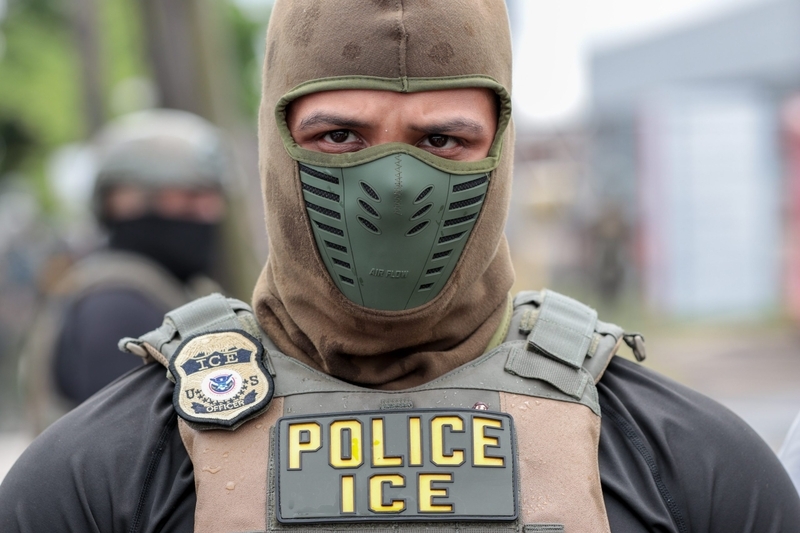
A U.S. Immigration and Customs Enforcement officer watches a crowd of protesters at Delaney Hall, a detention center, in Newark, New Jersey, on May 25, 2026. Employing new tactics, ICE arrested more people in July than in any previous month of the Trump administration. (Photo by Ben Ackman/New Jersey Monitor)
Federal immigration agents are employing new tactics — from arresting academics at airports to setting up a checkpoint at a popular creek in a National Forest — to boost their arrest numbers, leading to more arrests in July than in any previous month of the Trump administration.
Though it is striving to fulfill the White House’s demand for more arrests, U.S. Immigration and Customs Enforcement is still falling short of the Trump administration’s announced goal of 2,000 arrests per day. And more arrests won’t necessarily translate into more deportations, said Colleen Putzel-Kavanaugh, an associate policy analyst at the Migration Policy Institute, a nonpartisan think tank.
“The focus is so much on the arrest numbers that the mission seems a little confused to the general public,” Putzel-Kavanaugh said.
She noted that many of the new arrests catch non-criminals in a legal “gray area,” such as having an expired visa while applying for another legal status. Such people are hardly the “worst of the worst” the Trump administration has identified as its top targets, she said.
“Meeting some arbitrary arrest quota doesn’t necessarily serve this larger purpose of deporting a larger number of people, so there’s a disconnect about what the mission really is.”
The Department of Homeland Security, which oversees ICE, told Stateline it arrested about 51,000 immigrants in July, up from 43,000 in June and the highest number recorded by the Trump administration. The administration did not release state specific numbers.
Trump administration ramps up pressure on indefinite immigrant detention
The department said that last month it arrested an average of 20-40 people per day at airports, as federal agents targeted passengers with expired visas. According to media reports, those arrested last month included a Cameroonian researcher at Johns Hopkins University in Baltimore — a Fulbright scholar — and a University of Maryland instructor from Ethiopia who was detained as he returned from a conference where he accepted a Teacher of the Year award. Advocates suggested immigrants with expired visas should not travel without consulting an attorney.
Arrests based on expired visas are likely to continue and will accelerate in September when a new rule takes effect that sets stricter time limits on visas for students, exchange visitors and foreign media.
Michael Clemens, an economics professor at Johns Hopkins, has estimated that by limiting the number of international STEM students, instructors and researchers in the U.S., the new rule could cost the nation’s economy as much as $145 billion per year by 2035.
“Implementation of the rule will cause large numbers of highly-skilled students and scholars to fall out of status. We’ll certainly be seeing a lot more cases like the seizure of Fatima Ameaka,” Clemens said, referring to the Johns Hopkins researcher from Cameroon, an expert in disease outbreaks.
In an interview, Clemens said federal immigration authorities “see airports as an easy bottleneck because everyone in there is ID’d, so it’s lower cost to seize people there than in any other place except a prison.”
Kate Angustia, supervisory policy and practice counsel at the American Immigration Lawyers Association, a trade group, said it’s a “misconception” that the people being arrested at airports let their visas expire and therefore forfeited their legal status.
“Many of these folks are in a lawful period of authorized stay,” Augusta said. “This means that longstanding policy and practice has been, for decades, to allow these people to remain here as their legal processes continue to be processed by the government.”
DHS said in a statement to Stateline that “this administration is working diligently to ensure that aliens in our country illegally can no longer fly unless it is out of our country to self-deport.”
An asylum seeker from Zambia, working as a registered nurse at a Portland, Maine, hospital, was released Thursday after her arrest at Boston Logan International Airport sparked protests.
“Nurses in Maine found out one of their own was locked up and sprung into action to get her out,” Puneet Maharaj, a local nurse union representative, said in a statement.
On July 26, immigration agents set up a checkpoint near Wilson Creek in North Carolina, a site that is popular with Hispanic residents and is managed by the U.S. Forest Service. Federal agents arrested 13 people, according to the local sheriff’s office.
There were local protests by Methodist clergy and relatives who said at least some of those arrested had no criminal record and entered the country legally, contradicting a social media post by Republican North Carolina Assembly Speaker Destin Hall calling those arrested “a gang of previously arrested illegal aliens.”
The Sierra Club also protested the arrests.
“Bringing immigration enforcement into public recreation areas undermines the sense of safety and belonging that these spaces provide and could discourage people from visiting national forests and other outdoor spaces altogether,” the organization wrote in a statement.
At the end of July, federal agents and state highway patrol officers conducted roadside checks of trucks in Illinois, Indiana, Iowa and Ohio “to crack down on illegal, unvetted drivers and unsafe vehicles.” DHS said it detained 51 drivers who were in the country illegally.
The agency has said it is “delivering on President Trump’s promise to the American people to arrest and deport pedophiles, murderers, rapists, and other criminals.” But less than a third of current detainees have a criminal conviction and 40% have never been accused of anything but non-criminal immigration violations, according to statistics reviewed by Stateline through early July.
The statistics also show that about 2,000 detainees a month have been freed after court-ordered bond hearings as many federal judges, some of them Trump appointees, have ruled against the Trump administration’s policy of mandatory detention for many immigrants. The U.S. Supreme Court is likely to rule on the legality of the policy in its October term.
July also saw two immigrants shot and killed during traffic stops in Texas and Maine. After a brief pause, President Donald Trump ordered such traffic stops to continue, though ICE officers will now wear body cameras when they pull over drivers, according to border czar Tom Homan.
Also in July, a Mexican man who had a valid tourist visa was struck and killed by a truck after he fled ICE officers who pulled him over in St. Augustine, Florida.
Stateline reporter Tim Henderson can be reached at [email protected].