Democrat John Hickenlooper of Colorado defeats Senate primary challenger Julie Gonzales
Jun 30, 2026 | 9:51 pm ET
Description
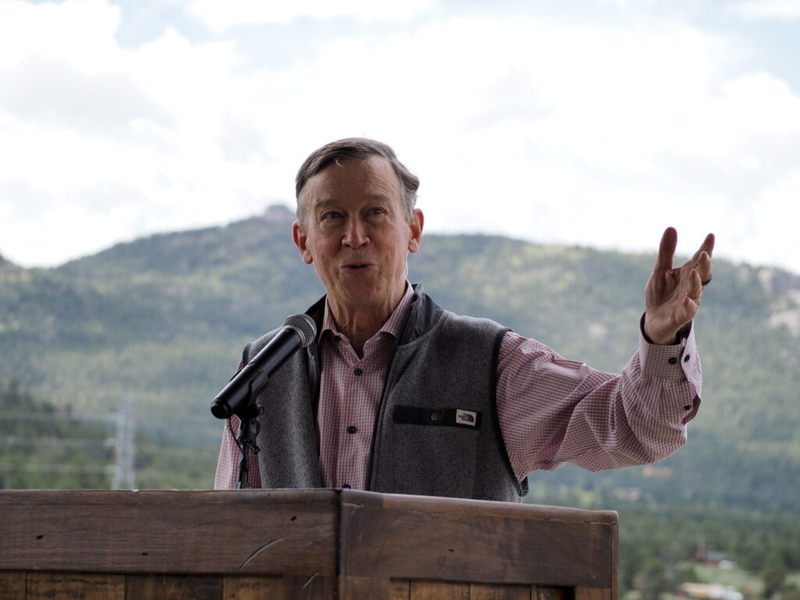
U.S. Sen. John Hickenlooper speaks at a press conference on protecting public lands in 2025 at the Lake Estes Marina. (Lindsey Toomer/Colorado Newsline)
Incumbent U.S. Sen. John Hickenlooper secured the Democratic nomination for U.S. Senate Tuesday night, holding off a primary challenge from state Sen. Julie Gonzales in an election largely defined by Hickenlooper’s absence from the campaign trail.
The Associated Press called the race at 7:36 p.m. Tuesday.
With more than 750,000 votes counted as of mid-day Wednesday, Hickenlooper led with 55% of the vote to Gonzales’ 45%.
Hickenlooper, who turned 74 in February, enters the general election as the heavy favorite over the Republican Senate nominee, state Sen. Mark Baisley of Douglas County. He has said that the six-year term he is seeking would be his last.
“I want to thank every voter who once again put their trust in me,” Hickenlooper said in a video statement posted to social media.
He thanked Gonzales, a two-term state senator from Denver whom he declined to meet in a debate during the campaign, for her “passion and (her) fight for working Coloradans.”
“To your supporters, I hope you will join our fight,” Hickenlooper added. “I’ve always believed we are our strongest when we are united together.”
Gonzales, a progressive leader in the General Assembly since 2019, launched her campaign late last year. After Hickenlooper skipped the Colorado Democratic Party’s March assembly process, opting to qualify for the primary ballot through petition signatures instead, Gonzales took the top spot in the party’s statewide assembly with 74% support.
But her campaign struggled to overcome Hickenlooper’s massive fundraising advantage, collecting just over $869,000 in contributions through June 10, compared to Hickenlooper’s $7.7 million. His campaign used that financial firepower to fund a barrage of TV and digital ads touting his plans for “fighting Donald Trump’s cruelty and turning the page on his chaos.”
In the race’s final weeks, Hickenlooper also benefited from $495,000 in independent expenditures by two super PACs, Common Sense Action Fund and Our Future Colorado, whose donors won’t be disclosed until July 15. Gonzales’ campaign didn’t air ads on television at all. She received about $260,000 in support from super PACs tied to the Working Families Party and the national activist group Indivisible, mostly for digital and text advertising and mailers.
“My heart is full, knowing that we’ve put the Democratic establishment on notice: keep taking folks like us for granted at your own peril,” Gonzales said in a statement. “That has never been more true, despite tonight’s outcome.”
“To our team, our volunteers, and our supporters, thank you,” she added. “Thank you for everything you did and will continue to do to build the movement for freedom, justice, and dignity.”
It’s rare for a sitting U.S. senator to be unseated by a primary challenge — though it’s happened twice so far this year on the Republican side, with GOP Sens. Bill Cassidy of Louisiana and John Cornyn of Texas losing to Trump-backed challengers. Only eight other Senate incumbents have lost their seats in a similar fashion since 1982.
A low-key campaign
Tuesday’s primary marked the second time that Hickenlooper, a former Colorado governor and Denver mayor, has prevailed in a head-to-head Democratic Senate contest. After failing to gain traction as a 2020 presidential candidate, he jumped into the Senate race and quickly cleared a crowded field of Democratic hopefuls, with the exception of former state House Speaker Andrew Romanoff. Hickenlooper went on to defeat Romanoff by a relatively comfortable 18-point margin.
Hickenlooper’s victory over Gonzales followed a campaign in which he refused to participate in a single debate or forum alongside his challenger. The closest the two candidates came to a face-to-face dialogue were separate, 20-minute virtual appearances during a “discussion” hosted by a Durango activist group in February. His campaign declined invitations to at least seven events proposed by Democrats, media outlets and advocacy groups in the final weeks before Election Day, Newsline reported.
Hickenlooper also eschewed many other public-facing staples of a typical Colorado political campaign, including sit-down interviews and voter questionnaires, relying instead on his campaign’s considerable advertising operation to reach voters.
Ideological divide
In his statement, Hickenlooper assailed Trump’s attacks on democracy, including his efforts to undermine Colorado’s vote-by-mail system, and his “unwanted war” with Iran.
“But stopping Trump is just the beginning,” Hickenlooper said. “We need to unrig the system, and deliver the big solutions that Coloradans deserve.”
Gonzales, 42, charged Hickenlooper with practicing “go-along-to-get-along” politics, and with being out of step with Colorado’s young, diverse and increasingly Democratic-leaning electorate.
A Newsline analysis last year found that in the early months of Trump’s second term, Hickenlooper had voted with the president and congressional Republicans nearly a third of the time, despite representing a state that Trump lost by 11 points in 2024 — the largest such gap of any Democratic senator.
His likely return to the Senate for another six years could have substantial implications not only for the remainder of Trump’s second term, but for federal policymaking in the event that Democrats control the White House and Congress after the 2028 election.
Gonzales touted her support for Medicare for All, a Green New Deal, a wealth tax, the abolition of U.S. Immigration and Customs Enforcement and other policy proposals favored by the Democratic Party’s progressive left wing. Hickenlooper, a moderate with longstanding ties to Colorado’s business establishment, has firmly opposed many of those proposals, including during his 2020 presidential campaign.
Editor’s note: This story was updated at 12:36 p.m., July 1, 2026, to include the latest election results and additional comments.
Denver, CO