DEM director warns of ‘devastating’ consequences for R.I. decarbonization mandate under Trump
Nov 26, 2025 | 11:57 am ET
Description
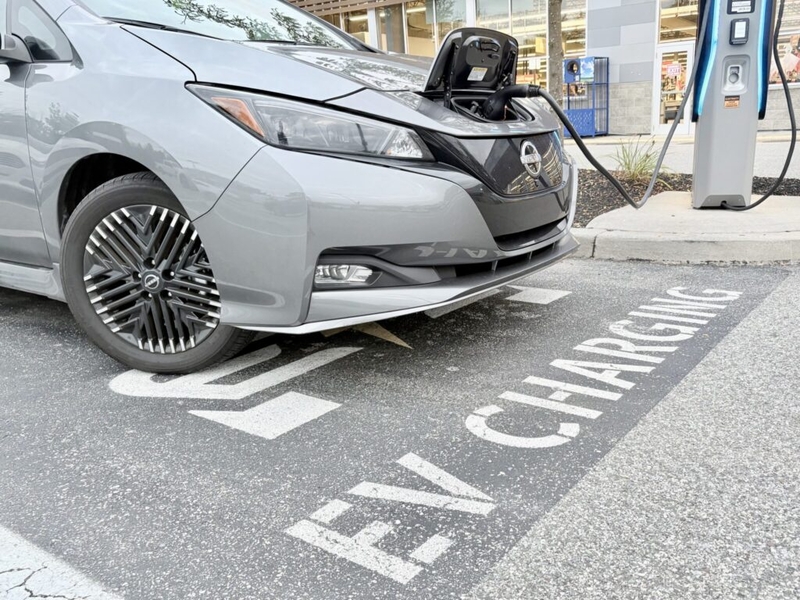
Rhode Island needs to accelerate its adoption of hybrid and battery-powered vehicles in order to achieve the 2050 net-zero carbon emissions mandate. (Photo by Peter Hall/Capital-Star)
Rhode Island Department of Environmental Management Director Terry Gray had reason for optimism when he and other state administrators kicked off their work in November 2024 charting a path to achieving the state’s decarbonization mandates.
“When we first started working on this, Trump hadn’t taken office,” Gray, who heads a consortium of state agencies overseeing the implementation of Rhode Island’s Act on Climate law, said in an interview Wednesday. “We still had very strong federal policies, federal authorities and grants in place. Those three things were really, very important.”
On Tuesday, the Executive Climate Change Coordinating Council released a draft of its first comprehensive review of existing progress and future forecasting to help achieve the state’s net-zero emissions law. The 31-page report is open for public comment through Dec. 10.
And as Gray wrote in his opening letter, recent shifts in federal policy and funding have eroded his confidence in achieving Rhode Island’s aggressive emissions reduction plan.
“These shifts will have devastating and immediate consequences for Rhode Island’s climate planning,” Gray wrote. “While this Strategy focuses on impacts to our climate-change portfolio, the broader federal rollbacks are poised to trigger severe disruptions across energy, environmental protection, health care, and food-security systems, placing extraordinary strain on state agencies and undermining long-standing strategic investments.”
The One Big Beautiful Bill Act yanked more than $75 million in federal funding to Rhode Island for clean energy programs and related research and infrastructure projects. Before that, Biden-era federal tax credits for renewable energy were canceled, more stringent state vehicle emissions standards paused and offshore wind projects set to power New England’s grid were halted or pulled back. Even the federal grants for the climate council to hire a consultant to model state emissions output in future years were temporarily frozen.
“We’re trying to figure out ways to do this without necessarily direct monetary incentives everywhere,” Gray said.
Asked what alternative, nonfinancial incentives might be, Gray responded “I don’t know. That’s what we’re working through.”
And yet, Rhode Island still must meet the legally binding mandate to reduce carbon emissions, with the first benchmark in 2030.
“Rhode Island will forge ahead in the face of this shifting landscape and continue to collaborate across all agencies in 2026 and beyond,” the report states.
The council is charged with updating its assessment in subsequent reports issued every five years through the 2050 deadline for completion.
Establishing the goal line
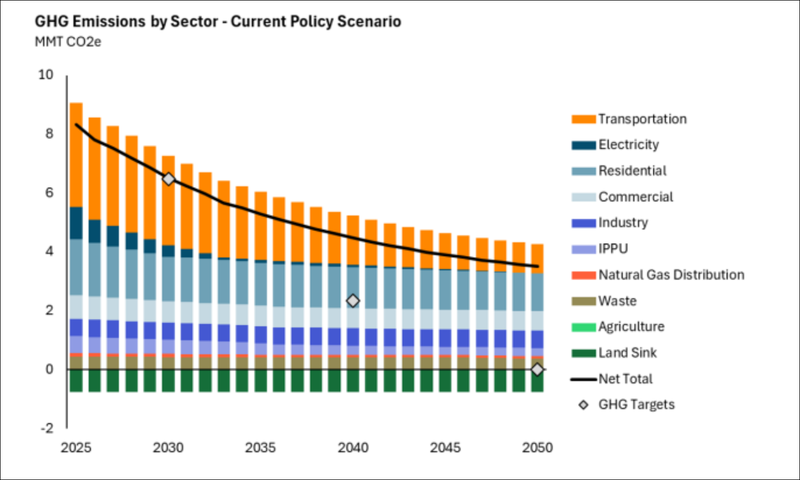
As of 2023 — the most recent data available — Rhode Island produced 9.52 million metric tons of carbon, 19.5% less than the 1990 levels used as a baseline, according to data collected and analyzed by the Rhode Island Department of Environmental Management. The emissions inventory report published last week stressed the need to accelerate incentives and policies that promote a clean energy transition, warning that the existing pace of progress was not enough to meet the first incremental benchmark in 2030.
However, according to the climate council’s models, Rhode Island will meet the 2030 benchmark, which calls for reducing total emissions 45% from the 1990 baseline. This is largely thanks to state incentive programs and policy choices, such as discounts for property owners to switch to heat pumps, weatherize and make their homes energy efficient, and buy or lease battery-powered and hybrid cars, the report stated.
But achieving net-zero emissions by 2050 remains just of reach without “additional ambition,” the council’s draft strategy report states. The report outlines broad steps to speed up the clean energy transition, targeting the biggest culprits of carbon emissions: transportation, home heating and electricity use.
“We still have the challenge of ‘how do we achieve this,’ but at least now we kind of all know what the goal line is,” Gray said of the strategy report.
We still have the challenge of ‘how do we achieve this,’ but at least now we kind of all know what the goal line is.
In order to achieve the 2050 net-zero mandate, for example, Rhode Island needs to accelerate its adoption of hybrid and battery-powered vehicles, including cars, trucks, and off-road sources like boats and airplanes. Specifically, the report recommends nearly tripling annual electric vehicle sales, from the 13,000 sold this year in the state to 36,000 by 2030.
Gray is eyeing the transportation sector with extra concern, noting that Trump has sought to repeal federal waivers letting states, including Rhode Island, adopt more stringent vehicle emissions standards.
Much of Rhode Island’s ability to achieve reductions in transportation sector emissions relies on its authority to set lower emissions standards for new cars and trucks.
“Especially when we look beyond 2030, we have a significant challenge in reducing transportation emissions,” Gray said.
Federal rollbacks have not cooled the state’s incentive program to help property owners convert from oil or gas to electric-powered heat pumps. But surging winter electricity prices have dissuaded some heat pump converts from using their new systems, Gray said.
“We need stability and certainty in electric rates so people actually use their heat pumps,” he said.
Meanwhile, the heat is on to keep selling these greener home heating alternatives.
Every home and business in Rhode Island must have a heat pump installed by 2050 to meet the decarbonization mandate, per report modeling. Achieving this overhaul requires increasing heat pump sales from the 3,000 sold in 2025 to 15,000 a year by 2030, according to the report.

Sticker shock
Convincing cash-strapped consumers and business owners to look to long-term savings versus the upfront costs of a hybrid car or heat pump conversion is not easy, Gray acknowledged. Cost was a top concern cited by residents in a series of community meetings organized by the climate change council this fall.
“There’s got to be more hesitancy now to say ‘where is this all going’ given the rhetoric coming out of the federal government,” Gray said.
But there is also a price for doing nothing — $940 million in “social costs” by 2050, according to the report.
“Decarbonization reduces spending on fossil fuels, avoids the economic and health damages caused by climate change, and delivers cleaner air and healthier communities across the state,” the report states.
Going green will also boost the state economy, adding an estimated 6,500 jobs by 2035 for work on offshore wind projects, battery storage and residential heating and cooling, the report states.
The report concludes with a call to action.
“The decarbonization and transition of our economy must be done carefully, and deliberately with affordability in mind, to meet the goals set forth in the Act on Climate,” it states. “It is important to emphasize that acting on climate change cannot be championed by state government alone. Businesses, municipalities, nonprofit leaders and residents will continue to be called up to prioritize action towards the goals of the Act on Climate.”

Providence, RI