Record-breaking fundraising, billionaire-backed super PACs shape Colorado governor’s race
Jun 10, 2026 | 1:30 pm ET
Description
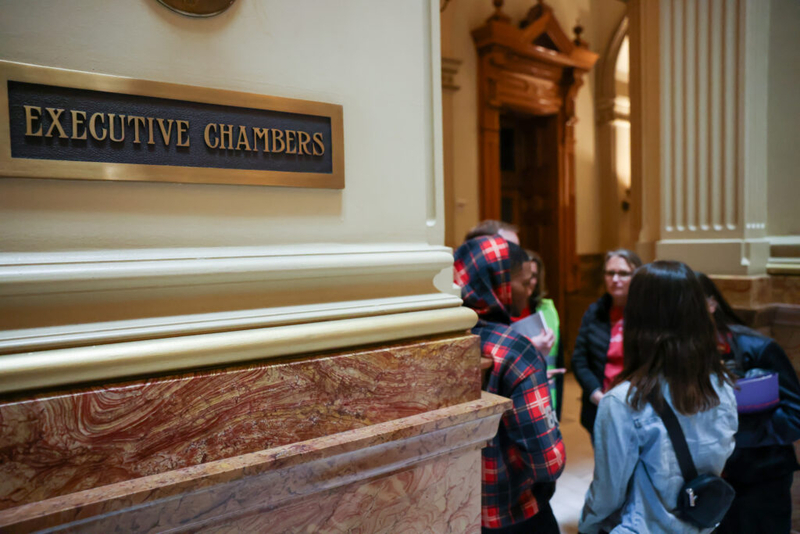
Students and teachers gather outside the Colorado governor's office in 2023. (Kevin Mohatt for Colorado Newsline)
As Colorado’s June 30 primary draws nearer, two strong campaign fundraising performances and a lopsided super PAC spending spree have turned the Democratic race for governor into a $20 million blockbuster.

U.S. Sen. Michael Bennet, whom a recent poll showed as the race’s slight favorite, entered June having received more than $4.6 million in direct campaign donations from his supporters, according to disclosures filed with the Colorado secretary of state’s office.
Bennet’s haul would have set a new record for primary fundraising by a candidate for Colorado governor — if it weren’t for his opponent, Attorney General Phil Weiser, who had raised over $6.4 million as of the same date in his bid to pull off an upset victory over the three-term senator. Weiser’s campaign entered the primary’s final weeks with more than $1.2 million in the bank, substantially more than Bennet’s $388,373 in cash on hand, records showed.
But Bennet’s supporters have more than offset that deficit with the $8 million amassed by Rocky Mountain Way, a so-called independent expenditure committee or super PAC promoting his candidacy.
Unlike candidate committees — which are subject under Colorado law to relatively strict limits, like a maximum donation of $1,450 and a prohibition on corporate contributions — super PACs can raise and spend unlimited sums of money from anyone, but are barred from coordinating directly with candidates.
A pro-Weiser super PAC, Fighting For Colorado, has raised about $1.3 million.
With their combined financial firepower running into the tens of millions of dollars as of the beginning of June, the two Democratic candidates and their supporters are poised to blanket the airwaves and online platforms with advertising spending in the final weeks of the race.
Despite Bennet’s super PAC advantage, the race is a more evenly matched contest than Colorado’s last competitive Democratic primary for governor in 2018, when then-U.S. Rep. Jared Polis eased to victory, having poured an unprecedented $9 million of his own fortune into his campaign by June, while his three opponents struggled to break the $1 million mark.
GOP candidates
Things are more lopsided financially on the Republican side, where Victor Marx, a Colorado Springs ministry leader and first-time candidate, is widely considered the three-way GOP primary’s frontrunner after building a commanding fundraising lead over his opponents.
The $2.3 million spent by Marx’s campaign committee by the end of May was more than four times the $479,385 spent by his closest Republican rival, state Sen. Barbara Kirkmeyer of Weld County. State Rep. Scott Bottoms of Colorado Springs trails behind with $215,785 in total campaign expenditures.
Marx has also benefited from super PAC support from Victory for Colorado, a committee launched last year and shut down in early May, and the Freedom Independent Expenditure Committee, which has spent more than $380,000 to support Marx’s candidacy since being registered in November.
The bulk of Freedom IEC’s funding this year has come from Sema Construction, a Centennial-based civil construction firm that has contributed $400,000 to support Marx’s candidacy.
Kirkmeyer received $93,716 in support in May and June from Colorado Strong, a super PAC that has supported Republican candidates in Colorado since 2017.
The winner of the Democratic primary will be heavily favored to win the general election in November. Coloradans have elected only one Republican governor in the last 50 years, and Democrats are widely expected to gain ground in a favorable midterm election year.
Big donors and lobbyists
Nearly a third of the funding for Rocky Mountain Way, the pro-Bennet super PAC, has come from one source: billionaire former New York City mayor Mike Bloomberg, who has contributed $2.6 million.
The PAC’s second-biggest contributor, at just over $1 million, is Brighter Future for Colorado, a “dark money” nonprofit that does not disclose its donors. The Colorado Trial Lawyers Association and the Colorado League of Charter Schools are also among the top donors to Rocky Mountain Way.
The top donors to the pro-Weiser super PAC, Fighting for Colorado, are Jay Monroe, Jason Mendelson and Jim Kelley, all venture capitalists who have contributed a total of $100,000 each.
At least two donors — philanthropist David Merage and private equity investor Ron Davis — have each contributed at least $20,000 to both the pro-Bennet and pro-Weiser super PACs.
More than 200 other individuals have contributed at least $500 directly to both Bennet’s and Weiser’s campaigns, a list that features real estate developer Pat Hamill, Xcel Energy Colorado president Robert Kenney, and a host of veteran Colorado lobbyists, including Scott Chase, Stan Garnett, Peter Kirsch, Jep Seman and R.D. Sewald.
Primary ballots were scheduled to be mailed to all active registered voters in Colorado this week. Coloradans can consult Colorado Newsline’s 2026 Voter Guide for information on contested primary races.
Denver, CO