Data center backlash spills into Missouri primaries as GOP candidates demand action
Jul 02, 2026 | 10:00 am ET
Description
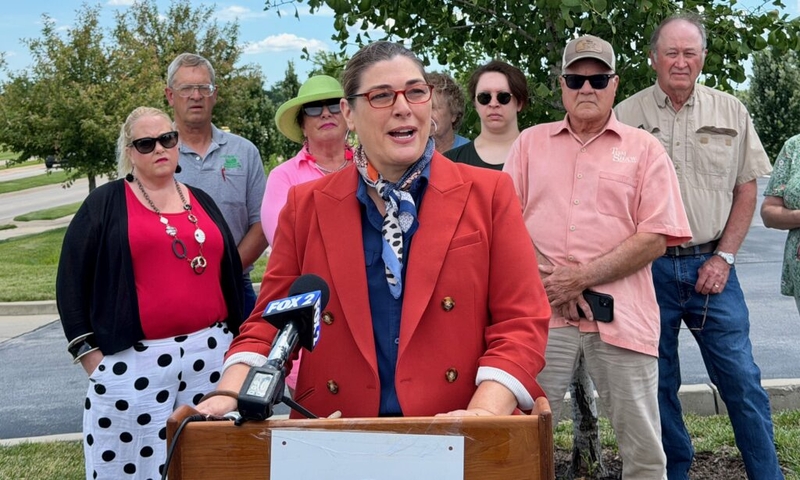
Republican State Rep. Tricia Byrnes of Wentzville describes legislation she plans to sponsor aimed at increasing transparency of discussions between local officials and data center developers during a press conference last week in Wentzville (Steph Quinn/Missouri Independent).
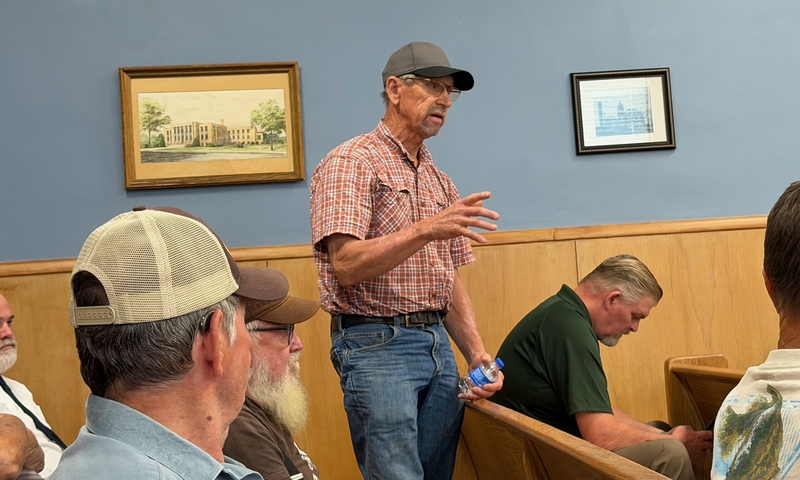
MONTGOMERY CITY — Bill Cope stood before the Montgomery County Commission earlier this month to urge local officials to reject a 25-year, 70% personal property tax abatement for a $15 billion, 934-acre Google data center project under construction outside of New Florence.
“I’m not against the schools or health department or anybody getting more money,” Cope said, referring to expected real property tax revenues from the project. “I think that’s needed. I do. I’m against the abatement part of it, because if [data center developers] are that good, they should come in, and we would welcome them. But pay your fair share.”
Cope’s objection captures the tension now pushing data centers into Missouri’s statehouse politics: Local officials are approving multibillion-dollar projects while lawmakers debate whether the state needs rules on transparency, utility costs, water use and public input before more deals are locked in.
Cope told The Independent he lost about 300 acres of his 1,500-acre corn and soybean farming operation in Truxton when the owner of land he was renting sold to Amazon, which is building a $10 billion data center in New Florence north of the highway. Losing that ground, he said, will drive up fixed costs across the remaining 1,200 acres he farms.
The Amazon and Google data centers, part of a 5,000-acre “Heart of America” industrial mega-site, are among at least five data centers proposed for a 30-mile stretch along the I-70 corridor west of St. Louis. Other data center projects are under discussion in Liberty, Maryville, Independence and Joplin.
As Missouri’s Aug. 4 primary approaches, the promise and peril of data centers have moved from local development meetings into statewide campaign politics.
Data centers have become a flashpoint in fights over constitutional amendments and in nearly every competitive Republican state Senate primary, with candidates turning local frustration over tax breaks, secrecy and development pressure into a campaign issue.
A television ad set against the backdrop of rows of humming data center servers seeks to convince viewers that Amendment 5 would reverse a 2015 law that created sales and use tax exemptions for data center projects, though the Legislature would have to vote separately to undo those tax breaks.
Republican state Rep. Tricia Byrnes of Wentzville, who is running in a hotly contested primary for a seat in the Missouri Senate, last week sketched out legislation she plans to file next year to bolster transparency of data center development and require local officials to allow more opportunities for public input. Byrnes also announced the House Intergovernmental Affairs Committee will convene Sept. 16 to discuss data centers.
And in a letter to Gov. Mike Kehoe last week, 16 Missouri lawmakers asked for a special session of the General Assembly to address “growing concerns surrounding the development of large-scale data centers and the impact these facilities may have on Missouri communities.”
The lawmakers were led by another Republican representative who is running in a crowded GOP primary for Missouri Senate, Don Mayhew of Crocker. They argued data center development is moving too quickly for lawmakers to wait until the General Assembly reconvenes in January.
“The rapid emergence of large-scale data centers and artificial intelligence technologies is creating challenges that existing laws were never designed to address,” their letter reads. “Missouri should not wait until irreversible decisions are made before determining whether adequate protections exist for its citizens.”
Byrnes said her planned bill isn’t finalized, but her priorities include mandated public comment periods for large-scale data center projects and restrictions on nondisclosure agreements preventing local officials from seeking expert opinions on proposals.
“When you’re given an NDA, you start to become fearful if you can ask experts questions you might have, and I want to stop that from happening,” said Byrnes, who served as a Wentzville alderman before being elected to the House and is running to represent the district including the two Montgomery County data centers.
Mayhew, an engineer and former Pulaski County surveyor, posed with a piece of surveying equipment in a video on his campaign’s Facebook page where he said rapid development of artificial intelligence has created “a technological dilemma with data centers.”
“Too many times the legislature is five years behind on legislation, and we need to get ahead of it this time,” Mayhew said.
The role of the state
As lawmakers weigh in on data centers, questions remain about the role of the Legislature in putting up guardrails around decisions that typically fall to local officials.
Legislation last session aiming to shield residents from bearing the costs of data centers’ electricity and water consumption did not get a committee vote.
Sponsored by Republican state Reps. Colin Wellenkamp of St. Charles and Mike Costlow of Dardenne Prairie, the legislation sought to expand on a 2025 law requiring the state’s investor-owned electric utilities — Ameren, Evergy and Liberty — to develop higher rate schedules for large-load electricity consumers, like data centers.
Costlow and Wellenkamp’s bills would have extended that requirement to municipally owned utilities and electric cooperatives, mandating a separate rate schedule for customers expected to have an annual peak demand of 50 megawatts or more.
The bills proposed similar measures for water use. Consumers using more than 2 million gallons of fresh water per day or 80% of local water capacity would have had to pay higher rates and get a permit from the Missouri Department of Natural Resources. The department would then have had to notify county commissioners within 30 days of receiving the permit application and hold a 30-day public comment period.
Costlow told The Independent that the department’s role would be to act “as the objective arbiter to ensure that we are getting correct information and that the locals, when they’re considering these projects, get accurate information.”
He cautioned against state lawmakers compelling additional disclosure during discussions between developers and local officials. While the state should tackle issues of grid integrity and protecting natural resources, he said, “we want local communities to really get engaged.”
That includes residents voting in April elections, as well as local officials communicating with their constituents.
“The real concern that residents have is that their elected officials walk in on day one of the [public] notice, and they already know how they’re going to vote and that they don’t listen to the people that are talking,” Costlow said. “That’s the real big problem, and additional time [for public comment] is not going to fix that trust.”
The goal of the legislation, Wellenkamp told The Independent, is “to empower communities to be able to make a more informed decision for themselves if they want to host a data center or AI infrastructure, and if they do, what controls and demands do they have on those companies.”
Community engagement and decommissioning requirements for developers to properly dispose of outdated facilities or equipment are issues state lawmakers may need to consider in the future, Wellenkamp said.
“Almost pointless”
Last week, hours after Byrnes’ press conference in Wentzville, Montgomery County residents gathered as the Missouri Rural Crisis Center announced the results of a county-wide survey of voters about the data centers in New Florence.
Nearly 85% of the 1,461 people who returned surveys said they opposed the development, while almost 11% expressed support and the remainder said they were undecided.
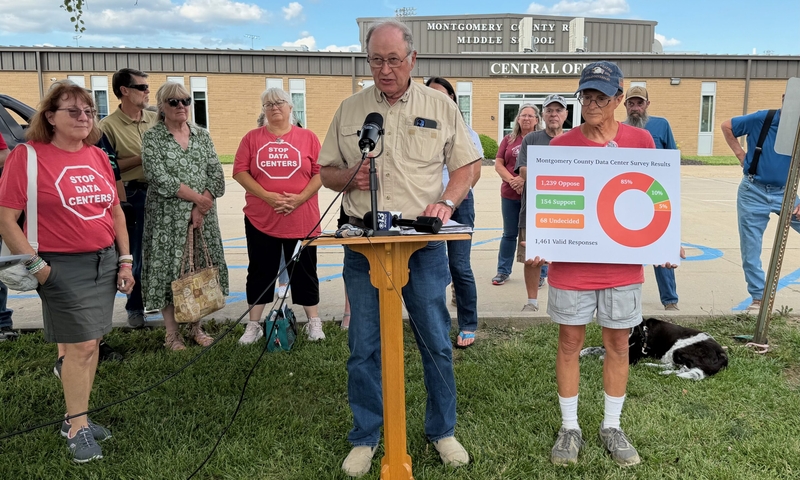
The event took place outside Montgomery County Middle School in Montgomery City, where Amazon was holding a barbecue dinner and public information session about its data center in New Florence.
Tom Westhoff, a retired conservation agent for Montgomery County who spoke at the event, described the potential environmental threats of data center development. He also told those gathered that the public information session came too late.
“An informational meeting at this time, when all the contracts have been signed and construction is already underway, is almost pointless,” Westhoff said. “Why were we not given the opportunity months ago to talk to the Amazon people?”
Jefferson City, MO