‘Congress, do your job:’ Checks and balances depend on voters, too
Sep 23, 2026 | 6:36 pm ET
Description
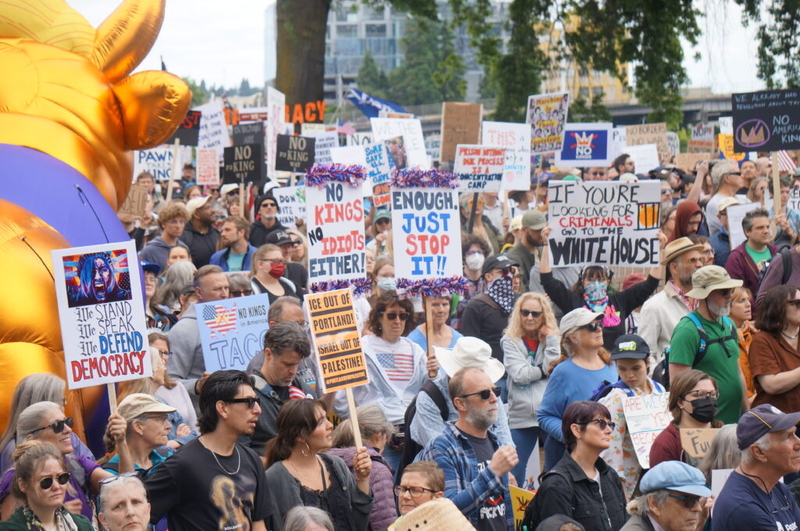
Tens of thousands showed up at the 'No Kings' protests in Portland, Oregon on Saturday, June 14, 2025. (Photo by Alex Baumhardt/Oregon Capital Chronicle)
“Congress, do your job.” That was a repeated refrain at this summer’s convention of the nonpartisan League of Women Voters in Columbus, Ohio. Whether Republican, Democrat, Independent or every member with an affiliation in between, there was serious concern regarding our U.S. checks and balances.
You may love or loathe the current executive administration, but since we are not an autocracy, we cannot lay the blame of all government action at the feet of President Donald Trump. It is the duty of Congress to protect checks and balances.
Further, it’s the duty of voters (hopefully all of us) to hold Congress accountable.
As a collective body, the Congress of the U.S. has abdicated its duty. It has failed to use its Constitutional authority to protect this unique system of checks and balances. By declining to take action, the assembly has jeopardized rights of Americans, worsened our weakening pocketbooks and endangered democracy itself by ignoring its oversight of tariffs, budget, immigration, due process, war and more.
Despite our party registrations (if any), we can appreciate the risks stemming from examples such as these below.
- Article 1, Section 9 grants Congress the power of the purse to approve spending in the federal budget. While Congress may allow the president discretion on how to implement programs for which it appropriates money, the president cannot decide whether to implement them. Nevertheless, numerous executive orders have paused, frozen, blocked, or restricted federal funds in some way, blatantly disregarding both congressional authority and constitutional requirements. Congress often remains silent.
- Article 1 Section 8 empowers Congress to “lay and collect taxes, Duties [tariffs], Imports and Exports and regulate commerce with foreign nations.” Yet the administration has imposed tariffs without Congressional approval. The Supreme Court reversed the earlier bulk tariffs, not Congress. Various tariffs or threats of them remain.
- The Fourteenth Amendment specifies that all people should be given due process. However, there are numerous cases of people being imprisoned and deprived of their liberty without due process. Congress has a duty (as a check on executive power) to intervene to stop the practice of detaining people unlawfully and/or without due process. Due process is not a matter of “us vs. them” or due process only to those with whom we agree.
- Article 1 Section 8 Clause 11 specifies that Congress shall have the power “To declare war, grant letters of marque and reprisal and make rules concerning captures on land and sea,” yet the executive branch has entered into military conflicts with Venezuela and Iran without Congressional authority.
Perhaps we need to think of voters as a fourth branch of government, joining the executive, judiciary and congressional branches. This fourth branch needs to do its job as well. To both declare “Congress do your job,” and more importantly to hold each member accountable.
Salem, OR