Clean Elections tells court it must investigate Green Party fraud claims
Sep 23, 2026 | 7:22 pm ET
Description
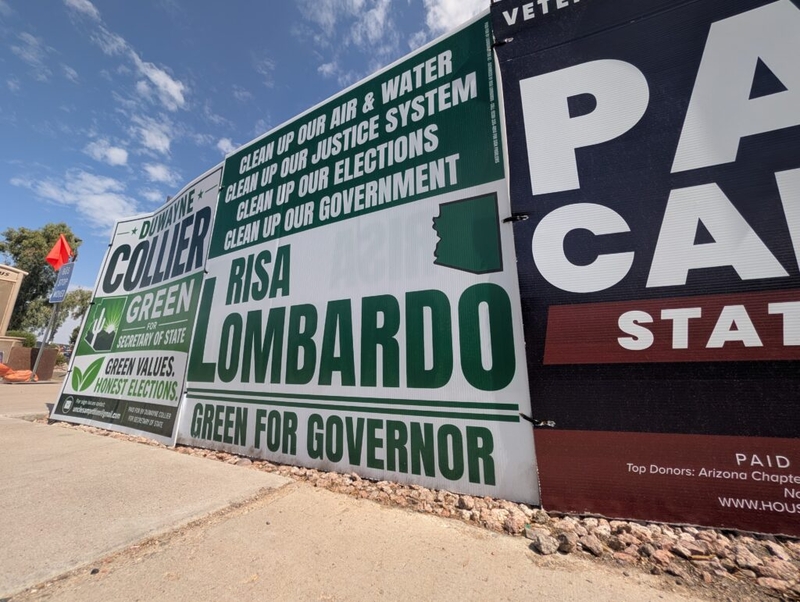
Green Party candidates Risa Lombardo and Duwayne Collier are running for statewide office using Clean Elections money. At least six voters say that they have no idea why they are listed as having made small-dollar donations to help Lombardo, Collier and GOP gubernatorial candidate Scott Neely qualify for the public campaign funding. (Photo by Jim Small/Arizona Mirror)
The Arizona Citizens Clean Election Commission says that its investigation into whether two Green Party candidates fraudulently qualified for campaign funding is squarely within the scope of its legally mandated job of protecting the state’s public campaign finance system, and that a Maricopa County Superior Court judge should throw out the candidates’ lawsuit to block the commission from doing that job.
“It is not optional for the Commission and its representatives to enforce the provisions of the (Citizens Clean Election Act) at issue here,” the commissioners said in their response to the lawsuit.
Risa Lombardo and Duwayne Collier, the Green Party nominees for governor and secretary of state, filed a lawsuit earlier this month that accuses the Clean Elections Commission of violating their First Amendment rights by launching an investigation into whether they falsely qualified for millions of dollars in campaign cash. They want a judge to block the investigation and block the Commission from forcing them to repay the money.
Lombardo, Collier and Republican Scott Neely, who lost his primary for governor to Andy Biggs, are all being investigated by the Citizens Clean Elections Commission and the Arizona Attorney General for allegations that they falsified documentation for enough $5 contributions from voters to qualify for a collective $4.7 million in public campaign funds.
Last month, the Arizona Mirror reported that six people who were listed in campaign finance records as having made $5 contributions to all three candidates were adamant they didn’t give any money to the candidates.
In the commission’s response to the lawsuit, its attorneys wrote that the court should not grant the injunction as it didn’t have authority to interfere with the commission’s investigation, which is mandated by state law.
Like other Clean Elections candidates, Lombardo, Collier and Neely agreed to forgo large contributions and money from PACs in exchange for a fixed amount of public funding, based on the office they seek.
As a condition of their participation, candidates agree to follow a long list of Clean Elections rules, including increased reporting requirements about how they spend campaign money.
Now that they’re facing the scrutiny they consented to in exchange for public funding, Lombardo and Collier cannot exempt themselves from state law and Clean Elections rules, the commission’s attorneys wrote.
“By accepting the certification as a participating candidate, and especially by accepting the public Clean Elections funds accompanying that certification, the Plaintiffs accepted the obligation to abide by all the (Citizens Clean Election Act) terms, prerequisites, and campaign finance controls and restrictions, including the existing and transparent Commission investigation and enforcement procedures,” the commissioners wrote in their response to the lawsuit. “The Plaintiffs made no objections to such terms until just recently when they became the subject of an investigation.”
Lombardo and Collier have already been subject to political scrutiny after the Arizona Green party disavowed their candidacies and accused them of being Republicans in disguise.
After Tom Collins, the executive director of the Clean Elections Commission, announced on Aug. 25 that the commission was investigating the three candidates, Tim La Sota, Lombardo and Collier’s attorney, said the accusations were “nothingburgers” and conspiracy theories relayed to the candidates “in a menacing manner.”
On Sept. 10, the pair filed a lawsuit in Maricopa County Superior Court, saying that Collins was attempting to bully them into ending their campaigns.
The bullying they described were letters to Lombardo and Collier informing them of the investigation, recommending that they obtain legal representation and advising them to stop spending the public campaign funds, as they could be required to repay them.
La Sota asked the court to block the Clean Elections Commission from “decertifying” them as Clean Elections candidates so that they could continue their campaigns, using the public funding they received. He argued that, because the secretary of state and county recorders certified that the candidates collected enough $5 contributions to qualify for public funding, the commission had no power to “decertify” them and make them return the money.
Lombardo and Collier also argued that they had a First Amendment right to spend the public campaign money however they see fit.
Both the commissioners and Collins responded by saying that the candidates’ right to free speech had not been infringed upon simply because they’d been advised of an investigation, and they are subject to rules they agreed to in order to receive Clean Elections funding.
“Plaintiffs remain free to spend the funds in their accounts, subject to the risk that those expenditures may later be deemed improper and added to any repayment obligation — which has always been the case and which they agreed to when deciding to participate under the Act,” Collins said in his response.
But La Sota argued that the commission and Collins were hamstringing the candidates by advising them not to spend the funds, with plans to end the investigation by Oct. 29, just days before the election.
He also argued that the commission hadn’t proven any wrongdoing by the candidates.
So far, he wrote, Collins has only shared his suspicions that the candidates violated campaign finance law, not his full investigation, which isn’t complete.
La Sota pointed out in the lawsuit that the people who spoke to the Mirror admitted that the signatures on the false $5 donation slips looked like their signatures.
He failed to note that all six of them said they had signed unrelated petitions in grocery store or marijuana dispensary parking lots within the past year, and believed their information and signatures had been taken without their knowledge from the petitions and used instead to qualify the candidates for public funding. And all of them said that they were certain they never gave any of the candidates $5 to help them qualify.
The Mirror found that thousands of donors were listed as contributing $5 to all three campaigns on the same days. Many of them had never made a contribution to any other candidate, according to campaign finance reports.
While La Sota argued that Collins’ investigation largely relied on the Mirror’s reporting, Collins told the commission at its Aug. 27 meeting that he’d already been in the midst of his own investigation when the story was published. The Mirror’s reporting confirmed what he’d already found, he said.
La Sota said that the commission’s investigation was based on “crackpot conspiracy theories and a newspaper article with six hearsay statements. And how do we know that these hearsay statements reflect actual reality? We do not know if these people simply forgot contributing $5, or something more nefarious is at play. We do know the Commission has zero evidence tying the actual Candidates to this wrongdoing, and the Candidates have denied any knowledge under oath.”
Oral arguments in the case are set for Sept. 24 in Maricopa County Superior Court.
Phoenix, AZ