Colorado Attorney General Phil Weiser sues to stop ICE detention center in Hudson
Sep 29, 2026 | 4:48 pm ET
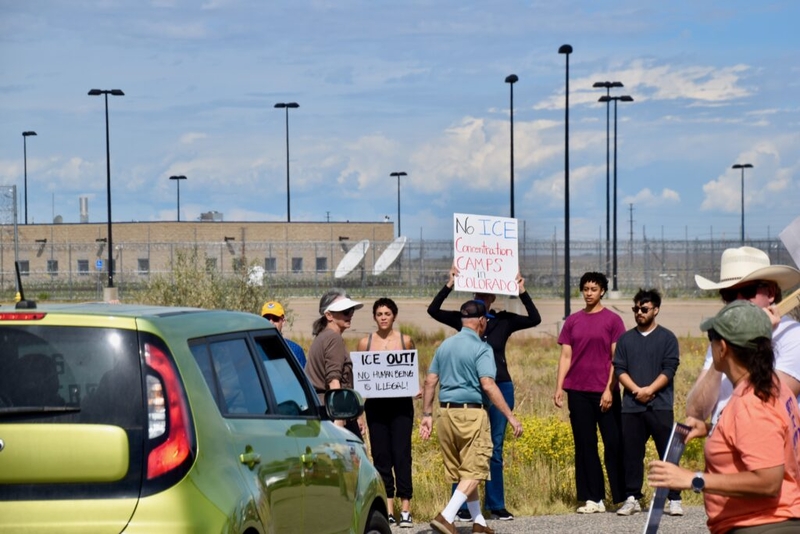
Description
Protesters demonstrate against Immigration and Customs Enforcement outside the empty Hudson Correctional Center on Sept. 13, 2025. (Photo by Chase Woodruff/Colorado Newsline)
Colorado Attorney General Phil Weiser sued the federal government on Tuesday in an effort to stop or delay the opening of a new immigration detention facility in Hudson, alleging that the agencies in charge failed to perform a statutorily-required environmental review or provide information to the public before finalizing the plan.
The lawsuit is very similar to one filed last week by two advocacy organizations over concerns that the U.S. Department of Homeland Security and U.S. Immigration and Customs Enforcement ignored requirements of the National Environmental Policy Act before entering into a contract with The GEO Group to open and operate the new detention center. The state also alleges that the agencies violated the Administrative Procedure Act and the Immigration and Nationality Act.
Weiser’s office wants a judge to cancel the contract and stop any ongoing preparations for the detention center’s opening until the Trump administration completes the required analysis.
“Neither DHS nor ICE engaged in the required public review process involving the necessary analysis of potential environmental impacts from any of the construction, renovation or operation of this facility,” Weiser said Tuesday. He called the lack of transparency by the federal government “stunning.”
Weiser, a Democrat, is running for governor and has led or joined dozens of lawsuits challenging actions by the Trump administration over the last two years.
“Even though this proposed facility would nearly double the town’s population, the federal government is ignoring the basic legal requirement to determine what effects its actions could have on nearby residents and the surrounding environment,” he said.
GEO secured a contract with ICE earlier this year to reopen a shuttered 1,250-bed prison in Hudson as an immigration detention center, dubbed Big Horn. The company currently operates the Aurora immigration facility, which has been the subject of numerous complaints about living conditions, medical neglect and public health concerns.
“We know how Coloradans, including me, are concerned about the opening of another immigration detention facility carrying out what I’ve said before is an often illegal and inhumane mass deportation policy,” Weiser said, noting that his office has received thousands of complaints about the Aurora facility.
NEPA, the federal environmental law, requires agencies to compile an environmental impact statement, complete an environmental assessment or seek a valid exemption from environmental review before major actions like construction. The Department of Homeland Security has done none of that, and the lawsuit contends that both development and operation of a new detention facility would stress the town’s water infrastructure, worsen air pollution and endanger nearby protected wildlife. A mule deer migration corridor is half a mile from the site, and a protected habitat in the Box Elder Creek is about one mile away.
Hudson’s recent Water Supply Master Plan, for example, recommends expanding the drinking water treatment plant and opening another well if the facility reopened and reached capacity. The lawsuit also notes that when it operated the site as a private prison, GEO violated wastewater pretreatment requirements, which have become more strict in the years since.
“There is no indication in the public record that Defendants considered the water resource impacts of their decision prior to entering into a contract to renovate and operate the facility,” the lawsuit reads.
Homeland Security has previously completed environmental reviews for new immigration detention centers pursuant to NEPA, including for sites run by private contractors. Because the department has not explained its change in position for the Big Horn project, state lawyers argue it violated the Administrative Procedures Act. Additionally, the lawsuit alleges that the agencies violated the Immigration and Nationality Act by not ensuring the facility is “appropriate” for immigration detention. Its previous use as a private prison does not automatically make it suitable for immigration detention.
“This has been a shuttered facility for quite some time,” he said. “It can’t just be picked up and put into use without going through the required reviews. They are there for a reason.”
Weiser said it will be up to a judge whether to merge the two similar lawsuits.
The department did not immediately respond to a request for comment on the new lawsuit.

Denver, CO