Citizens Research Council outlines impacts of Mop Up Michigan initiative
Sep 29, 2026 | 4:51 pm ET
Description
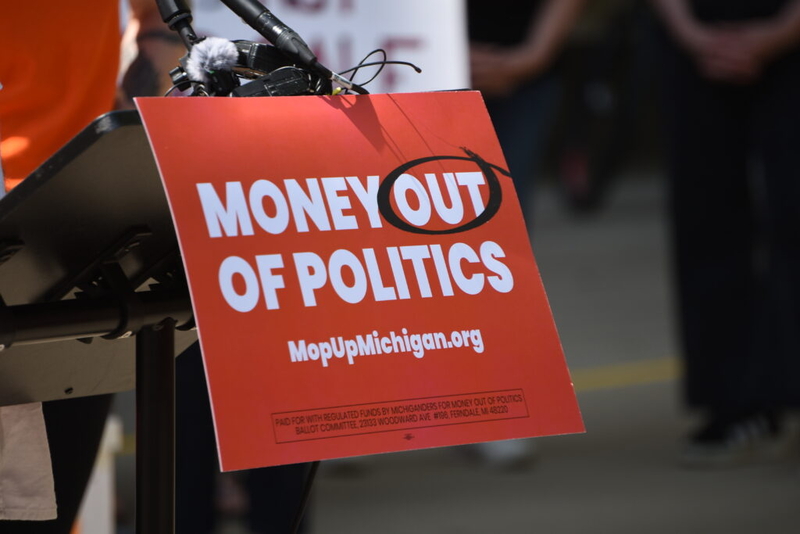
Michiganders for Money Out of Politics submitted its signatures in Lansing to make the November 2026 ballot. May 27, 2026. | Photo by Katherine Dailey/Michigan Advance.
As absentee ballots make their way to voters, Michigan residents this election season are faced with another question beyond just candidates running for various offices.
Among the final questions on the ballot is Proposal 2, also known as the Mop Up Michigan Initiative. The committee backing the ballot effort, Michiganders for Money Out of Politics, says the proposal would help hold politicians accountable to the people rather than corporations by banning government contractors and regulated utility companies from making political contributions to candidates for state and local office.
On Tuesday, members of the Citizens Research Council of Michigan, a nonpartisan, nonprofit public affairs research firm focused on providing factual information about state and local government, released a report breaking down what the proposal does, how it could affect the state’s political environment and potential challenges the proposal would face, if it is approved by voters.
Speaking with reporters, Research Associate Karley Abramson explained that the proposal addresses three key issues by amending the Michigan Campaign Finance Act. It would require “paid for by” disclosures on certain political ads distributed on the internet; expand donor and spending disclosure for certain types of political ads; and would restrict certain campaign contributions from regulated utilities, government contractors and their principals.
If enacted, a three-fourths vote from the Michigan House and Senate would be needed in order to amend the law. Abramson also noted that the proposal includes a severability clause, meaning that if any part of the proposal is found unconstitutional, the unaffected pieces would remain in effect.
Potential impact
The proposal’s opponents argue that the effort impinges on free speech, with Abramson telling reporters the proposal will likely face challenges over its restrictions on government contractors’ and utility companies’ political donations.
In Citizens United v. Federal Election Commission, the U.S. Supreme Court ruled 5-4 in 2010 that political spending is considered speech, and that the only permissible justification for most restrictions would be to prevent quid pro quo corruption.
“Generally the public favors stricter controls on money in politics, but this is an area where there aren’t a lot of more robust laws because of the high bar that SCOTUS has set for restricting political speech,” Abramson said. “So there’s only so much that any state can do to really tackle this issue under the current framework.”
As such, the proposal limits its scope to a few specific targets Abramson said, before explaining its first, closing loopholes in campaign finance disclosure loopholes.
Michigan’s existing law doesn’t explicitly require internet ads to include a disclosure of who pays for them, Abramson explained, noting that the proposal tweaks the language to try and address that.
The proposal also aims to ensure issue ads that effectively function as campaign ads are required to disclose their donors, Abramson said, emphasizing that changes should not impact true issue-centered ads.
“Ultimately, this will lead to more transparency about the spending and the donors,” Abramson said.
She noted that the disclosure requirements could deter some groups from running political ads. There could also be some additional cost to both the groups and the state to make sure they comply with the law, Abramson said.
While Abramson raised concerns that some language within the proposal could restrict disclosure requirements to a 100-day window ahead of the general election, she told reporters this is something that could be a potentially easy fix.
Constitutional questions
Looking at the restrictions on political spending, the proposal focuses on two groups: state and local contractors with more than $250,000 in annual contracts, and rate-regulated gas and electric utilities. Owners with a 5% or higher stake in the utility or the contractor, board members, individuals in the executive suite and their family members, lobbyists and groups controlled by these individuals would also be barred from making political contributions.
There would be an 18-month implementation period for the ban on contractor donations. If a contractor knowingly and willingly makes a donation prohibited by the proposal, the contract can be canceled and the contractor will be banned from receiving contracts for a year. However, there is a 30-day window where an unlawful contribution can be returned.
As far as the impacts, Abramson noted that this change would affect thousands of contracts valued at $250,000 or more at the state level and could come with a high cost to ensure the law is enforced.
The change could also deter contractors from wanting to do business with the government, Abramson said, creating a smaller pool of contractors.
As far as utilities, it’s hard to know the total amount of contributions that will be impacted, Abramson said, noting that utility companies give a lot of money as campaign contributions.
However, the proposal does not bar utilities from shifting that money into outside spending independent from political campaigns.
“Even if the political influence is affecting the regulatory process, campaign contributions are only one part of the political spending,” Abramson said, noting that utilities could just spend their money on ads.
Additionally, while Michigan residents have raised frustration with poor energy reliability and high energy bills, demanding better accountability from their electrical providers, the economic reality is that utility performance and energy rates are working in opposite directions, Abramson said.
The report also notes that regulatory capture, where agencies intended to protect the public are dominated by the groups they are tasked with overseeing, can occur with or without political contributions.
Looking at the potential for a constitutional challenge, Abramson noted that restrictions on political contributions must be closely drawn.
While the U.S. Court of Appeals for the D.C. Circuit has upheld restrictions on federal contractors making political contributions, Abramson said the ban included in the ballot proposal is broader, and could see a challenge on those grounds.
In order for the ban on utility contributions to survive a constitutional challenge, proponents would have to articulate a way in which the energy utility industry holds a particularly high risk for quid pro quo behavior and why this risk applies to utilities and not other industries impacted by government action, Abramson explained.
Even if the court finds that there is a quid pro quo risk, the proposal could still be subject to narrowing, Abramson said.
Ultimately, the report concludes that Proposal 2 could bring additional disclosure requirements and new restrictions on political contributions, but the extent of its impact would depend in part on how the law is implemented and whether its provisions withstand legal challenges.
Lansing, MI