SC governor recognized for preserving records, making them easy to access
Sep 23, 2026 | 6:09 pm ET
Description
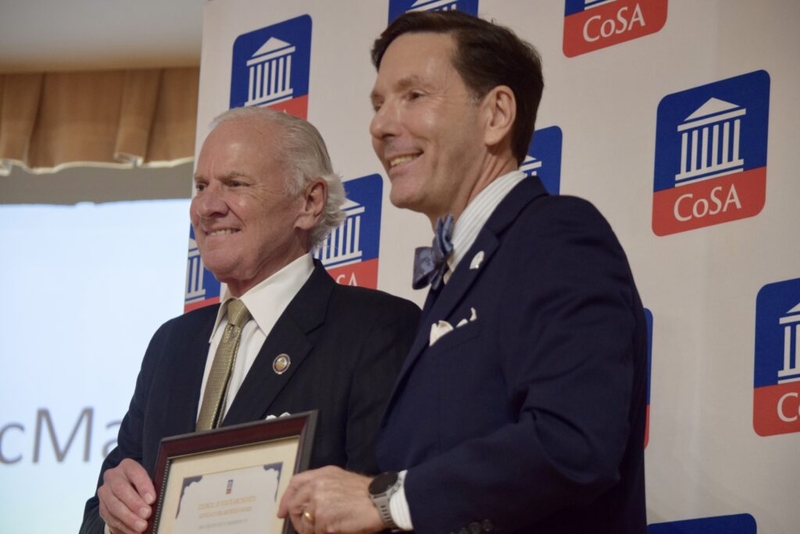
South Carolina State Archivist Eric Emerson, right, presents Gov. Henry McMaster, left, with a national award recognizing his contributions to state records preservation Wednesday, Sept. 23, 2026, at the state Department of Archives and History. (Photo by Jessica Holdman/SC Daily Gazette)
COLUMBIA — During his tenure as South Carolina’s attorney general, now-Gov. Henry McMaster fought in court to retrieve a trove of Civil War gubernatorial papers taken from the government’s possession in 1865.
He argued the case through U.S. Bankruptcy Court, U.S. District Court and subsequent appeals, said Eric Emerson, director of the state Department of Archives and History.
As governor, he backed efforts to preserve the seven state constitutions adopted throughout South Carolina’s history, beginning with a temporary framework enacted in 1776 and culminating in the document ratified in 1895 that still governs the state.
And he supported state budget requests to hire more archivists and make records stored on microfilm accessible online.
It’s for this work that state archivists across the country recognized him with their association’s Advocacy for Archives Award.
McMaster became the first governor in the Council of State Archivists’ 37-year history to receive the award given to government employees and officials who spent their careers committed to archives and record keeping.
“We’ve had members of Congress and U.S. senators, but this is the first time for a governor,” said the association’s executive director Joy Banks.
To know history, someone has to record it, McMaster said in accepting the award Wednesday during the organization’s conference in Columbia.
“Without a knowledge of history, without people preserving that history, then it’ll be lost,” he added. “And if it’s lost, then we’re all lost.”
Beyond historical documents, Emerson said the governor also has cooperated with the state’s archives agency to preserve present-day records from his own administration, as well as that of former Gov. Nikki Haley.
Over the past several months, Emerson said the governor’s office has transferred all paper records to the agency and is in the process of transferring digital records.
When Haley was appointed as President Donald Trump’s first U.S. ambassador to the United Nations, it was McMaster’s staff who transferred her gubernatorial records as McMaster transitioned in January 2017 from lieutenant governor to the Governor’s Mansion.
“He was pivotal in making sure that those records were preserved and so really set the standard,” Emerson said.
Haley, early on in her tenure, faced criticism after public records requests from media outlets revealed her office routinely deleted emails.
In response, Haley signed a new records retention policy with the state archives — the first of its kind in 40 years.

Emerson called executive correspondence, whether written or digital, “vital to what state government is doing.”
“Government records are really an essential component of democracy,” Banks added. “Without the preservation, the protection, and making accessible the record to the people, then you lose that picture of who we are as a country,”
She said the national association also strives to educate the next generation on the importance of government transparency,
“These records are theirs. The government is theirs,” Banks said. “The things that are held in these archives and records management centers across the country create the receipts to let us know the work that we’ve elected public servants to do and lets us hold them accountable to things.”
Columbia