Clap during a city meeting in Emporia and you too might be hustled off to jail. Just ask Lux.
Aug 09, 2026 | 4:33 am ET
Description
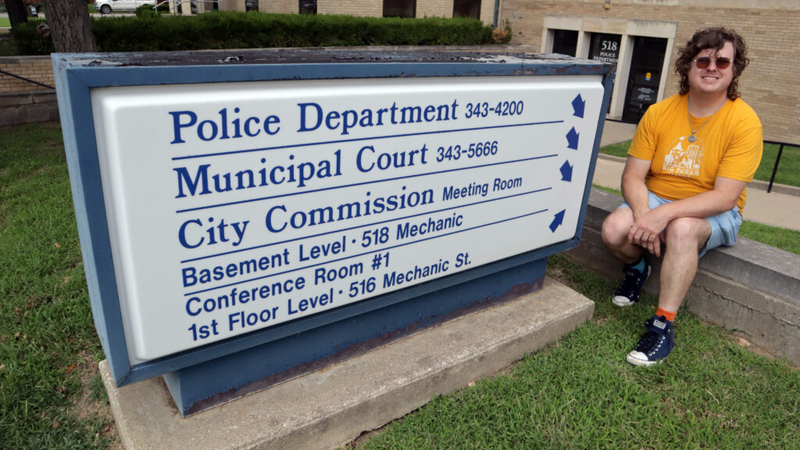
When high school physics teacher and data center opponent Lux Claridge, 37, was arrested for clapping during a city commission meeting last month, the video of their arrest made national news. Claridge — seen here Aug. 4, 2026, outside the Emporia city offices — was booked into jail on charges of disorderly conduct and interfering with law enforcement. (Photo by Max McCoy/Kansas Reflector)
Lux Claridge isn’t who you’d expect to be busted for disorderly conduct. The 37-year-old high school physics teacher is soft spoken and has quick green eyes beneath a mop of brown hair. Wearing a yellow tee promoting a bicycle festival in northwest Arkansas, a pair of pale blue shorts, and with one blue sock and one orange sock stuffed into the tops of new generation Chuck Taylors, they exude a kind of natural calm.
But Claridge is Public Enemy No. 1 to the Emporia City Commission.
Claridge has become the face of data center resistance for my town of Emporia, in east-central Kansas, and much of the nation, because video of their arrest after clapping at a July 22 city commission meeting went hyperscale. Yes, clapping. There were at least three television stations on hand and dozens of smartphones in hand to capture Claridge being hauled by police out of the commission room at city hall, up the steps outside and into the back seat of a police car.
The video was carried by CNN and the arrest was reported in outlets as varied as the New York Post and 404 Media. As Wichita Eagle columnist Dion Lefler dryly noted, “this was not a good look for Emporia.”
But the optics have been painful ever since the data center proposal was unveiled June 2 and the city commission unanimously voted to annex 1,000 acres for the project on the west edge of town the very next day, despite heavy public opposition. Where was the fire? It was coming from inside the station all along. City leaders have been ignoring the public and committing civic arson ever since.
Then there is Gary Pinkston, the Chase County native and West Coast real estate developer who was introduced to the public as the folksy and benevolent developer of the Flint Hills Digital Campus project, but who is entangled in a messy personal and business Chapter 11 bankruptcy.
Pinkston’s credibility was shot when it was revealed he testified in a bankruptcy hearing in June that he had no personal interest in the project. He also swore he did not write “A Message to My Neighbors in the Flint Hills,” a column that identified him as the developer of the project. Pinkston is second in crowd unpopularity only to Garrett Nordstrom, the sharp-dressed Lawrence grant specialist and municipal consultant who has represented the project at various city meetings. Unsurprisingly, much of the Flint Hills Digital Campus website is no longer publicly accessible. It is password protected. Some of the information appears at another site, gosouthwind.com, but Pinkston’s name is absent
It’s been all smoke and mirrors since June 2.
Seven weeks in, the data center has fractured this community of about 25,000 on the edge of the Flint Hills, dividing those who are for it — the pooh-bahs at the local Regional Development Association, Emporia Main Street, and the local Chamber of Commerce — against a diverse swath of the public united in outrage over the secrecy of the project, the environmental effects that accompany data centers, and the existential question of whether data centers are good for humanity. What is happening in Emporia is similar to the push for data centers across rural Kansas, an economic development gold rush threatening to turn thousands of acres into a silicon prairie.
A resistance group, Emporia Neighbors United, has organized protests and mounted petition drives aimed at stopping the data center by resolution or referendum, recalling city commissioners, and seeking to change the structure of city government from a commission to a council. Commissioners are elected at large, Neighbors United founder Jay Vehige told me, which favors the wealthy and the well-connected. With a council, the city would be divided into wards, with some candidates being elected from poor and working-class neighborhoods.
While the petition to recall Commissioner Erren Harter, and another to reform the city government, are still being circulated, a petition asking for an ordinance to ban “high impact data centers” or to put the question to a citywide vote was verified by the county election official on July 21. The petition met the 805-signature threshold, which amounts to 25% of registered voters. The clock began ticking on the city’s 20-day deadline to adopt a resolution banning data centers or put the issue on the Nov. 3 ballot.
I ran into Vehige the other day, outside the city offices. He said he had been trying to visit the city clerk’s office to check on the status of some open records requests he’d filed, but found the outside doors were locked. He said he finally gained entry by going through the water department. The controversy over the data center has city officials so rattled they’re apparently afraid to answer the door.
The Claridge arrest drew national attention to Emporia at a time when anger over data centers has coalesced into a new grassroots political movement. Factions who traditionally disagree on immigration enforcement or gun rights are finding common ground in their opposition to data centers, with concerns ranging from environmental pollution and higher utility rates to what more artificial intelligence may do to us as a society. The opposition also stems from a feeling that we are losing agency in our own lives, that we’re being forced to accept big and faceless tech whether we like it or not, that our decisions are increasingly made for us wholesale.
The question in Emporia isn’t technical. It’s not about Luddites resisting progress, or civic leaders as Ayn Randian visionaries. It’s about who government ultimately serves. It’s about who you can trust.
Despite hours of public testimony at rezoning and other hearings that ran about 6-1 against the data center, city officials have plowed ahead, giving the project green lights at every step of the way.
It is clear they don’t a damn about how the public feels.
Watch the video stream from the July 22 commission meeting in which Claridge was arrested. The audience is warned not to applaud in support of those speaking during the public hearing and then is forbidden from snapping fingers or even silently waving hands. Such behavior was deemed “disruptive.” But Claridge continues to clap, and as their wife, Jessica Danford, approaches the lectern to give her two minutes of comment in opposition, Mayor Becky Smith, apparently prompted by another commissioner, instructs police to remove Claridge.
Claridge tells police they have a right to be there and a right to clap.
“Drag me out,” Claridge says resignedly.
Claridge then goes to the floor. Three police officers, including the chief, carry them out of the room.
The five commissioners look on without a word urging restraint. Harter puts his hands on top of his head, as if signaling internal distress. Smith attempts to calm Danford, telling her it’s “OK.” But the commotion caused by Claridge’s removal is by far the most disruptive thing to happen during the meeting, and it is self-inflicted.
A leader, at this point, might have calmly suggested that Claridge should stay. A leader might have urged compassion over cruel adherence to arbitrary rules. But there were no leaders in that moment. There were only tinpot tyrants who cared more about decorum, which always favors those in power, than the opinions of the public they are elected to serve.
Still waiting to speak, Danford begins to cry.
“Please don’t hurt them,” she pleads.
Then the video stream was paused as the commission took a 10-minute break. Meanwhile, Claridge was booked into the county jail, made to change into an orange jumpsuit, and informed they were facing two charges, of disorderly conduct and interference with law enforcement. They were given a summons with a court date of Sept. 10 and released after Emporia Neighbors United raised $385 for their bond.
When I asked Claridge why they didn’t leave when asked, they said it was improper for the commission to order no clapping in the first place. It was a First Amendment issue, they said. Claridge has retained an attorney and intends to fight the charges.
“The Emporia Police Department remains committed to ensuring public meetings are conducted safely and in an orderly manner,” the city declared in a statement, “while also respecting the rights of all citizens to participate in the civic process.”
Claridge was engaging in the kind of civil disobedience and passive resistance practiced by Henry David Thoreau and Martin Luther King Jr. There was nothing unsafe in what Claridge was doing, and any disorder was the result of overreaction by the commission and police.
On Aug. 5, the city commission met again, but this time the public had less of an opportunity to participate because the meeting was held virtually. The session was live streamed, but no public comment session was allowed. The reason for the virtual meeting, according to a press release, was “public safety.”
The next meeting, set for Aug. 19, also will be held remotely.
“I want everybody to know that these were real threats,” Smith said during the meeting. “Our security was upped. And it’s not necessarily the locals. There are threats from all over the world and all over the country, and all it takes is one. And I want everybody to be safe.”
She said the public comment session was scrubbed because there was no good way to handle it safely. Guess she didn’t know Zoom works both ways. Smith also said the situation had been rough for city staff and police and that the threats were continuing.
“If you don’t believe us, we’ve got a lot we could show you,” she said, “but we try not to give those people too much advertising.”
OK then, show us. Help us understand why you hid from the public during the most important city meeting since just about forever.
Later, the commission took up the issue of the Emporia Neighbors United petition. The city attorney questioned whether the action the petition sought was legislative or administrative in nature. If administrative, which requires specialized knowledge that city staff might possess for zoning or other requests, then it would be invalid. The commission voted unanimously (but of course!) to seek a “declaratory judgment.”
This was framed as impartially sending the matter to a judge to decide, as if the commission were simply asking for an opinion, but that’s not how such actions work. Such judgments are final, not advisory. There must be a dispute to be resolved. The city will go to court to block the petition and odds are that a judge will agree that it’s an administrative issue and that voters just aren’t as qualified as the zoning board and city staff in making decisions.
Cities seek declaratory judgments to avoid being forced to take action by petition. In 2020, Wichita challenged a petition by “Save Century II” that would have forced a binding public vote on the demolition, transfer or replacement of historic buildings owned by the city. A district court judge, and later the Kansas Court of Appeals, voided the petition because it was deemed to ask for administrative action.
Meanwhile, Kanza Park Place LLC, the official applicant for the Flint Hills Digital Campus, is now free to prepare the site and market the proposal to end users. City officials stress that any end user will have to agree to certain “nonnegotiables” yet to be worked out, but it’s clear that in Emporia money talks and the public walks.
I am reminded of historian Howard Zinn’s “A People’s History of the United States.” In the chapter explaining the rise of the robber barons in the last quarter of the 19th Century, Zinn noted the concentration of power and wealth among an elite few. At the top of the power pyramid were J.P. Morgan, of U.S. Steel, and John D. Rockefeller, of Standard Oil.
“Meanwhile, the government of the United States was behaving almost exactly as Karl Marx described a capitalist state: pretending neutrality to maintain order, but serving the interests of the rich. Not that the rich agreed among themselves; they had disputes over policies. But the purpose of the state was to settle upper-class disputes peacefully, control lower-class rebellion, and adopt policies that would further the long-range stability of the system,” he wrote.
What is happening in Emporia during the last seven weeks, and in rural communities across the country, has disrupted the local political system of the kind we haven’t seen in decades. Once small town governments could be relied upon to provide the necessary services of modern life, such as water and sewer and trash collection, schools for our children, and police to keep us safe on the streets. It typically did so with little fuss, through nonpartisan elections in which feelings might get hurt, but which were of little note to the rest of the country.
The existential question of our age, the proliferation of AI by a few tech oligarchs, is being taken up by towns across rural America unprepared to deal with the technical or philosophical questions before them. Add the threat of violence, and the anxiety for all sides becomes acute.
In Emporia, the division between city leaders and the public is now all but complete with the move — albeit temporary — to hold remote meetings. The city has broken no laws, as Kansas allows for remote meetings and doesn’t require a public comment period. The threats might be real, but the timing couldn’t be worse for public trust.
But the city never intended for the public to have a meaningful voice in this anyway. The last seven weeks have been about quashing a grassroots rebellion.
Violence, or threats of violence, must be discouraged. But putting the city into near lockdown and placing a screen between the commission and the public is not the answer. Let’s see some arrests for actual lawbreaking, and not merely for clapping, if the threats are credible. But allow the public to address their commissioners face-to-face, especially when action is being considered that will change the very character of the town.
“There’s a big disparity between we, the people, and the government in power,” Claridge told me. “Everywhere you look, communities are saying: ‘We don’t want this.’ But the government is working pretty hard to make it happen.”
Claridge remains committed to getting answers about the data center, and they intend to be professional about it.
“Being violent doesn’t help,” they said. “Disagreeing with someone is not an excuse for violence, or anything that puts someone in real danger.”
I asked if the socks had any personal or political meaning.
“Life is too short to match socks,” Claridge said.
Max McCoy is an award-winning author and journalist. Through its opinion section, the Kansas Reflector works to amplify the voices of people who are affected by public policies or excluded from public debate. Find information, including how to submit your own commentary, here.
Topeka, KS