Children’s Mercy insurance loss calls attention to struggling Kansas hospital system
Oct 28, 2026 | 12:35 pm ET
Description
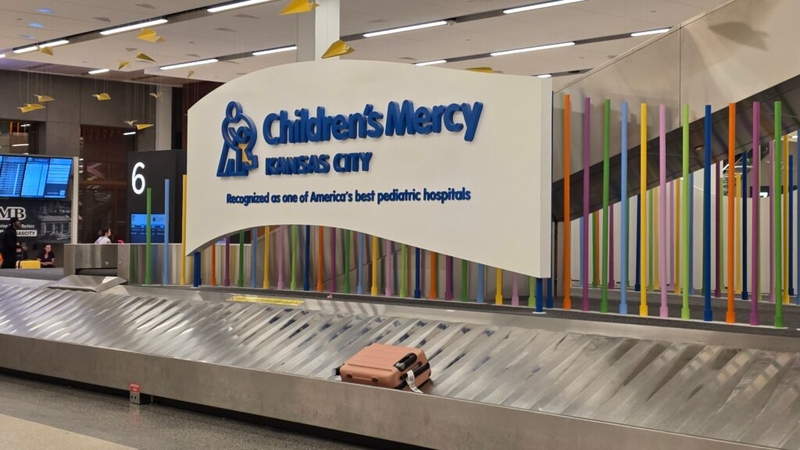
Children's Mercy's logo and locations are found throughout the Kansas City area, including greeting people arriving at the Kansas City International Airport. The hospital made news recently when it announced that it wouldn't accept any Affordable Care Act plans beginning in January after the one company it contracted with pulled their plans from two Kansas counties and six Missouri counties. A Kansas expert says many factors play into why this situation occurs. (Photo by Morgan Chilson/Kansas Reflector)
TOPEKA — When Children’s Mercy announced patients won’t be covered by Affordable Care Act insurance beginning Jan. 1, stressed parents vented online and some politicians blamed the refusal to expand Medicaid in Kansas.
Children’s Mercy, which has locations in Kansas and Missouri, has just one insurance plan on the ACA marketplace this year, Medica, which covers about 400 current patients, hospital leaders said in a statement. The Medica ACA plan decided to exit the market in Johnson and Wyandotte counties in Kansas, and in Clay, Jackson, Johnson, Lafayette, Platte and Ray counties in Missouri.
“The other ACA plans servicing the KC Metro were previously out of network with Children’s Mercy and have elected not to contract with Children’s Mercy in 2027,” the hospital statement said.
A Medica spokesman did not answer questions about why the company is exiting the market, saying in a statement only that the company recognizes the impact such a decision has on patients.
Although the Children’s Mercy statement said staff will work with parents to ensure continuity of care, worried parents took to Facebook to point out the problems the change will cause.
“What makes this situation so alarming is that Children’s Mercy is the only comprehensive pediatric health system in our region — there is simply no backup local hospital equipped for this level of specialized care,” wrote Destiny Zelsnack, a Kansas City, Kansas, parent, on her personal Facebook page. “If a child loses network access, parents aren’t just switching to another clinic down the street; they are being forced to look three to four hours away to cities like St. Louis, Omaha, or Wichita just to find in-network pediatric specialists.”
Sen. Cindy Holscher, the Democratic nominee for governor, said decisions made by Kansas Republicans not to expand Medicaid are a significant factor contributing to situations like that at Children’s Mercy. Her GOP opponent in the governor’s race, Senate President Ty Masterson, has always opposed Medicaid expansion.
Kansas is one of 10 states that hasn’t expanded Medicaid.
“Medicaid expansion would be the single biggest factor to strengthen our healthcare system overall,” Holscher said in an interview. “Expansion would cover approximately 150,000 working Kansans and people working in childcare, construction, retail, agriculture, and some of those are families who rely on the marketplace plans today.”
Multiple factors
In Kansas, 58 of its 100 rural hospitals are at risk of closure, with 21 at risk of immediate closure, according to a June report from the Center for Healthcare Quality and Payment Reform.
“Hospitals in rural areas are six times more likely to shut their doors without Medicaid expansion, and we know when a rural area loses its hospital, not only are they losing access to care, they’re losing good jobs,” Holscher said.
Masterson didn’t respond to Kansas Reflector questions about whether Medicaid expansion affects issues like Children’s Mercy losing ACA coverage and what he would do as governor to strengthen rural hospitals.
Kansas hospitals and organizations have supported Medicaid expansion, saying it would stabilize hospitals and offer insurance to Kansans who are uninsured or under-insured. However, Missouri has expanded Medicaid and Medica also chose to leave Missouri counties.
Insurance companies leave markets when they determine they can’t be profitable there, which can happen for several reasons, said Cindy Samuelson, spokeswoman for the Kansas Hospital Association.
Hospitals consider several elements when deciding whether to accept insurance from a specific plan, including whether payments for services actually cover the cost of providing the service and whether the plan has good customer service, Samuelson said.
For instance, hospitals look at how long a plan takes to authorize or deny care, which can cause delays in the patients receiving care, she said.
Hospital revenue
Samuelson said the complexity of insurance and hospital operations makes it difficult to summarize how decisions are made. Revenues are affected by everything from the amount of charity care and uncompensated care hospitals have in their communities to prescription drug programs and percentage of Medicare and Medicaid patients hospitals are serving.
Kansas hospital operating revenue, which is solely from treating patients and not from investments or other income, comes from private and public payers.
Public payers are government programs like Medicare and Medicaid, while private payers are employer insurance plans, people who self-pay and ACA marketplace plans, according to a brief from the Kansas Hospital Association.
“In 2024, Medicare payments to Kansas Hospitals covered only 87% of the total cost of caring for Medicare beneficiaries,” the brief said. “In the same year, Medicaid payments covered just 70% of the total cost of treating Medicaid patients at Kansas hospitals.”
The difference is made up by charging private plans more to cover the gap created by public payers.
“In order to maintain a viable financial status, hospitals attempt to negotiate payment rates from private insurance groups,” KHA information said. “The margins on these payments subsidize hospital losses from public payer underpayment, bad debt and charity care. This is known as cost-shifting, and can result in higher premiums for privately insured individuals.”
To illustrate what happens, KHA said that in 2024, Medicare and Medicaid beneficiaries received nearly 54% of the clinical services from Kansas hospitals, but public payer revenue was just 43% of the hospitals’ total revenue.
“In comparison, private payers received 30% of the care provided by Kansas hospitals and represented 49% of its total net revenue,” KHA said.
Samuelson said 21% of Kansas hospital uncompensated care comes from insured patients who can’t pay their out-of-pocket costs.
Changing environment
Although Holscher has said throughout her campaign that she will expand Medicaid, that is likely to be a tough battle in a Republican state that missed out on hundreds of millions of dollars in incentives from the federal government to expand before now.
“I come from a very collaborative approach,” Holscher said. “I’m the most successful Democrat in the Senate in terms of getting bills passed, and actually more successful than 90% of the Republicans.”
Holscher said she co-founded the Women’s Bipartisan Caucus and as a House member in 2017 helped to pass Medicaid expansion, which was vetoed by then-Gov. Sam Brownback.
But she sees a changing environment in Kansas, including the fact that House Speaker Dan Hawkins won’t be returning to his seat. Hawkins, who served as Speaker of the House, and Masterson, who is Senate president, led efforts to stop Medicaid expansion. Hawkins is running for state insurance commissioner.
“We’re working to flip some of those seats, and now it feels like there are more citizens that are speaking up because we have this affordability crisis,” she said. “People are absolutely struggling and hurting in terms of access to affordable healthcare, childcare and housing.”
Topeka, KS