Republican cash advantage showing up with late spending in Indiana legislative races
Oct 27, 2026 | 5:00 am ET
Description
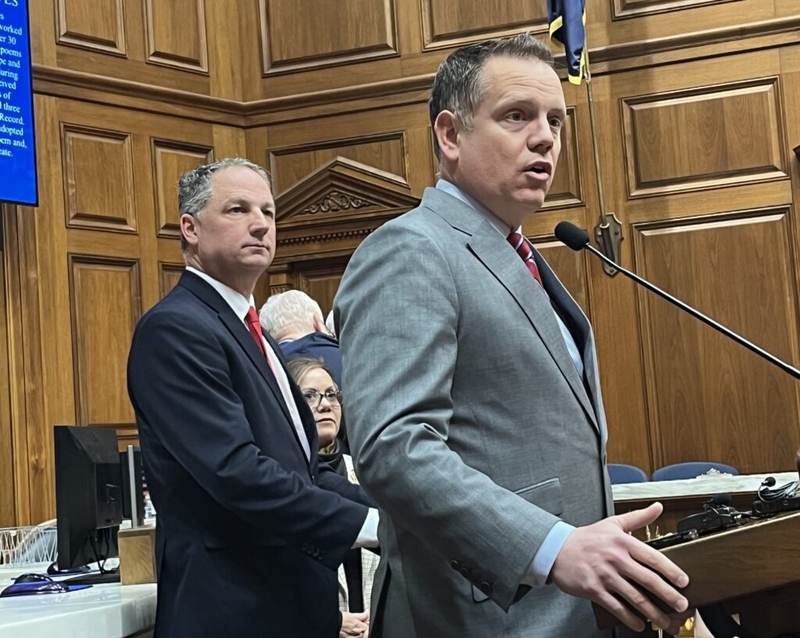
Indiana House Speaker Todd Huston, left, watches as Rep. Chris Jeter, R-Fishers, speaks during a January 2025 news conference in the House chamber. (Photo by Tom Davies/Indiana Capital Chronicle)
Republicans are making big money drops in a handful of Indiana legislative races as they aim to secure their full General Assembly supermajority for an eighth straight election.
The October spending surge that is approaching $2 million ahead of the Nov. 3 Election Day is centered on a cluster of House and Senate districts across the northern suburbs of Indianapolis, while also reaching into northwest Indiana and a perpetually close Bloomington-area House race.
Republicans are following the playbook they’ve used in recent election cycles of tapping their sizable fundraising advantage to pour money into hotly contested races during the final weeks.
The GOP enters this year’s elections with a 70-30 House margin, with Democrats needing to gain at least four seats to break the two-thirds supermajority Republicans have held since the 2012 election that allows them to take action even without any Democrats present.
“We really feel good about our team and the members and want to support them and are doing everything we can to support them,” Republican House Speaker Todd Huston told the Capital Chronicle. “We’re giving them the resources that they need to get their message to the voters in their district.”
Cash infusions for Republican incumbents
Terri Austin, a former longtime Democratic state legislator from Anderson, sees the late flood of Republican money differently.
“They don’t spend money unless they think they’re in trouble,” Austin said.
October funding infusions from state Republican committees reported to the Indiana Election Division as of Monday include boosts for:
- Rep. Chris Jeter of Fishers, with about $250,000 in his bid for a fourth term against Democrat Stephanie Jo Yocum, whom Jeter defeated with 58% of the vote two years ago.
- Rep. Danny Lopez of Carmel, receiving more than $220,000 as he seeks a second term against Democrat Lindsay Gramlich.
- Rep. Dave Hall of Norman, getting about $220,000 in his run for a third term from a Bloomington-area district against Democrat Amy Huffman Oliver.
- Rep. Becky Cash of Zionsville, with about $140,000 in her race for a third term against Democrat Tiffany Stoner.
Republicans have parlayed their supermajority status into big fundraising hauls. For this fall’s elections, for example, the House Republican campaign arm reported raising about $6.5 million as of early October, while the House Democrats raised about $2.5 million.
The Democratic candidates in those House races had largely similar fundraising to the Republican incumbents before the latest money moves began.
Could data center opposition boost Democrats in Indiana House races?
Democrats have responded from their smaller state bank accounts, giving about $180,000 to Gramlich for her race against Lopez; about $130,000 to Yocum’s challenge to Jeter, and a $45,000 boost to Stoner in her bid against Cash.
Democrats have also invested in a couple other suburban Indianapolis House races, sending about $225,000 to Racheal Bleicher’s campaign against Republican Rep. Hunter Smith of Zionsville — and $75,000 to Lauren Cole for her challenge to Huston in his district that runs from Fishers into rural northern Hamilton County.
Huston was unopposed in his 2022 and 2024 reelection runs but said he knew the national mood of voters could turn against Republicans. Both Huston and Cole have been running TV ads in recent days, with Cole’s commercials targeting Huston for his support of data center tax breaks and increases to the state’s gasoline tax.
“I’ve been knocking doors since July, recognizing that this year could be challenging,” Huston said. “This is the type of year you just don’t take anything for granted and you go out there and you work really hard.”
Austin is the Democratic chair in the 5th Congressional District, which includes much of the contested suburban Indianapolis area.
Democrats have targeted those legislative districts for the last three or four election cycles, only to have Republicans largely hold onto the seats.
Austin said she believed voters “not only are frustrated by the national economy, but they’re very unhappy with the direction of the state.”
“After 20 years of Republican rule, there’s only one place to look if you want to make some change,” she said.
“Working hard” to keep Republican supermajority
Republicans hold an even stronger advantage in the state Senate, with a current 40-10 margin for the supermajority they’ve had in that chamber since the 2010 election.
Senate Republicans are looking to hold — or even build — that majority with their October spending moves.
So far this month, state reports of spending by Republican committees show:
- Republican candidate Trevor De Vries receiving $450,000 in bid to hold an open Lake County seat for the GOP against Democrat Scott Houldieson.
- Republican Nate Uldricks getting $315,000 for his run against Democratic Sen. Rodney Pol of Chesterton.
- Republican John Ruckelshaus being boosted by $215,000 in his bid to flip an open district in suburban Indianapolis against Democrat Kristina Moorhead.
- Republican Juanita Albright getting $110,000 as she seeks to hold another suburban Indianapolis district for the GOP against Democrat Kerry Forestal, the Marion County sheriff.
Senate Democrats, meanwhile, have only responded with $25,000 to Pol — whose $210,000 in fundraising by early October was more than three times the $65,000 Uldricks had raised.
State Senate control likely safe for Republicans but Democrats aim to make gains
Democrats argue that breaking the supermajority would give them additional influence over legislation.
A recent Republican-paid mailer in the Lopez-Gramlich race in Hamilton County highlights the 2011 boycott by House Democrats against right-to-work legislation that lasted for 36 days.
The mailer argues that Democrats want the power to “not show up for work to stop legislation they don’t like.”
Huston, the House speaker, said Republicans “are doing everything we can” to hold the supermajority.
“I have no idea what, if any, impact it would be if it wasn’t the case,” he said. “Certainly, we want it to be the case and are working hard to keep it.”
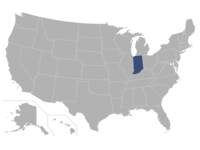
Indianapolis, IN