Chief of staff to Gov. Riley becomes 3rd Democrat in SC governor’s race
Mar 25, 2026 | 5:27 pm ET
Description
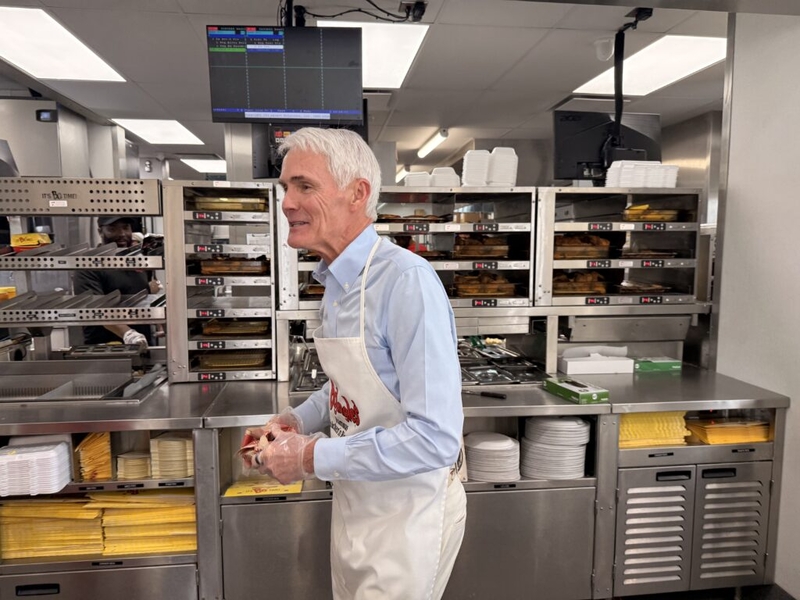
Democrat Billy Webster makes a Cajun Filet Biscuit with cheese after a news conference at a Bojangles restaurant launching his bid for governor in Columbia, South Carolina on Wednesday, March 25, 2026. (Photo by Adrian Ashford/SC Daily Gazette)
COLUMBIA — An Upstate businessman who worked for former Gov. Dick Riley and in the Clinton administration has shaken up the Democratic primary for governor.
Billy Webster, 68, of Greenville, highlighted his experience in Washington and as an executive as he officially launched his bid Wednesday. He becomes the third Democrat trying to flip the governor’s office blue for the first time in 28 years.
“If you look at the folks in this race so far, I’m the only one who’s prepared and experienced for this job,” Webster told reporters at a Columbia Bojangles where he said his career began.
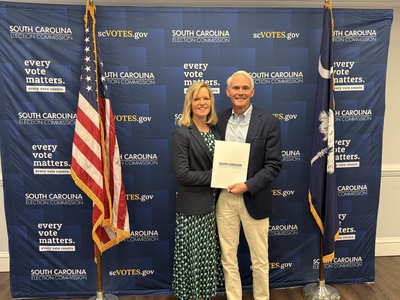
He held the news conference shortly after filing his candidacy with the State Election Commission.
“All the important lessons I learned about business, I learned right back there in that kitchen,” he said, before going back into the kitchen to prove he could still make a Cajun Filet Biscuit with cheese.
After working at a Bojangles restaurant owned by his family, Webster became president of a Bojangles franchisee before going to work in Washington in the ‘90s under both Republican and Democratic presidents.
He joins two Democrats who announced their campaigns last year: state Rep. Jermaine Johnson of rural Richland County, who filed his candidacy paperwork Monday, and Charleston attorney Mullins McLeod, who filed last week.
Webster, a father of six, touted himself as someone who can work across the aisle. Citing problems including rising costs and medical bills, he called himself the only person who “looks at these issues through the lens of solving a problem — not Democrat problems, not Republican problems.”
He went to Washington in 1992 as a White House fellow during President George H.W. Bush’s administration.
He was chief of staff to Riley in South Carolina and Washington — during Riley’s tenure as governor (the state’s last two-term Democrat in the governor’s office) and later when Riley became President Bill Clinton’s education secretary. Webster then worked as an assistant and director of scheduling for Clinton.
Webster was chief executive at Advance America, a payday lending company based in Spartanburg, from its founding in 1997 to 2011.
During that time, the payday lending model expanded nationwide as Advance America, which became the industry’s largest business, fought efforts to rein in what advocates for the poor called a predatory practice. The Legislature eventually passed a law in 2009 that put limits on the loans in South Carolina. It became law despite the opposition of then-Gov. Mark Sanford, who argued it gave consumers needed options.
Advance America was sold in 2012 to a Mexican billionaire, according to Forbes.
Webster now teaches health care policy at Wofford College in Spartanburg as an adjunct professor.
He said he wants to expand Medicaid edibility, adding he’ll pitch it from “a revenue-generation perspective.”
South Carolina’s GOP leaders have repeatedly rejected the idea, and the “one big beautiful” law Congress passed last summer made it more expensive. The law’s biggest cost-cutting measures, however, don’t apply to South Carolina because it didn’t expand Medicaid as the 2010 federal law intended.
Still, Webster said, “This can be done, but it has to be done with Republicans and Democrats together.”
On social media Friday, Johnson addressed rumors that party insiders were pressuring him to step aside for Webster. In a video posted on Instagram and Facebook, the only Black candidate in the gubernatorial field said he’d considered dropping out and even prepared a statement about his departure.
“I tore that statement up,” he said, vowing to instead stay in the race. “Let’s make sure we don’t allow these outside pressures to continue coming in and trying to say that South Carolina isn’t ready for a Black man to be governor.” He filed to run Monday.
Johnson, first elected to the state House in 2020, said in January he would not seek re-election to that Statehouse seat as well. (State law allows candidates to seek more than one office at the same time. They just can’t occupy more than one if they win multiple races.) He said then he wanted to focus on his campaign for governor.
Money was a big factor in the discussions among Democrats.
Johnson’s latest campaign report shows he raised less than $250,000 between his campaign launch in October and year’s end. And he spent just over half of it, leaving him with about $110,000 cash available on Dec. 31.
That compares to $1.9 million in McLeod’s campaign account at year’s end. He’s largely self-funding his campaign. Of the nearly $2.5 million he’s collected for the race, 95% of it came from his own pocket, his campaign filings show.
Webster told reporters the push for Johnson to drop out didn’t come from him.
Calling Johnson a “good man,” Webster said, “I welcome the chance to talk about what I believe and my experience with the other two candidates that are in the race.”
He also told reporters that he wouldn’t take a salary as governor. By law, the governor’s annual salary is $106,000. Webster said he’d donate that to first responders on the coast. He didn’t specify where or what type of emergency personnel.
South Carolina Democratic Party executive director Jay Parmley told the SC Daily Gazette the party hasn’t formalized any plans to host a debate between the three candidates, but said he’s excited to see competition for the Democratic nomination.
“It just shows that there’s life, that there’s momentum, that there’s excitement, that there’s interest,” he said. “Now we’ve got a lot of activity on our side, and I think that is only good for South Carolina voters.”
Six Republicans have announced bids to replace term-limited Gov. Henry McMaster.
The primaries to choose the Republican and Democratic nominees are June 9.
The last Democrat to win the governor’s office was Jim Hodges in 1998, when he defeated Republican Gov. David Beasley. Hodges was ousted by Sanford in 2002.
Columbia