Cautious Maps in New York Haunt Democrats’ Redistricting War
May 20, 2026 | 11:32 am ET
Description
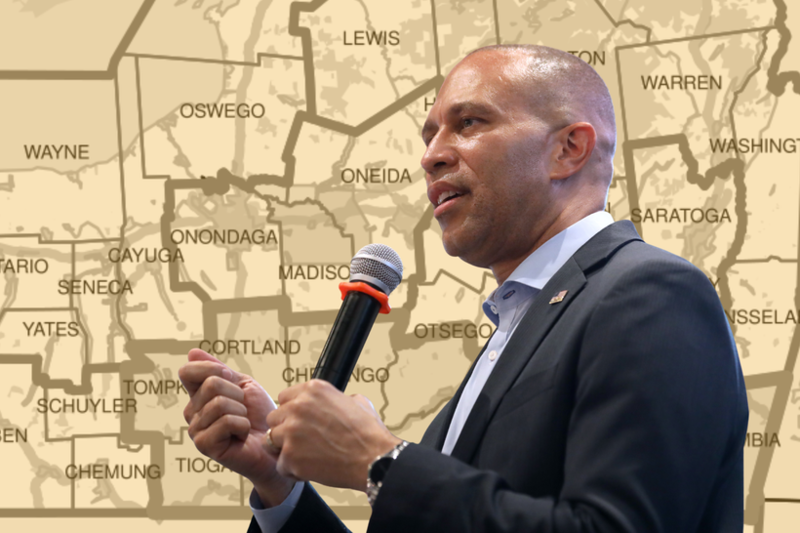
House Minority Leader Hakeem Jeffries’s cautious approach to redistricting two years ago contrasts sharply with his calls this year for action against Republicans’ redistricting efforts. / Photo: Gage Skidmore/Flickr; Map: Twotwofourtysix/Wikimedia Commons | Illustration: Leor Stylar
As a redistricting war rages in statehouses across the country, New York has been effectively locked out of the conversation. Democrats in Albany must wait until at least 2028 to redraw New York’s congressional maps, since the state’s constitution currently bans mid-decade redistricting — a delay that could cost the party multiple seats in its quest to reclaim the US House of Representatives this fall.
Things could have gone very differently.
When the state’s top court ordered new congressional maps at the end of 2023, some New York Democrats hoped for an aggressive approach that could give the party a better shot of winning several Republican-held seats in 2024 and beyond. Instead, to the surprise of many, the Democratic-controlled state legislature mostly passed up the opportunity — making only small changes to maps that had been proposed by an independent commission. Republicans celebrated the legislature’s “restraint.”
The decision to move cautiously was driven by House Minority Leader Hakeem Jeffries of Brooklyn and party leaders close to him, according to six sources who spoke with New York Focus — all of whom spoke on condition of anonymity to avoid antagonizing the potential future House Speaker. Some New York Democrats are still fuming about that restrained approach, especially as Jeffries now casts himself as the leader of Democrats’ aggressive redistricting push at the national level.
“It was Hakeem’s core preference that drove a modest [map],” said one person familiar with the 2024 talks. “People were absolutely like, ‘Why aren’t we messing with the Republicans?’”
Jeffries had reason to be cautious. New York’s top court had rejected a previous set of Democratic-friendly maps in 2022, setting off a chaotic chain of events that resulted in Democrats losing control of the process. Republicans were all but guaranteed to sue again if Democrats moved aggressively in 2024 to boost their chances in GOP districts.
“The reason the changes were very minor was because they were concerned about winding up in court again,” said John Faso, a former upstate Republican congressman who has helped lead the GOP’s redistricting efforts.
But some Democrats say Jeffries should have taken the risk. The state’s conservative-leaning chief judge retired shortly after the 2022 ruling and was replaced by a liberal, Rowan Wilson, giving liberals a majority on the seven-person Court of Appeals. Indeed, it was Wilson’s court that ordered the maps to be redrawn again before the 2024 election to avoid relying on court-drawn districts.
Justin Chermol, a spokesperson for Jeffries, rejected the criticism — arguing that Democrats’ wins in several of New York’s 2024 House races showed the maps worked well.
“As a result of the approved map, Leader Jeffries and Democrats flipped four seats in New York in 2024, held our toughest districts, cut the GOP majority to just three seats and set Democrats on track to take back the House in November,” Chermol said. (Democrats won three Republican-held seats that fall, while Democrat Tom Suozzi defended a Long Island district that he had won in a special election months earlier under the old lines.)
“The leader is considering all legally available options with the governor, delegation and state legislature to counter the desperate GOP gerrymandering scheme ahead of 2028. These ill-informed anonymous sources should either pipe down or put their name on it,” Chermol said.
Jeffries’ restraint two years ago contrasts with what he’s called “maximum warfare, everywhere, all the time” against Republicans’ current redistricting efforts. The push across the country to redraw lines mid-decade, initiated by President Donald Trump and Texas Republicans, has fueled a state-by-state tit-for-tat that could determine House control — making New York’s decisions two years ago even more consequential.
“I think about this every single day,” said one Democratic operative who worked on the 2024 New York effort. “I think it is politically criminal what they did.”
The 2022 redistricting cycle was a nightmare for New York Democrats. Required to redraw districts after the 2020 Census, the state legislature initially went big: proposing maps in early 2022 that would have likely doomed Staten Island Republican Nicole Malliotakis and flipped at least three other GOP seats.
Democratic leaders publicly denied they were engaging in gerrymandering. But the conservative-leaning Court of Appeals thought otherwise, unexpectedly tossing those maps. The ones then drawn by an independent special master helped the GOP gain three seats in the 2022 midterms.
Democrats’ fortunes improved thanks to two unexpected gifts: Chief Judge Janet DiFiore’s retirement, and the top court’s subsequent ruling that the congressional maps had to be redrawn before the 2024 elections.
New York’s Independent Redistricting Commission, a bipartisan group created by former Governor Andrew Cuomo, agreed on a new set of maps in February 2024 that made modest changes to the court-ordered districts: making upstate Republican Brandon Williams’ district more Democratic-friendly along with a smaller blue shift for Hudson Valley Republican Marc Molinaro, but doing little to hurt the endangered Republicans Mike Lawler in the Hudson Valley, Anthony D’Esposito and Nick LaLota on Long Island, or Malliotakis in New York City.
The New York Times predicted that Albany leaders would face pressure from Jeffries to reject the maps and draw their own — something the legislature had the legal right to do. Indeed, the legislature voted down the commission’s maps days later. Hours after that, however, state lawmakers revealed a new set of maps that made only modest tweaks, many of which benefited incumbents — including by adding Jeffries’s own home back into his Brooklyn district. (In making those changes, lawmakers also overrode a Cuomo-era state law that banned districts’ populations from changing more than 2% from the commission’s version.)
Jeffries’s team had pushed for those changes, calling them a surefire way to pick up one GOP seat — Williams’s, in the Syracuse area — without risking another legal battle, sources said.
“They thought they could bank one for sure with no risk as opposed to trying to bank three or four with the possibility of extended litigation,” said one person familiar with the dynamic.
Hochul signed the new maps into law after Jeffries personally called her and encouraged her to approve them, according to three people familiar with the outreach.
Jeffries praised the maps for reuniting so-called “communities of interest” and for reducing the number of counties that were “split” between districts — although it actually split more counties compared to the 2022 map, commentators noted.
Some Albany Democrats were unhappy that Jeffries had signed off on only limited changes, but felt they could not rebel against one of the most senior figures in their party.
“When Republicans have the pen, they stab us in the neck,” New York City Council member Justin Brannan complained at the time. Brannan, a South Brooklyn Democrat, had been considering challenging Malliotakis under more favorable lines.
Jeffrey Wice, a redistricting expert and professor at New York Law School, said it’s true that a more aggressive gerrymander would have sparked a lawsuit from Republicans. But the reshaped Court of Appeals may well have ruled in Democrats’ favor, said Wice, who noted that the state’s top court had almost never rejected maps drawn by the legislature until the 2022 ruling.
“When Republicans have the pen, they stab us in the neck.”
—Justin Brannan
“It’s hard to say what a court would or wouldn’t have done,” Wice said.
Of course, Jeffries in 2024 had no way of foreseeing this year’s national redistricting war, although the process had already become highly politicized in many states. He also had to mind the preferences of his own incumbent congressmembers, who might have rebelled against major changes to their district lines.
Tim Persico, a strategist who was executive director of the Democratic Congressional Campaign Committee until 2023, argued that the state’s geography limits Democrats’ ability to redraw maps in their favor. Changing Lawler’s district, for example, might have required making upstate districts held by Democrats Pat Ryan and Josh Riley more GOP-friendly.
The state legislature’s 2022 maps did favor Democrats, Persico acknowledged, but were then struck down in court. “And by the way, you’re going to have to make some sort of an argument as to why that isn’t just partisanship,” he added.
Jeffries wasn’t alone in being risk-averse. Democrats around the state were fatigued with the years-long redistricting battle, sources said, and it’s unclear how much appetite would have existed in Albany to enact an aggressive gerrymander.
The 2024 elections went well for Democrats, who picked up three House seats in New York. Rep. Joe Morelle, an upstate Democrat, argued those results validated Jeffries’ approach — pointing to Democrats like Tom Suozzi on Long Island, who won in 2024 after the new maps made tweaks to his district.
“I actually think, even with the lens of history, that that ended up being a real masterstroke by Hakeem,” said Morelle, who has often served as an intermediary between Jeffries and Albany leaders.
But the absence of bigger changes in districts like Lawler’s looms large for Democrats this year — especially after a court ruling in Virginia gave Republicans a leg up in the national battle.
Now, New York is stuck with its maps until at least 2028, since constitutional amendments require approval from two consecutive legislative sessions followed by a statewide referendum. In the coming days, state lawmakers will start the process of creating those new maps, which may be more advantageous for Democrats than anything they could have done in 2024 thanks to the recent US Supreme Court ruling on the Voting Rights Act that will permit dramatically gerrymandered districts. But all that must wait.
“We could have been done with this already,” said one Democratic official. “We wouldn’t have to do a constitutional amendment.”
Albany